Most product ideas never make it to market. Not because the idea was bad, but because nobody had a clear process for turning it into something real. That’s what product development actually solves.
If you’ve ever wondered how a rough idea becomes a working app, a physical gadget, or a full SaaS platform, this guide breaks it down piece by piece. You’ll learn what product development means, the stages every product moves through, the frameworks teams rely on, and how to choose the right partner once you’re ready to build.
What Is Product Development?
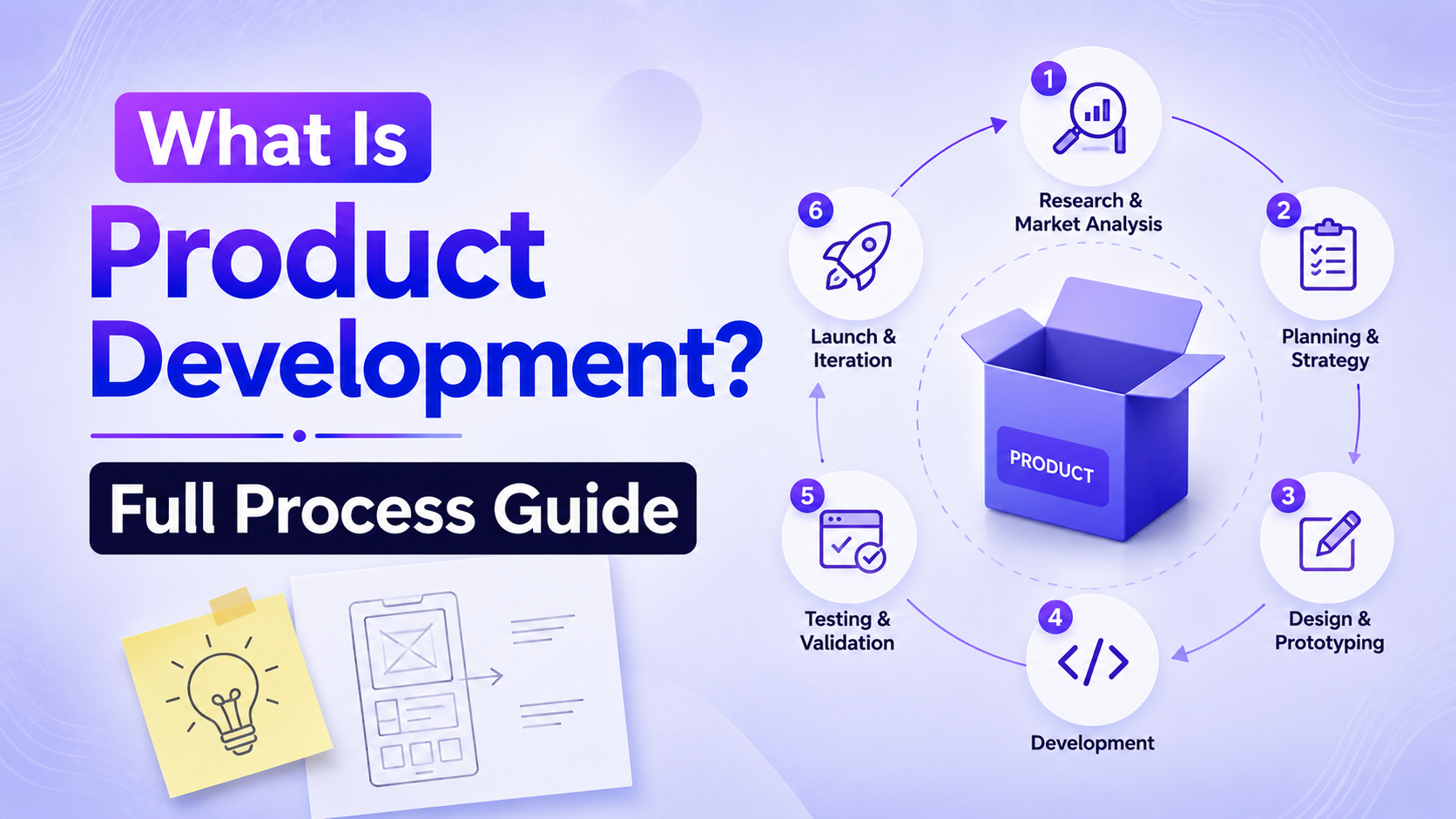
Product development is the process of turning an idea into something customers can actually use, buy, or subscribe to. It spans everything from the first spark of an idea through market research, design, building, testing, and launch.
The term applies just as much to physical products as it does to digital ones. A furniture company designing a new chair follows a surprisingly similar logic to a startup building a mobile app. Both start with a problem, test whether people genuinely care about solving it, then design and build something worth paying for.
That said, the tools and timelines differ a lot depending on what you’re building, which is exactly what the next section covers.
Why Product Development Matters for Businesses
Product development matters because it lowers the risk of building something nobody actually wants. Skip the process, and teams tend to jump straight into building, which remains one of the most common reasons products die quietly after launch.
A clear process pays off in speed too, not just safety. It gives everyone a shared roadmap, helps founders spend money on the right features first, and creates checkpoints where a weak idea can get killed early instead of after months of wasted effort.
For startups specifically, this often decides whether the company survives its first funding round. Investors don’t just want a good idea, they want proof it works, and a real process is how that proof gets built.
With the “why” out of the way, let’s look at the different forms product development can actually take.
Types of Product Development
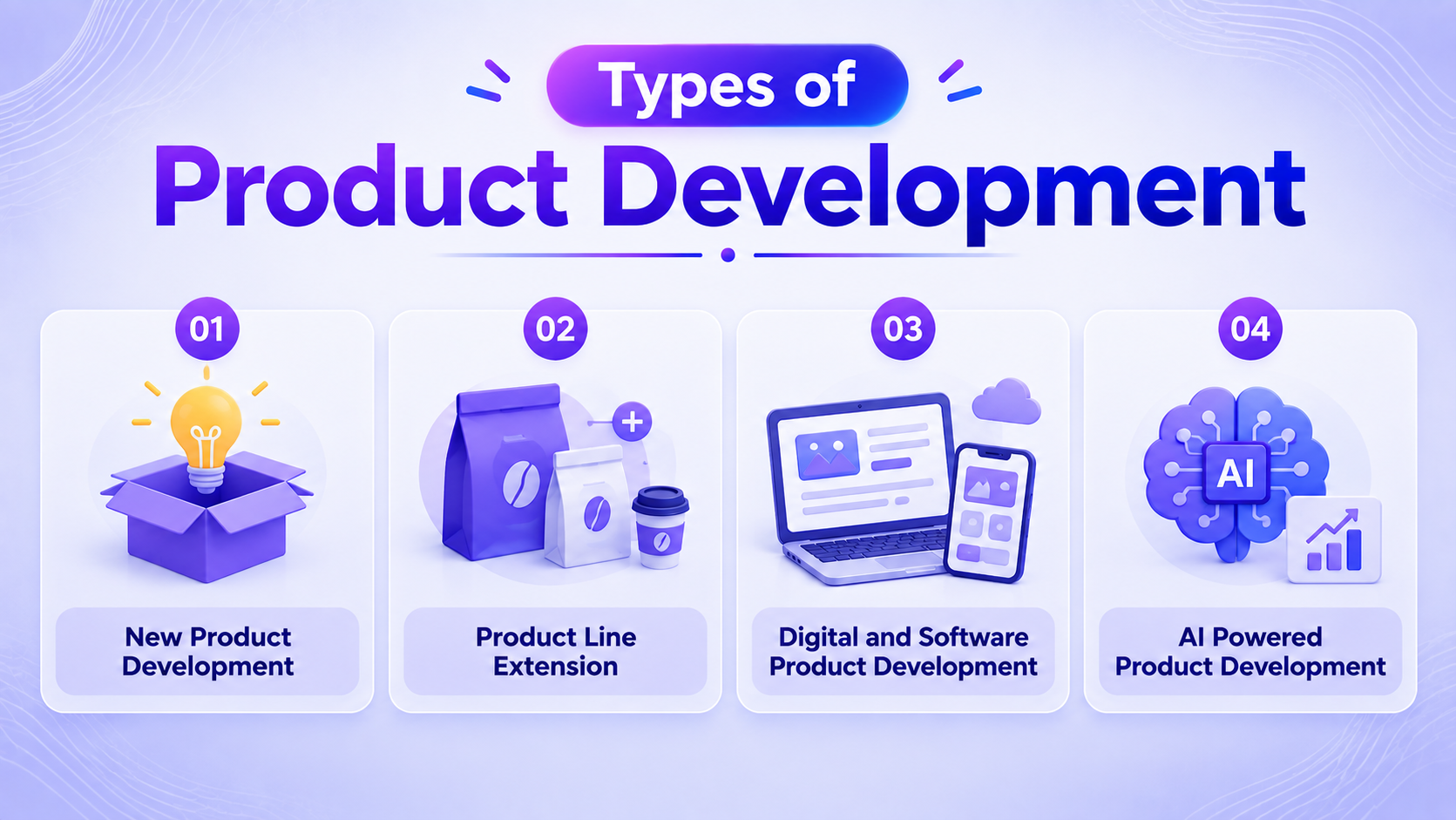
Product development splits into a few distinct categories, and knowing which one applies to you changes your entire approach from day one.
- New Product Development: Building something that didn’t exist before, either for your company or the market at large. It carries the highest risk, but also the highest upside, since there’s no existing user base to lean on.
- Product Line Extension: Adding a new version, feature set, or variant to a product you already sell. Think of a coffee brand launching a decaf line. Much of the validation work is already done, so this path usually moves faster.
- Digital and Software Product Development: Covers apps, websites, and platforms. It typically moves through shorter build cycles than physical goods, since updates can ship without any manufacturing delay.
- AI Powered Product Development: A fast growing category where features like recommendations, automation, or predictive analytics get built directly into a digital product. It demands extra planning around data quality, since the AI needs to genuinely improve the experience, not just add noise. Our AI-powered applications and automation work often starts right here, identifying where AI adds real value instead of complexity.
Once you know what type of product you’re building, the next question becomes how to actually move it forward, step by step.
The Product Development Process: Key Stages
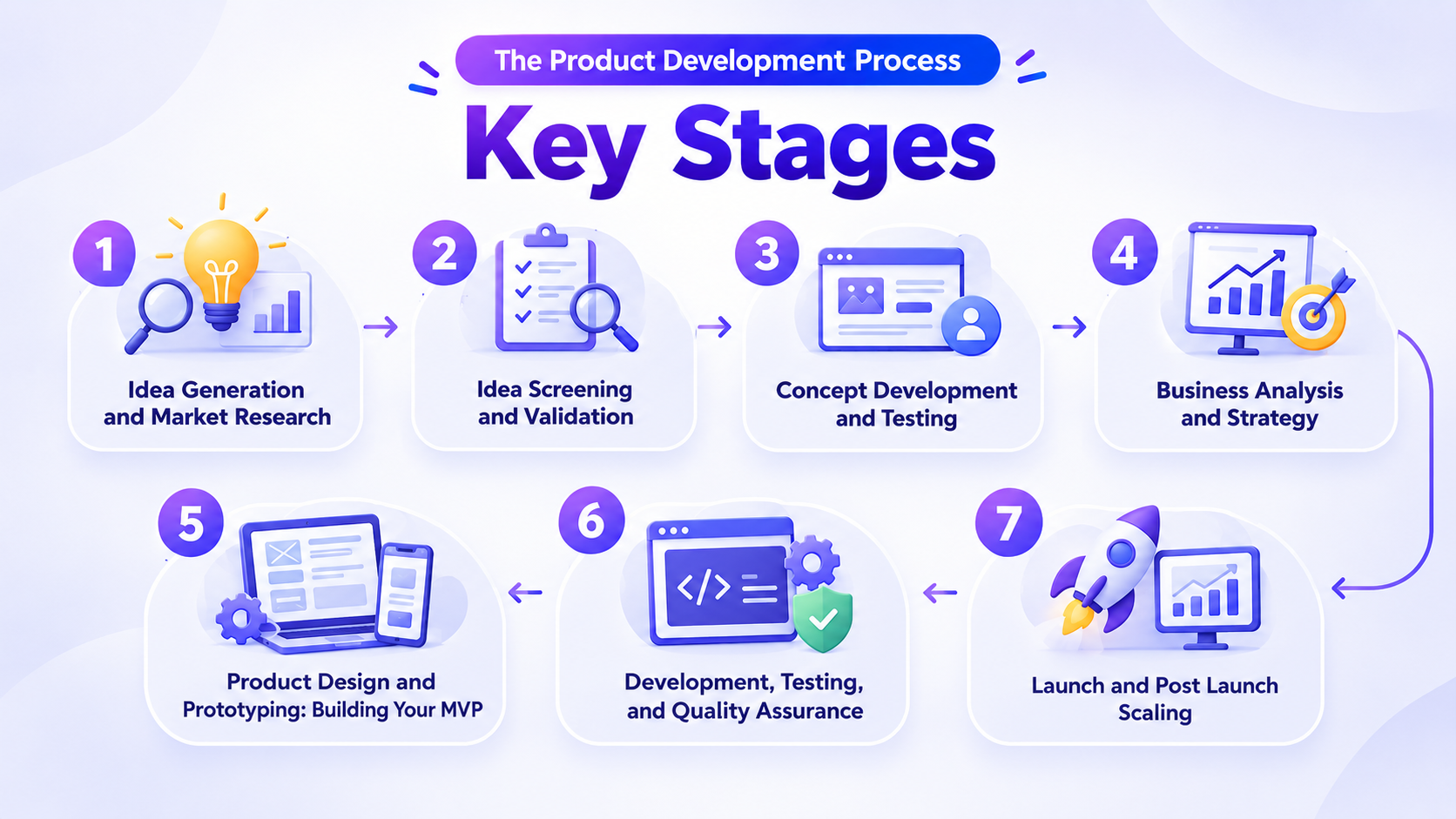
The product development process usually runs through seven core stages, from idea generation to launch. That number isn’t set in stone though. Marketing professors Philip Kotler and Kevin Lane Keller describe eight stages in their well known textbook, while some companies simplify it down to five or six. The version below reflects what most startups and software teams use today.
One thing worth knowing before you dive in. These stages rarely move in a straight line. Teams loop back constantly, especially between design and testing, and that’s completely normal.
1. Idea Generation and Market Research
This stage is where raw ideas get collected and tested against a simple question: does this problem actually matter to real people? Talk to potential customers, study competitors, and hunt for market gaps before falling in love with any single solution.
A common trap here is starting with a feature instead of a problem. Flip that order. The problem comes first, the feature follows.
2. Idea Screening and Validation
Idea screening is where weak ideas get filtered out before they cost you anything meaningful. Ask the uncomfortable questions early. Is the audience big enough? Will people actually pay? Can your team realistically build this?
Surveys, landing page tests, and short customer interviews work well here. The goal is killing bad ideas cheaply, not after six months of development.
3. Concept Development and Testing
Here, the surviving idea takes shape as a clearer concept, usually through mockups, written descriptions, or a rough prototype. That concept then gets tested with real people outside your own team.
Honest feedback at this point often stings a little. Good. Hearing “I wouldn’t use this” now is far cheaper than hearing it after launch.
4. Business Analysis and Strategy
Business analysis is where the cost of building meets the expected return. This covers pricing, target audience size, competitive positioning, and a rough go to market strategy.
Skip this step, and you risk ending up with a product that works perfectly on a technical level but has no real business behind it.
5. Product Design and Prototyping: Building Your MVP
This stage blends design and early development to produce a minimum viable product, or MVP, built around only the core features needed to solve the main problem. Nothing extra, nothing decorative yet.
It’s also usually where founders bring in a development partner, since decisions made here directly shape how expensive and complex the build becomes down the road. Teams experienced in MVP and SaaS development tend to catch scope problems before they quietly turn into budget problems.
6. Development, Testing, and Quality Assurance
Full development happens here, running alongside continuous testing to catch bugs, performance issues, and security gaps before they reach real users. Agile teams typically build in short sprints, shipping testable versions every one to two weeks instead of waiting until everything feels finished.
Quality assurance shouldn’t sit at the end like a final checkbox. It works best running in parallel with development, start to finish.
7. Launch and Post Launch Scaling
Launch is when the product finally meets real customers, but the work is far from over. After launch, teams track usage data, fix issues fast, and plan the next round of features based on how people actually behave inside the product.
Many successful products barely resemble their original launch version a year later. That’s not a failure. It’s proof the team listened to real usage instead of guessing.
Now that you’ve seen the full journey, it helps to clear up a mix-up that trips up even experienced founders.
Product Development Process vs Product Life Cycle
The product development process and the product life cycle describe two different phases, even though people mix them up constantly. Development covers everything before and during the build. The life cycle describes what happens after launch.
| Concept | What It Covers |
| Product Development Process | Idea generation through launch |
| Product Life Cycle | Introduction, growth, maturity, and decline after launch |
This distinction matters because the strategy shifts too. During development, the focus stays on validation and building. Once the life cycle begins, attention moves to growth, retention, and eventually deciding when to reinvent or retire the product.
With that boundary clear, let’s look at the frameworks teams use to actually manage the development side.
Popular Product Development Frameworks and Methodologies
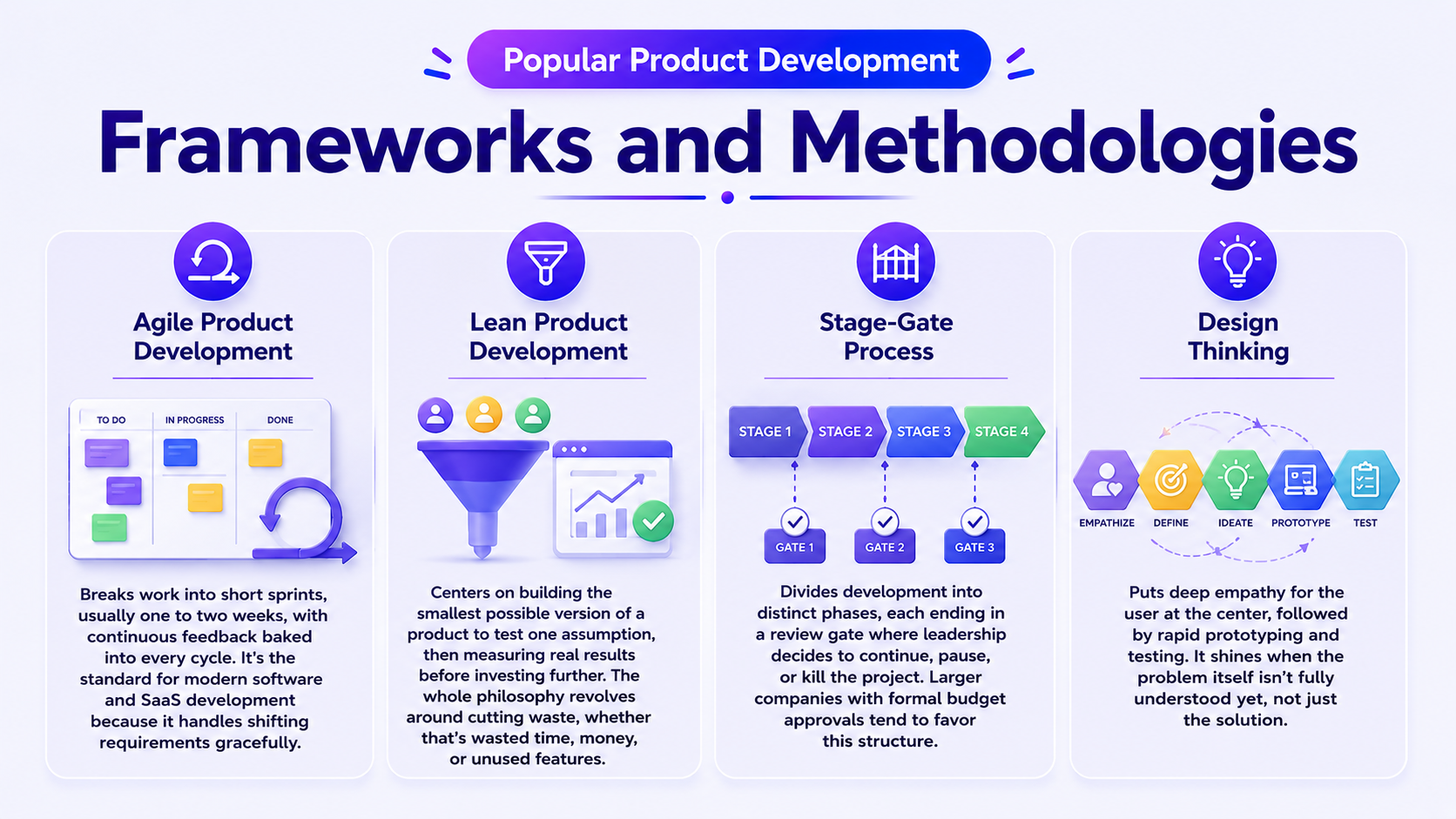
Most teams lean on one of four major frameworks, and each one fits a different kind of project. Agile suits fast moving software. Lean suits early stage startups. Stage-Gate suits larger, higher risk builds. Design Thinking suits problems where user needs aren’t fully clear yet.
- Agile Product Development: Breaks work into short sprints, usually one to two weeks, with continuous feedback baked into every cycle. It’s the standard for modern software and SaaS development because it handles shifting requirements gracefully.
- Lean Product Development: Centers on building the smallest possible version of a product to test one assumption, then measuring real results before investing further. The whole philosophy revolves around cutting waste, whether that’s wasted time, money, or unused features.
- Stage-Gate Process: Divides development into distinct phases, each ending in a review gate where leadership decides to continue, pause, or kill the project. Larger companies with formal budget approvals tend to favor this structure.
- Design Thinking: Puts deep empathy for the user at the center, followed by rapid prototyping and testing. It shines when the problem itself isn’t fully understood yet, not just the solution.
Frameworks shape how you build. What follows next is often more confusing: understanding who actually owns each piece of the process.
Product Development vs Product Management vs Product Design
These three terms get tangled together constantly, but each describes a distinct responsibility. Product development is the full process of building the product. Product management handles ongoing strategy and prioritization. Product design shapes how the product looks and feels to use.
| Term | Main Focus | Typical Owner |
| Product Development | The full process, from idea to launch | Cross functional team |
| Product Management | Strategy, priorities, and roadmap | Product Manager |
| Product Design | User experience and interface | Product Designer |
Here’s a simple way to remember it. Product management decides what to build and why. Product design decides how it should feel to use. Product development is the engine that turns both of those decisions into a working product.
Understanding these roles helps you spot problems faster, and speaking of problems, a few show up in nearly every project.
Common Product Development Challenges
The most common challenges in product development are unclear requirements, scope creep, weak validation, and slow time to market. Each one, fortunately, has a fairly direct fix once you catch it early.
- Unclear requirements: Write a simple product requirements document before development starts, even a short one.
- Scope creep: Lock the MVP feature list and push new ideas into a future release, not the current sprint.
- Weak validation: Talk to at least ten real potential users before writing a single line of code.
- Slow time to market: Trim the MVP further. Most first versions are still too big.
- Technical debt: Budget time for refactoring instead of treating it as optional cleanup nobody has time for.
None of these problems belong exclusively to first time founders. Experienced teams run into every one of them too. What separates the good ones is how fast they catch it and course correct.
Speaking of course correcting, budget is usually where the biggest surprises hide.
How Much Does Product Development Cost
Product development cost depends mainly on complexity, team location, and how much of the product gets built at once. There’s no single fixed number that applies across every project, but a handful of factors consistently push the price up or down.
Complexity drives the biggest swing. A simple MVP with a handful of screens costs far less than a multi-role platform packed with payments, real time features, and complex integrations.
Team location matters too, since offshore development teams often deliver meaningful savings compared to hiring locally, without sacrificing quality when the team has a strong delivery record.
Other cost drivers worth watching include the technology stack, whether you need native mobile apps or a single web platform, and ongoing maintenance after launch. Here’s a rule worth remembering. The MVP is rarely the biggest expense. Post launch iteration, support, and scaling usually add up to more over time than the first build ever cost.
Once you understand the cost picture, the next decision is who actually builds it with you.
How to Choose the Right Product Development Company
The right product development company brings proven technical expertise, a portfolio that matches your project type, clear communication, and support that continues well after launch. Skip any of these checks, and the gap usually surfaces later as delays, budget overruns, or a product that buckles under real usage.
Here’s what to verify before signing anything.
- Relevant portfolio: Look for case studies close to your product type, whether that’s SaaS, mobile apps, or AI features.
- Communication process: Ask how often you’ll get updates and exactly who you’ll be talking to.
- Technical depth: A strong team explains its architecture choices in plain language, not buzzwords.
- Post launch support: Confirm whether maintenance, monitoring, and future updates come included or cost extra.
- Transparent pricing: Fixed price for a defined scope, or clear monthly rates for ongoing work. Vague estimates are a red flag.
If a company can’t answer these five points clearly in your first conversation, take that as useful information in itself.
Why Businesses Choose CodersBucket for Product Development
Businesses choose CodersBucket because it combines strategy, design, and engineering under one roof, instead of forcing founders to juggle separate vendors for each piece. The team has spent over 14 years building custom software, SaaS platforms, and AI powered applications for startups, agencies, and product teams across more than 20 industries.
CodersBucket’s own case studies reflect that range well. The team helped Simply Eloped grow from an early idea into one of the largest wedding marketplaces in the United States, and partnered with GymCity to expand a single gym management app into a full fitness and personal trainer marketplace.
You can see the full breakdown of these projects, along with several others, in our case studies.
Beyond client work, CodersBucket also builds and runs its own products, including Hello HRM and Hello Wallet, which gives the team firsthand insight into what actually holds up after launch and what quietly falls apart.
That kind of hands-on experience shows up across the portfolio too, spanning custom software, mobile apps, and platform modernization work.
For founders who need to move from idea to MVP without hiring an entire in-house team, CodersBucket also offers dedicated offshore development teams that plug directly into your existing workflow and tools. If you’re at the point where you need a real technical partner rather than more advice, that conversation usually starts with a quick contact message.
Frequently Asked Questions About Product Development
What are the stages of product development?
The most common version includes idea generation, screening, concept development, business analysis, design and prototyping, development and testing, and launch. Some sources list as few as five stages, others as many as eight.
What are the 5 stages of product development?
A simplified five stage version usually merges idea generation with screening into one step, and folds development together with testing, covering the same ground with fewer checkpoints.
What are the 7 stages of the new product development process?
The seven stage version remains the most widely used today: idea generation, screening, concept development, business analysis, prototyping, development and testing, and launch.
What is the difference between product development and the product life cycle?
Product development covers everything before and during the build. The product life cycle describes what happens after launch, including growth, maturity, and eventual decline.
What is an MVP in product development?
An MVP, short for minimum viable product, is the simplest version of a product that still solves the core problem for early users, built specifically to test demand before a full investment.
How long does product development take?
A simple MVP can take anywhere from six to twelve weeks, while a full featured platform with multiple integrations often takes four to nine months, depending on complexity and team size.
How much does product development cost?
Cost depends on complexity, team location, and feature scope, ranging from a few thousand dollars for a basic MVP to well over a hundred thousand for a complex platform with custom integrations.
Final Thoughts on Product Development
Product development isn’t complicated in theory. Research the problem, validate the idea, design and build a focused version, then launch and improve based on real feedback. What’s genuinely hard is following that process without cutting corners the moment pressure builds to move faster.
If your idea already feels solid and what’s missing is a team to design, build, and scale it, that’s exactly the stage where the right development partner makes the biggest difference.
CodersBucket works alongside founders and product teams through that entire journey, from early MVP through long term scaling.