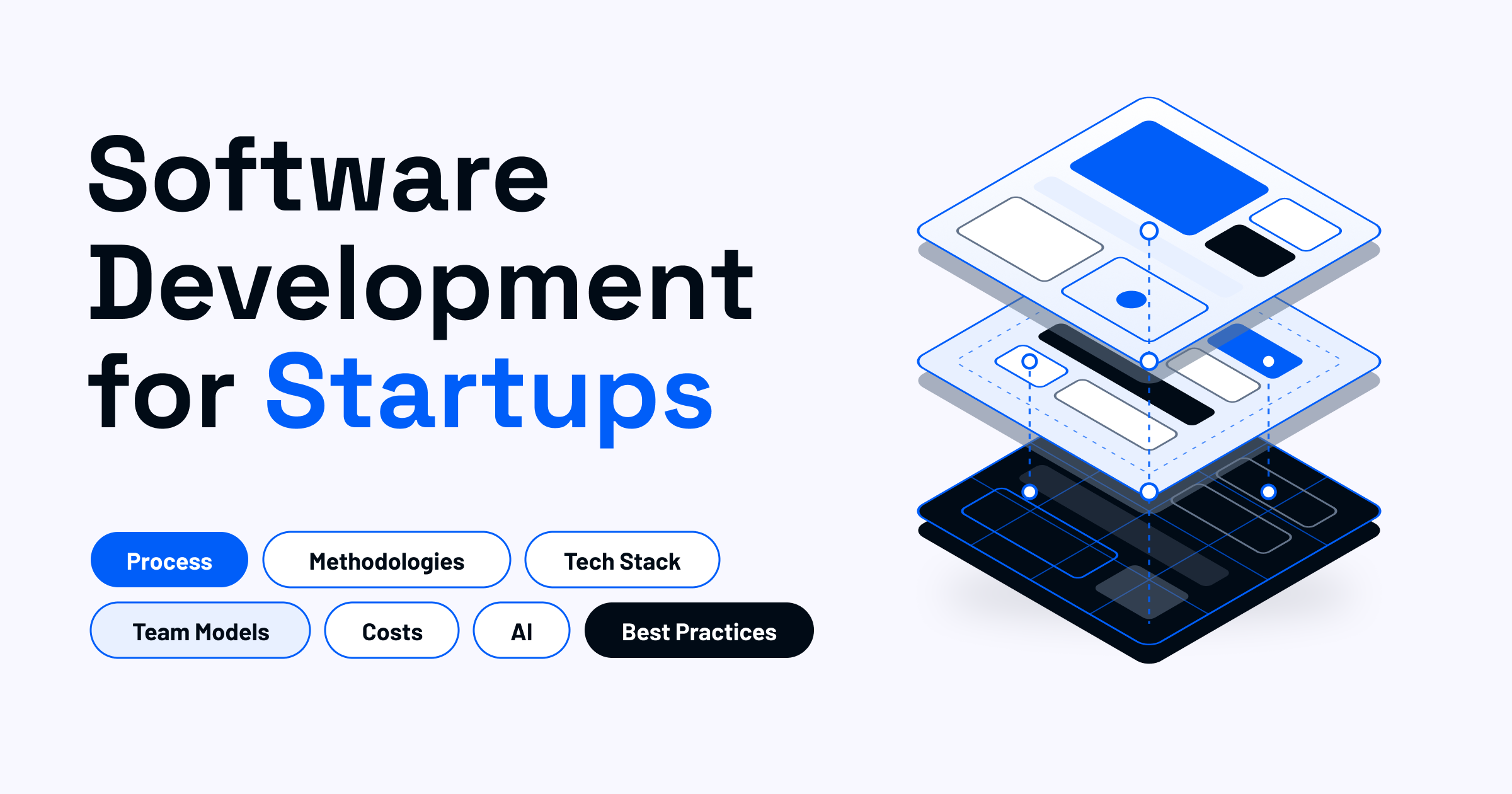
Software development for startups is about testing an idea fast, not building a perfect product on day one. Early-stage companies work with a lean budget, so every sprint has to move them closer to product-market fit. That’s why most founders start with a minimum viable product and grow it through user feedback.
The process runs from idea validation to an MVP, then through agile sprints, testing, launch, and iteration. Lean and Agile are the methodologies most startups rely on, often blended into a hybrid model. Your tech stack should fit your team’s skills, time to market, and a scalable architecture.
Next comes the team. You can hire in-house, use freelancers, hire an agency, build an offshore team, or mix models. Each choice shapes your costs, from a few thousand dollars to six figures for complex platforms.
AI has changed the picture too. AI coding agents help small teams prototype, code, and test faster. Still, human review decides what ships, even as founders add AI features to the product itself.
Below, you’ll find the benefits of custom software and the best practices that protect your product. You’ll also get clear answers on timelines, outsourcing, code ownership, and how startup development compares with other approaches. Every figure is a range, because real costs depend on your scope.
What Is Software Development for Startups?
Software development for startups is the design, build, and upkeep of a product for an early-stage company. It puts speed and flexibility ahead of perfection. The aim is to validate the idea with an MVP, then iterate on real user feedback.
Lean practices matter because startups rarely fail on code alone. A March 2026 CB Insights analysis reviewed 431 VC-backed startup shutdowns. It found 70% ran out of capital, and 43% cited poor product-market fit.
A feedback-driven build helps you avoid both problems. You only spend on features that users prove they want.
How Does the Startup Software Development Process Work?
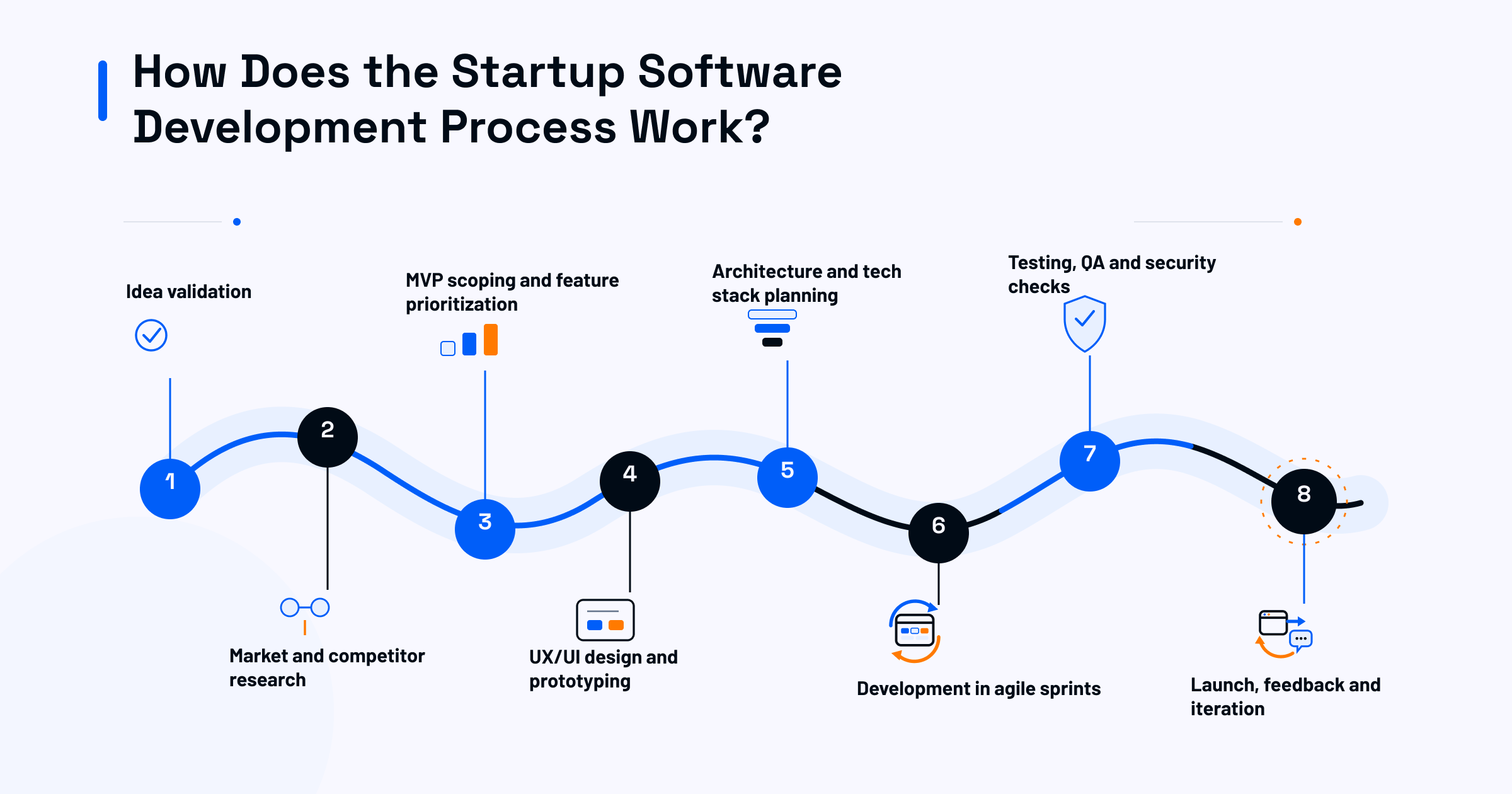
The startup software development process works by turning an idea into a tested product in short, repeatable stages. Each stage reduces risk before you commit more budget. It follows the same logic as a broader product development process, scaled for startups.
8 steps of the startup software development process are given below.
- Idea validation: Define the problem and the people who feel it most. Interview potential customers and confirm demand before you write any code.
- Market and competitor research: Study who already serves this market and where they fall short. That competitor analysis shapes a value proposition that gives users a reason to switch.
- MVP scoping and feature prioritization: Keep only the core features that prove your value. Methods like MoSCoW separate must-haves from nice-to-haves and protect your budget.
- UX/UI design and prototyping: Designers turn user flows into wireframes, then an interactive prototype. Testing it with users catches confusing screens before they become expensive code.
- Architecture and tech stack planning: Engineers choose the frameworks, database, and cloud setup for your product. Good planning keeps it scalable without overbuilding for users you don’t have yet.
- Development in agile sprints: The team builds features in short, time-boxed cycles called sprints. Each sprint starts with sprint planning and ends with working software you can review.
- Testing, QA and security checks: Quality assurance mixes manual checks with automated testing for core flows. Security checks cover login, data handling, and third-party packages before launch.
- Launch, feedback and iteration: Release to beta users or early adopters first and watch how they behave. Post-launch iteration turns that data into the next priorities on your product roadmap.
AI coding agents now speed up steps 4 to 7. They generate prototype screens, draft feature code, and write test cases in minutes. Still, human code review stays mandatory before anything reaches production.
What Are the Best Software Development Methodologies for Startups?
The best software development methodologies for startups are flexible ones, led by Lean Startup and Agile. Many startups begin with Lean to validate hypotheses, then move to Agile once product-market fit is clearer.
6 software development methodologies for startups are outlined below.
- Lean Startup: Lean runs on the build-measure-learn loop. You test one hypothesis at a time, then pivot or persevere. It fits pre-seed teams facing high uncertainty.
- Agile Scrum: Scrum splits work into short sprints of 1 to 4 weeks, with backlog prioritization before each. It suits small, cross-functional teams once the idea shows early traction.
- Kanban: Kanban moves work cards across a board and limits work in progress. It fits tiny teams and maintenance work where priorities change daily.
- Iterative and incremental development: The product grows in small working slices that build on each other. It works when you know the core but expect details to change.
- Rapid application development: RAD puts working prototypes and user input ahead of long planning. It suits founders who need a demo fast, such as before an investor pitch.
- Hybrid approach: A hybrid model mixes methods, like Lean for discovery and Scrum for delivery. It fits growing startups that need structure without losing speed.
Waterfall suits fixed, well-defined requirements, so it rarely fits early-stage products.
How to Choose the Right Tech Stack for a Startup?
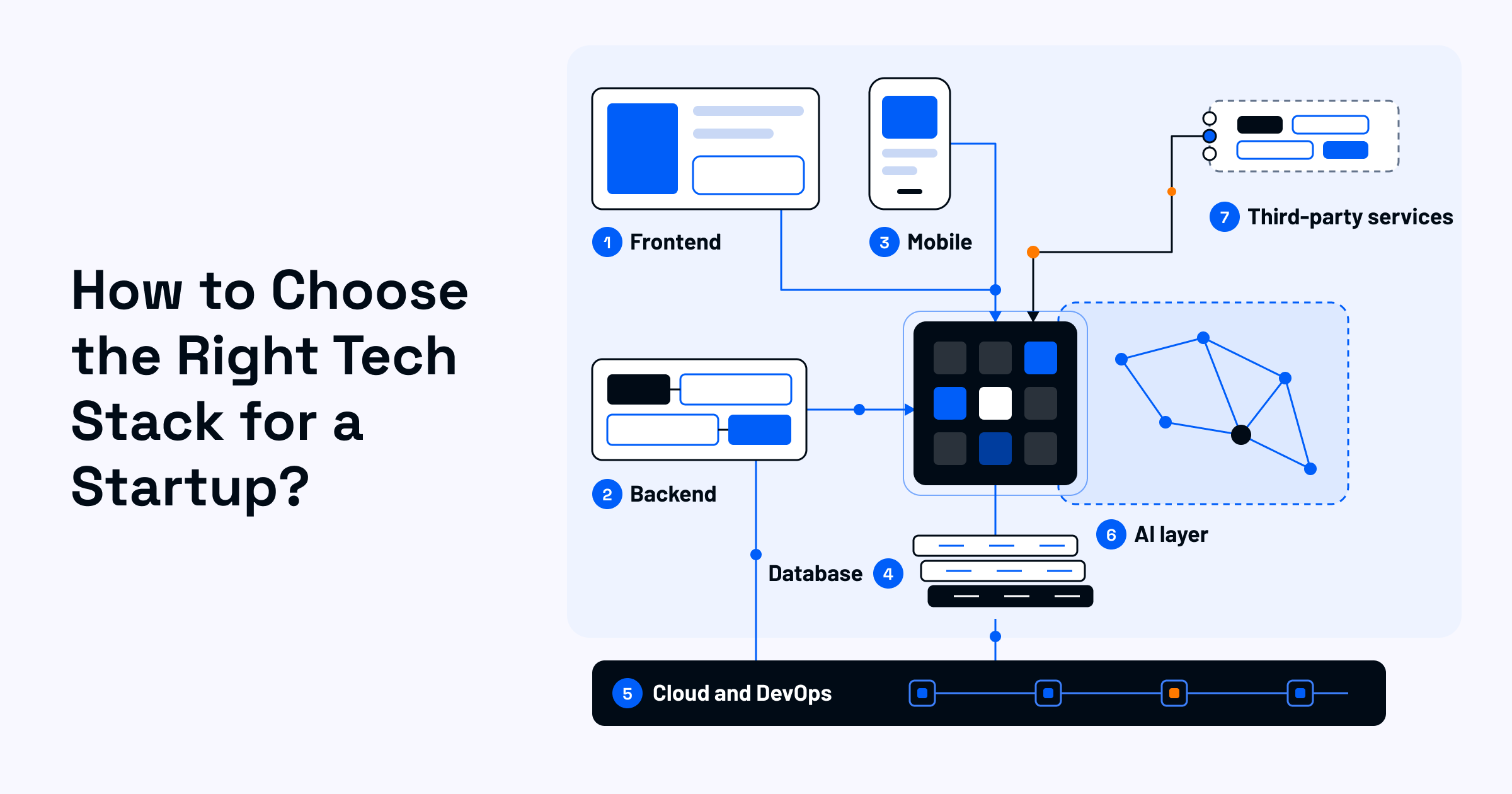
To choose the right tech stack for a startup, start with your team’s skills and your launch date. Then weigh scalability, the hiring pool, total cost, and AI readiness.
The core layers of a startup tech stack are given below.
- Frontend: React, Next.js, and Vue power most modern web interfaces. Next.js adds server-side rendering, which helps page speed and search visibility.
- Backend: Node.js suits real-time apps and JavaScript teams. Python with Django or FastAPI is strong for data and AI, while Laravel offers fast PHP development.
- Mobile: React Native and Flutter let one codebase serve iOS and Android, which cuts cost. Swift and Kotlin fit apps that need full native performance.
- Database: PostgreSQL is a reliable default for structured data, and MongoDB handles flexible documents. Supabase or Firebase add a managed backend with login built in.
- Cloud and DevOps: AWS, Google Cloud, and Azure offer cloud-native services that scale with demand. CI/CD pipelines test and deploy every change automatically.
- AI layer: LLM APIs add language features, and LangChain chains model calls together. Model Context Protocol, or MCP, connects models to tools, while pgvector powers vector search.
- Third-party services: Stripe handles payments, Twilio covers messaging, and analytics tools track user behavior. Buying these saves months of custom work.
The Stack Overflow 2026 Developer Survey shows how AI work shapes language choice. Python leads AI work at 39%, followed by JavaScript at 38% and TypeScript at 30%.
As a practical example, CodersBucket builds with React, Next.js, Node.js, Python, AWS, and Google Cloud. That mix covers web, backend, and AI features without juggling too many languages.
What Are the Team Options for Startup Software Development?
The team options for startup software development are in-house, freelance, agency, dedicated offshore, and hybrid teams. Each one trades off cost, speed to start, and control over the product. The right pick depends on your funding stage and how technical your founders are.
5 team options for startup software development are given below.
- In-house team: You get full control and deep product knowledge, but it’s the costliest path. The U.S. Bureau of Labor Statistics lists median developer pay at $135,980 in May 2025, before benefits. Hiring and onboarding usually take 2 to 4 months.
- Freelance developers: Freelancers are flexible and quick to hire for well-defined tasks, at roughly $25 to $100 per hour. The catch is coordination, since you manage quality, deadlines, and knowledge transfer yourself.
- Software development agency: An agency gives you designers, developers, and QA under one contract. Outsourcing rates often run $15 to $50 per hour, and teams can start within a few weeks.
- Dedicated offshore team: A dedicated offshore development team works only on your product, often through staff augmentation. You get more continuity than a one-off agency project, as long as you plan time zone overlap.
- Hybrid team: A hybrid team pairs a small in-house core with outsourced developers. That core might be a technical co-founder or a fractional CTO who keeps strategic control.
Treat these hourly rates as vendor estimates. Real quotes vary by region, seniority, and project scope.
How Much Does Software Development Cost for a Startup?
Software development for a startup costs about $15,000 to $100,000 for an MVP, and more for complex platforms. These are vendor estimates, not fixed prices, and they vary widely by vendor and region. One common range runs from $15,000 to $70,000, while another spans $20,000 to $100,000.
Your final number depends on 8 main factors. Scope and features come first, followed by team location and model, design depth, and your tech stack. Third-party integrations, AI features, QA, and compliance needs push the total higher.
Team location causes some of the largest swings, since hourly rates differ sharply by region. AI features also deserve their own budget line. Model API calls, vector storage, and extra testing add to both build and running costs.
The average startup software development costs by complexity are shown below.
| Complexity level | Typical features | Timeline | Estimated cost |
| Basic | Simple features, a few screens, standard login, basic admin panel | 2 to 6 weeks | $5,000 to $15,000 |
| Medium | User accounts, payments, dashboards, a few third-party integrations | 6 to 12 weeks | $15,000 to $50,000 |
| Advanced | AI or ML features, complex integrations, real-time data | 12 to 24 weeks | $50,000 to $150,000 |
| Enterprise | Multi-tenant architecture, strict compliance, high-scale infrastructure | 24+ weeks | $150,000+ |
Hidden costs catch many founders off guard. Legal and compliance work can add $2,000 to $5,000. Post-launch marketing often needs another $5,000 to $20,000 or more.
Hosting and maintenance then continue every year after launch, as covered further below. A 10% to 20% contingency budget is a common recommendation for surprises.
For comparison, CodersBucket quotes $5,000 to $30,000 for a scoped, AI-assisted MVP. AI-assisted delivery can lower costs, but only when the scope stays tight.
How Is AI Changing Software Development for Startups?
AI is changing software development for startups by letting smaller teams build, test, and ship much faster. But speed without review creates new risks, so the way teams work matters more than ever.
AI coding agents are now mainstream. The JetBrains Developer Ecosystem Survey 2026 polled more than 15,000 developers. It found 90% use AI coding agents at work at least weekly, and 68% use them daily.
Startups feel the shift most. About a quarter of Y Combinator’s Winter 2025 batch had codebases roughly 95% AI-generated. YC managing partner Jared Friedman shared the figure, as reported by TechCrunch in March 2025.
Teams are getting smaller too. In the Stack Overflow 2026 survey, respondents working in an “organization of one” rose from 4% to 10%. Stack Overflow links that jump to people using AI agents to start solo businesses.
The DORA 2025 State of AI-assisted Software Development report adds an important caution. AI adoption improves delivery throughput, but software delivery instability keeps rising. DORA calls AI an amplifier of a team’s existing strengths and weaknesses.
In practice, a disciplined team gets faster with AI. A messy team just gets messy faster.
AI also shows up inside the product, not only in the build process. Founders now ship chatbots, recommendation engines, and AI agents as core features. Many also add retrieval-augmented generation, or RAG, which answers user questions from the company’s own data.
That’s why planning for AI-powered applications and automation is now part of early product strategy.
Which AI Coding Tools Do Startups Use?
Startups mostly use agentic coding tools that read a codebase, write changes, and run tests. The shares below come from JetBrains 2026 fieldwork, run from May to July 2026.
6 popular AI coding tools for startups are given below.
- Claude Code: Anthropic’s agentic coding tool leads work adoption at 39%, up from 18% in January 2026.
- GitHub Copilot: The code completion pioneer, now with agent features, sits at 21%, down from 29% a year earlier.
- OpenAI Codex: OpenAI’s coding agent jumped to 16% work adoption, up from just 3% in January 2026.
- Cursor: This AI code editor holds 12% adoption and suits teams that want AI built into the editor.
- Google Antigravity: Google’s agent-first development platform is newer, with 6% work adoption in the 2026 survey.
- Prompt-to-app builders: Lovable, v0 by Vercel, and Replit Agent generate frontend UI and full apps from plain prompts.
Prompt-to-app builders are excellent for prototypes and demos, not for production code without review. Rankings shift fast, so recheck adoption before you standardize on one tool.
What Are the Risks of AI-Generated Code for Startups?
The risks of AI-generated code for startups are security flaws, flawed logic, technical debt, and legal exposure. Each risk grows when code ships without a careful human check.
5 risks of AI-generated code for startups are outlined below.
- Security vulnerabilities: The Veracode 2025 GenAI Code Security Report tested 100+ LLMs on 80 tasks. AI introduced vulnerabilities in 45% of cases, and cross-site scripting defenses failed 86% of the time.
- “Almost right” code: In Stack Overflow’s 2025 survey, 66% of developers cited AI answers that are almost right, but not quite. That code looks fine, then fails on real inputs.
- Longer debugging: The same survey found 45.2% say debugging AI-generated code takes more time. Subtle errors can erase the speed you gained.
- Hidden technical debt: AI often duplicates logic and misses edge cases. The code works today but gets costly to change as your product grows.
- IP, licensing and data privacy exposure: Pasting code or customer data into AI tools can leak secrets or break privacy rules. Output that mirrors open-source code also raises licensing questions.
METR’s July 2025 study adds a caution. Experienced open-source developers took 19% longer with early-2025 AI tools, though METR says newer tools changed the picture. Treat it as a warning sign, not a current rule.
The fixes are straightforward: senior code review, automated security scanning, strong test coverage, and a written AI usage policy.
What Are the Benefits of Custom Software Development for Startups?
The benefits of custom software development for startups are differentiation, ownership, scalability, and a user-focused product. Off-the-shelf tools help early on, but custom code reflects your unique business model. That’s why many founders invest in custom software and mobile apps once the idea is proven.
The benefits of custom software development for startups are given below.
- Competitive differentiation: Custom features do things that competitors’ generic tools can’t. That difference often becomes the reason customers choose you.
- Full ownership of code and IP: You own the source code and intellectual property outright. Investors value that, and a vendor’s changing terms can’t trap you.
- Scalability as users grow: The architecture fits your growth curve. You can add servers, services, or regions without rebuilding the core.
- Faster idea validation with an MVP: A custom MVP tests exactly the features that matter. Customer insights come from real usage, not workarounds.
- Tailored user experience: Every screen fits your users’ workflow, not a template’s limits. That usually means stronger activation and fewer support requests.
- Easier integration with existing tools: Custom APIs connect to CRMs, payment gateways, and partner systems. System integration happens on your terms, not a plugin’s.
- Lower long-term licensing costs: Per-seat SaaS fees grow with every user you add. Custom software costs more upfront but avoids rising fees later.
What Are the Best Practices for Startup Software Development?
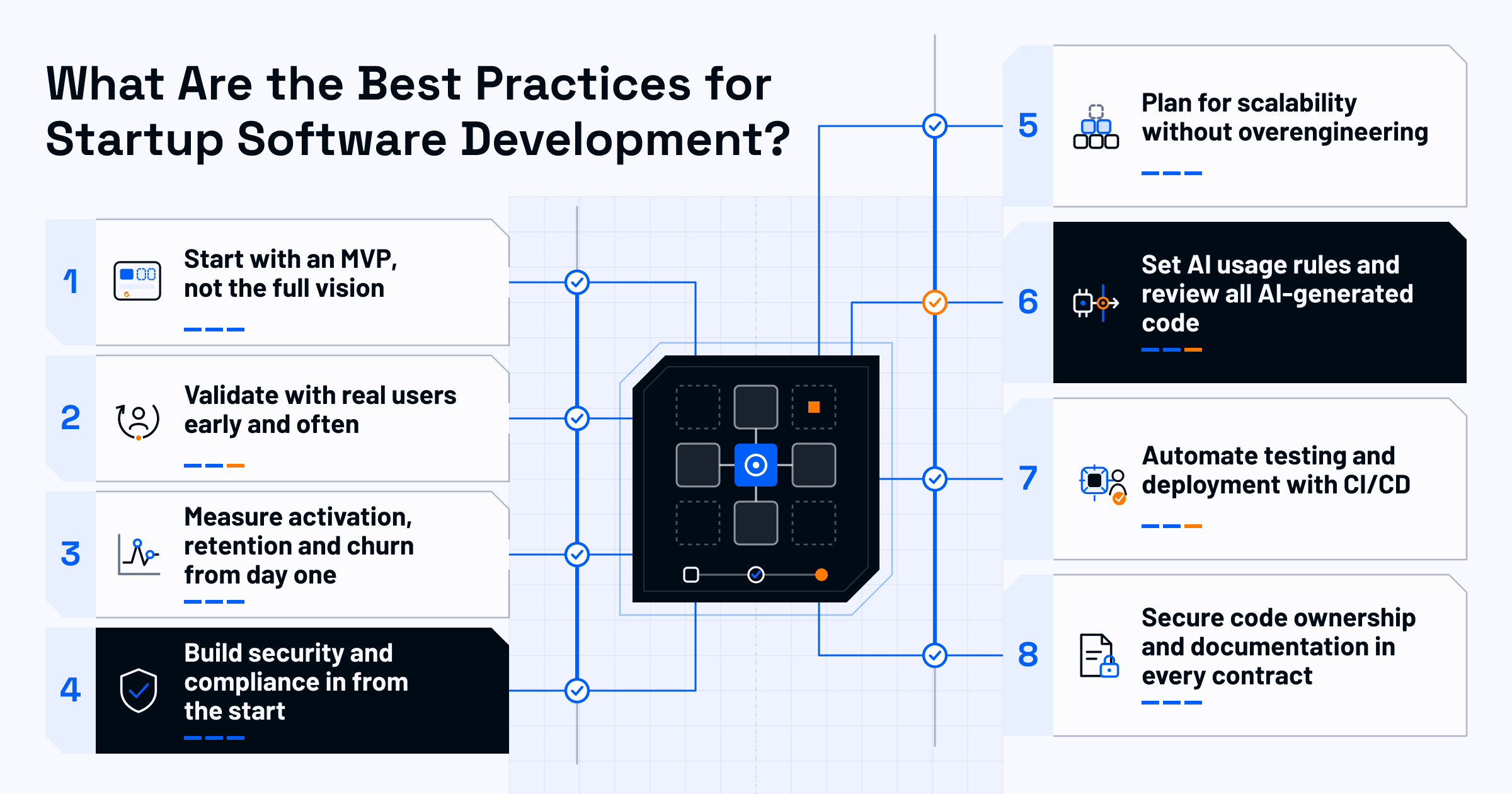
The best practices for startup software development are habits that keep you lean, secure, and ready to scale. If you work with a partner like CodersBucket, ask how each practice shows up in the delivery plan.
8 best practices for startup software development are given below.
- Start with an MVP, not the full vision: Build only what proves your core value. Extra features before launch delay the feedback you need.
- Validate with real users early and often: Run short interviews and usability tests from the first prototype. They reveal problems that internal reviews miss.
- Measure activation, retention and churn from day one: Install product analytics before launch. These numbers show whether users get value and keep coming back.
- Build security and compliance in from the start: Use HTTPS and encryption by default. Plan for GDPR, CCPA, HIPAA, or PCI DSS early if your market requires them.
- Plan for scalability without overengineering: Use a clean, modular architecture, but skip microservices until traffic justifies them. Simple systems ship faster.
- Set AI usage rules and review all AI-generated code: A written policy names approved tools and keeps private data out of prompts. Humans review every AI-generated pull request.
- Automate testing and deployment with CI/CD: A continuous integration pipeline tests and deploys every change. Solid DevOps services make releases routine, not risky.
- Secure code ownership and documentation in every contract: Require IP assignment, repository access, and current documentation from day one.
Why Do Startups Need Software Development?
Startups need software development because, for most of them, the product is the business model. Software lets a small team scale operations, automate workflows, and serve more customers without adding headcount. It also creates the usage data that investors look for as traction.
Demand keeps growing. Grand View Research values the custom software development market at $45.4 billion in 2025. It projects $178.9 billion by 2033, an 18.8% CAGR from 2026 to 2033.
What Does a Software Development Company Do for Startups?
A software development company plans, builds, and supports your product, so you don’t need a full in-house team. Services usually include product discovery, UX/UI design, MVP development, and AI integration. They also cover QA and testing, DevOps, post-launch support, and team extension when you need more hands.
Non-technical founders often need more than code. Many firms offer technical consulting or CTO as a service to guide architecture, hiring, and roadmap planning.
When Should a Startup Build an MVP?
Build an MVP after validating the problem, but before raising large rounds or hiring a full team. An MVP usually includes 5 to 8 core features.
That’s enough to test demand with early adopters before a major investment. It also cuts risk at the pre-seed stage.
You’re ready when you have a clear problem and a defined target user. You also need a testable value proposition and a limited budget to protect. A partner focused on MVP and SaaS development can help you scope that first release.
How Long Does It Take to Develop Software for a Startup?
A simple startup MVP usually takes 3 to 6 months to build. A complex platform can take 9 to 12 months or longer. Some vendors quote 8 to 12 weeks for a tightly scoped MVP.
AI-assisted teams claim even shorter timelines. One vendor cites 6 to 8 weeks with AI, compared with 12 to 16 weeks traditionally. CodersBucket quotes 2 to 5 weeks for a scoped MVP, so treat all of these as vendor claims.
Five factors drive your timeline most. They are scope, integrations, compliance needs, team size, and how fast you run feedback cycles. Scope creep, though, is the biggest threat to any launch date.
How Much Does It Cost to Maintain Startup Software?
Maintaining startup software usually costs 15% to 20% of the initial development cost each year. So a $60,000 build would need roughly $9,000 to $12,000 a year in upkeep.
Hosting for an early product typically runs $100 to $500 per month, and it rises as users grow. Maintenance covers bug fixes, security patches, dependency upgrades, monitoring, and feature updates. If your product uses AI, add model and API usage costs that grow with every request.
How Can Startups Reduce Software Development Costs?
Startups can reduce software development costs by cutting scope and reusing what already exists.
6 ways startups can reduce software development costs are given below.
- Scope a lean MVP: Cut every feature that doesn’t test your core hypothesis, and lock it in with a fixed-scope contract.
- Use open-source frameworks and managed services: Supabase and Firebase handle login, databases, and storage without a custom backend.
- Work with an outsourced or dedicated offshore team: Offshore rates lower labor costs while giving you a full team quickly.
- Use AI coding agents with human review: AI-assisted coding speeds up routine work, while reviewers keep quality and security intact.
- Reuse UI kits and third-party APIs: Prebuilt components and services for payments, maps, or email save weeks of custom work.
- Avoid switching teams mid-project: A switch can add 2 to 3 months and 20% to 30% to costs, by vendor estimates.
What Are the Pros and Cons of Outsourcing Software Development for Startups?
Outsourcing gives startups lower costs and a faster start, but it means less direct control. Picking the right outsourcing partner shrinks most of the downsides.
The pros and cons of outsourcing software development for startups are given in the table below.
| Pros of outsourcing | Cons of outsourcing |
| Lower hourly rates than in-house salaries and benefits | Less direct control over day-to-day decisions |
| Faster team start, often within weeks instead of months | Communication and time zone gaps without overlap hours |
| Access to specialist skills in design, QA, DevOps, and AI | Code ownership risk unless IP is assigned in the contract |
| Flexible team size through staff augmentation or a dedicated team | Vendor dependency that makes switching slow and costly |
| Founders stay focused on customers and funding | Quality varies widely from one vendor to the next |
For most early-stage startups, the pros outweigh the cons when the contract and communication plan are solid.
How to Choose a Software Development Company for a Startup?
To choose a software development company for a startup, compare experience, process, and contract terms, not price alone. These steps mirror how you’d find the right MVP development team.
6 steps to choose a software development company for a startup are given below.
- Define requirements, budget and timeline: List your core features, budget range, and target launch date. Clear inputs produce quotes you can compare.
- Shortlist 3 to 5 firms with startup and MVP experience: Pick teams that have shipped early-stage products. They understand tight budgets and shifting priorities.
- Review portfolios, case studies and Clutch or GoodFirms reviews: Check work similar to yours and call client references. Reviews show how a firm handles problems.
- Ask how they use AI in delivery: Ask which AI coding tools they use and how they review AI-generated code. Vague answers are a red flag.
- Check communication, time zone overlap and project tools: Confirm daily overlap hours and shared tools like Jira and Slack.
- Agree on code ownership, documentation and post-launch support: Put IP rights, handover, and transparent support pricing in writing.
Who Owns the Code When a Startup Outsources Development?
The startup owns the code, as long as the contract assigns all IP to it. Check for an IP assignment or work-for-hire clause, repository access from day one, documentation handover, and an NDA. Weak contracts make switching teams slow and costly, because you may lack source code access or context.
This isn’t legal advice, so have a lawyer review the contract before you sign.
How Does Startup Software Development Compare With Other Approaches?
Startup software development differs from other build approaches in speed, budget, and long-term control. The comparisons below show the trade-offs, so you can pick the right path for your stage.
What Is the Difference Between Startup and Enterprise Software Development?
The key difference is that startups prioritize speed and experimentation, while enterprises prioritize stability and compliance. Startups run small teams, test hypotheses quickly, and accept some risk to save cost. Enterprises work with large budgets, legacy systems, and formal processes that slow change but protect existing customers.
Put simply, a startup asks whether the product should exist. An enterprise asks how to run it safely at scale.
What Is the Difference Between an MVP and a POC?
A POC proves an idea is technically possible, while an MVP proves people want it. A proof of concept tests technical feasibility, often without a real interface. A prototype sits in between, showing how the product looks and flows through a clickable design.
An MVP is a working product that real users can try, which gives you market validation. For a deeper breakdown, read our guide on MVP vs POC.
What Is the Difference Between Custom Software and No-Code Tools for Startups?
No-code tools suit fast prototypes, while custom software suits scale, unique logic, and full ownership. Drag-and-drop platforms and AI app builders can get a demo or internal tool live in days. But they bring vendor lock-in and scalability limits once traffic and complexity grow.
Custom code handles unique business logic, stronger security, and full ownership of your IP. Off-the-shelf SaaS is the third option, a ready product you buy when your need isn’t unique.
Final Thoughts
Software development for startups works best when you validate first and build second. A lean MVP, a fitting tech stack, and the right team keep your spending tied to real learning.
AI can shorten the path, but only with human review on everything that ships. Used well, it lets a small team move like a much larger one.
Ready to turn your idea into a working product? You can start a project with CodersBucket and talk through your plans with our team.
Frequently Asked Questions
Here are short, direct answers to the questions startup founders ask most often.
Is Agile Good for Startups?
Yes, Agile is good for startups because it handles changing requirements well. Work happens in short sprints with frequent releases, so you get user feedback early. Scrum gives structure to small teams, while Kanban suits continuous work. Either way, you can change direction without throwing away months of effort.
Is Vibe Coding Safe for Startup Products?
No, vibe coding is not safe on its own for production startup products. Vibe coding means building through prompts and accepting AI output without reading it closely. Unreviewed code like that can hide security flaws and technical debt. It works well for prototypes and demos, where speed matters more than durability. In the Stack Overflow 2025 survey, 72% of developers said vibe coding isn’t part of their professional work.
Do Startups Need a CTO?
No, not every startup needs a full-time CTO at the start. A technical co-founder or a fractional CTO can guide early architecture decisions. Many development partners also offer CTO as a service. A common guideline: hire 1 to 2 senior tech leaders after raising about $1 to $2 million.
Should Startups Outsource Software Development?
Yes, most early-stage startups benefit from outsourcing software development, especially before they find product-market fit. An outsourced team starts faster and costs less than building a full in-house team.
What Is the Difference Between an MVP and a Full Product?
The difference is that an MVP tests one core idea, while a full product serves a proven market. An MVP ships only the features needed to validate demand with early adopters. A full product adds polish, extra features, deeper integrations, and the infrastructure to support growth. You build the full product step by step, using data from MVP users to decide what comes next.
Should a Startup Build a Web App or a Mobile App First?
Build a web app first, unless your core experience depends on a phone. A web app is faster to ship, easier to update, and works on every device through a browser. Choose mobile first when your product needs a camera, GPS, push notifications, or offline use.