
The best Next.js development company for you is the team whose specialty matches your product and budget. These firms build fast, full-stack web apps on Next.js, the React framework by Vercel. Our vetted shortlist of top Next.js agencies for 2026 starts with CodersBucket, followed by Blazity, Netguru and Pagepro.
We ranked each company on App Router expertise, Core Web Vitals results, Clutch reviews and Vercel partner status. Most offer custom web apps, headless commerce, integrations, migrations, AI features and long-term support. Businesses hire them for a ready team, sound rendering choices and managed delivery.
AI coding agents now write a growing share of Next.js code, which changes how you should vet teams. Hourly rates on this list run from under $25 to $149, and project costs vary widely by type. You’ll also find a 7-step method to choose the best Next.js development company for your project.
What Is a Next.js Development Company?
A Next.js development company is a software company that designs and builds web products with Next.js. Next.js is the React framework by Vercel, used for full-stack web applications.
Next.js handles frontend and backend logic in one React framework. So these companies deliver user interfaces, APIs and server logic together, as one end-to-end delivery. Pages also ship with SEO-friendly rendering, which helps search engines read them from the first visit.
What Are the Best Next.js Development Companies in 2026?
The best Next.js development companies in 2026 are CodersBucket, Blazity, Netguru, Pagepro, Pixelmatters, RaftLabs, GeekyAnts and Simform. The shortlist mixes offshore teams, nearshore teams, Vercel partners and large product firms.
We checked every rating and rate on Clutch in October 2026. Confirm them on each company’s Clutch profile before you reach out, since both change often.
The 8 best Next.js development companies are compared in the table below.
| Company | Headquarters | Best for | Pricing signal | Clutch rating |
| CodersBucket | Dhaka, Bangladesh | AI-enabled SaaS, MVPs and white-label work | Under $25/hr, $5,000+ minimum | 5.0, 3 reviews |
| Blazity | Warsaw, Poland | Headless commerce and Vercel AI Cloud builds | $50 to $99/hr, $10,000+ minimum | 5.0, 27 reviews |
| Netguru | Poznań, Poland | Funded SaaS and enterprise platforms | $50 to $99/hr, $50,000+ minimum | 4.8, 73 reviews |
| Pagepro | Białystok, Poland | Next.js and headless CMS migrations | $50 to $99/hr, $25,000+ minimum | 4.9, 34 reviews |
| Pixelmatters | Porto, Portugal | Design-led web products | $100 to $149/hr, $50,000+ minimum | 4.9, 38 reviews |
| RaftLabs | Dublin, Ireland | Fixed-price, end-to-end builds | $25 to $49/hr, $10,000+ minimum | 4.9, 20 reviews |
| GeekyAnts | Bengaluru, India | Next.js plus React Native products | $25 to $49/hr, $10,000+ minimum | 4.9, 120 reviews |
| Simform | Orlando, United States | AI-heavy enterprise builds | $25 to $49/hr, $25,000+ minimum | 4.8, 89 reviews |
1. CodersBucket

CodersBucket is a software and AI development company headquartered in Dhaka, Bangladesh, with a US office. It builds SaaS platforms, AI-powered applications and web apps for startups, agencies and product teams.
Why it made this list: Its Next.js work includes Surokkha, which supported 108M+ vaccinations, plus GymCity, SwaliTime and Ryogen’s AI university matching. The team has delivered 180+ projects, with Next.js work detailed in its case studies.
How they work: Clutch lists rates under $25 per hour with a $5,000 minimum project size. Defined scopes use fixed or milestone pricing, and dedicated teams use monthly pricing.
What to watch: CodersBucket has only 3 Clutch reviews and a 10 to 49 person team. Very large enterprise programs may need a phased start.
- Best for: Startups, agencies and product teams needing AI-enabled SaaS, MVPs or white-label Next.js work at offshore rates
- Specialization: Next.js, Laravel, Node.js and React Native with AI features
- Pricing: Under $25/hr, $5,000+ minimum
- Clutch: 5.0, 3 reviews
2. Blazity

Blazity is a Next.js-focused engineering company headquartered in Warsaw, Poland. Its teams are known for headless e-commerce, composable architecture and Next.js performance work.
Why it made this list: Blazity was named in Vercel’s inaugural Certified Solution Partner cohort in December 2025. Vercel lists it as a Gold partner, and its site shows case studies for CookUnity and Planday.
How they work: Projects start with a free architect consultation or an operations assessment. Clutch lists $50 to $99 per hour with a $10,000 minimum.
What to watch: Blazity doesn’t publish project pricing on its site, so request a scoped estimate early.
- Best for: Teams that want a Vercel-certified Next.js specialist for headless commerce
- Specialization: Headless e-commerce, composable architecture, Next.js performance
- Pricing: Custom quote, $50 to $99/hr on Clutch
- Clutch: 5.0, 27 reviews
3. Netguru
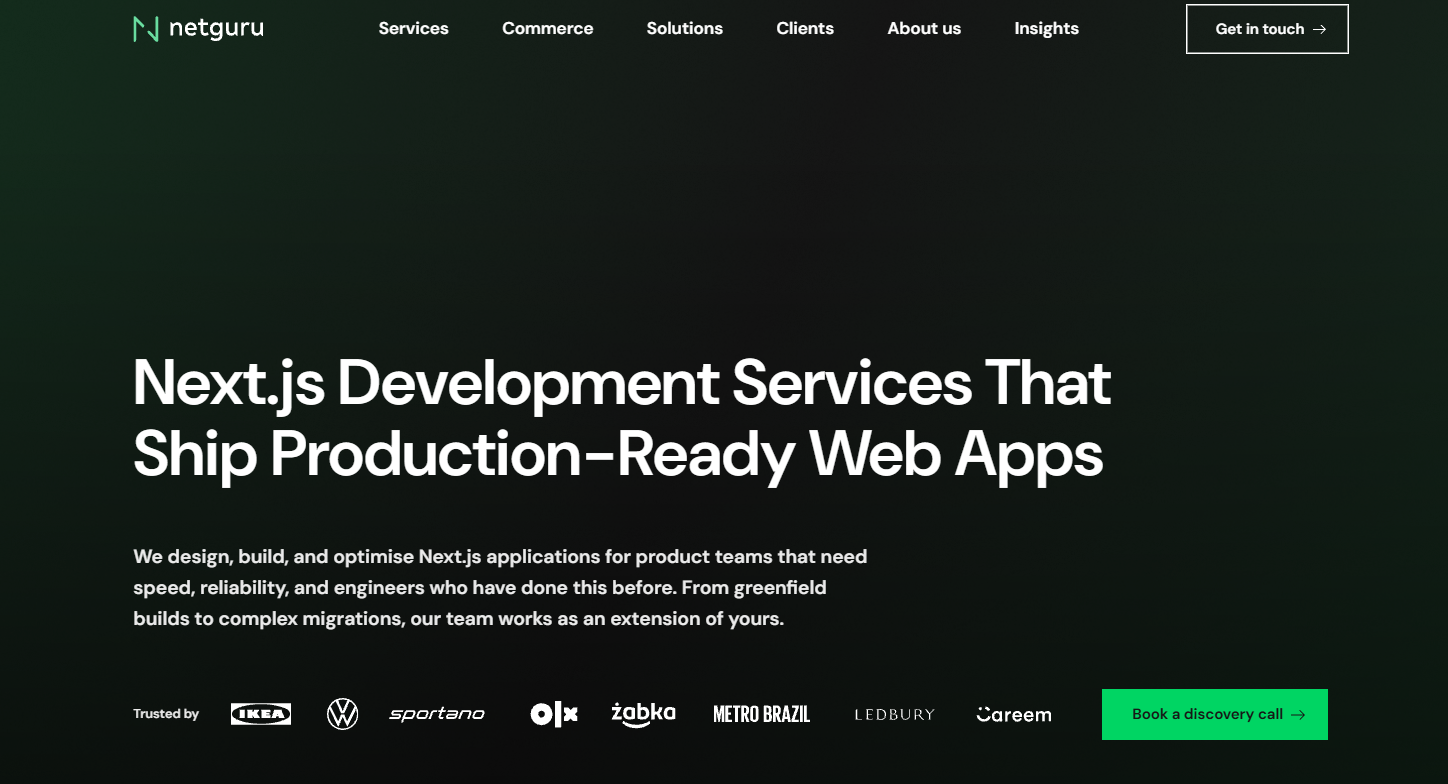
Netguru is a product design and engineering company headquartered in Poznań, Poland. It builds SaaS and enterprise web platforms with Next.js, React and TypeScript.
Why it made this list: Netguru reports 400+ in-house specialists, including senior Next.js engineers. Its client logos include IKEA, Volkswagen and Keller Williams. Its Next.js practice covers App Router architecture, rendering strategy and Core Web Vitals work.
How they work: Clients choose project-based delivery, team augmentation or an architecture review. Clutch lists $50 to $99 per hour with a $50,000 minimum.
What to watch: That minimum suits funded SaaS and enterprise builds more than small, tightly scoped projects.
- Best for: Funded SaaS products and enterprise web platforms
- Specialization: Design-led product engineering on Next.js
- Pricing: $50 to $99/hr, $50,000+ minimum
- Clutch: 4.8, 73 reviews
4. Pagepro
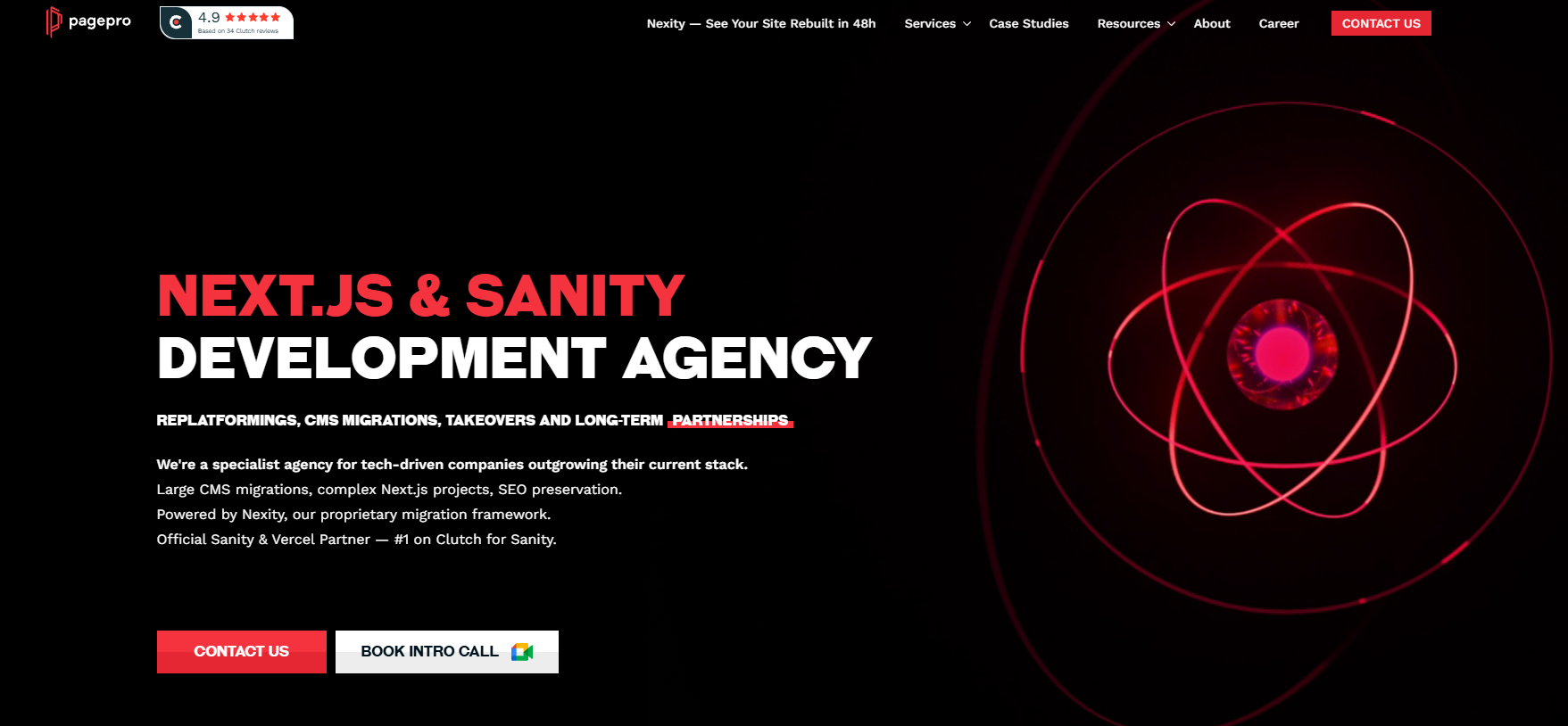
Pagepro is a Next.js and Sanity specialist headquartered in Białystok, Poland, with a London office. It builds and migrates e-commerce, content and enterprise sites on a headless stack.
Why it made this list: Pagepro is an official partner of both Vercel and Sanity, and has worked with Sanity since 2019. Its Nexity framework moves sites from WordPress and legacy stacks to Next.js.
How they work: Pagepro offers fixed-scope migrations, a two-week project takeover and monthly SLAs with guaranteed capacity. Clutch lists $50 to $99 per hour with a $25,000 minimum.
What to watch: Its 50 to 249 person team is mid-sized, so confirm capacity and start dates for larger programs.
- Best for: Headless e-commerce and enterprise marketing platforms
- Specialization: Next.js with Sanity and other headless CMS platforms
- Pricing: $50 to $99/hr, $25,000+ minimum
- Clutch: 4.9, 34 reviews
5. Pixelmatters
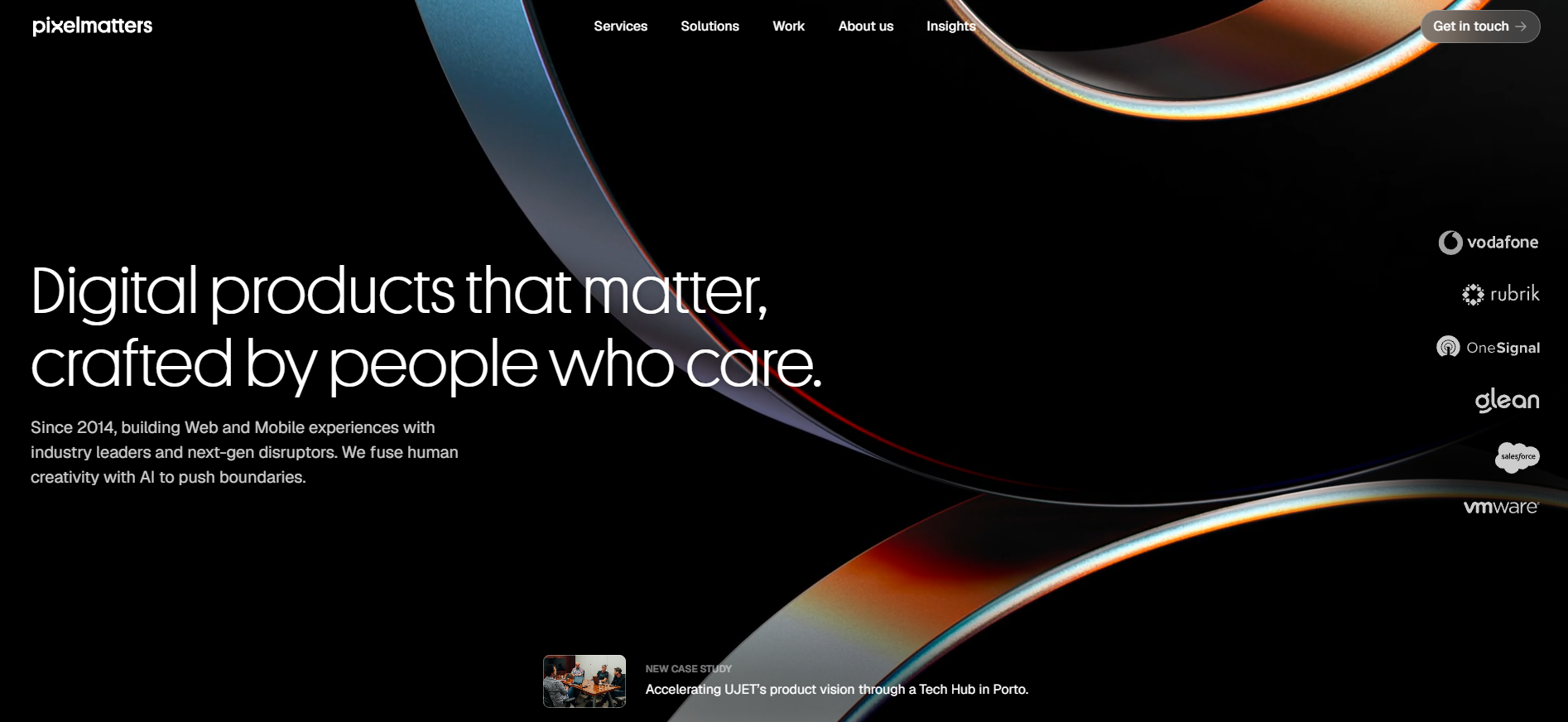
Pixelmatters is a digital product studio headquartered in Porto, Portugal. Since 2014, it has built web apps, websites and mobile apps for SaaS and technology companies.
Why it made this list: Pixelmatters pairs strong product design with engineering built to hold up under real load. Its published work includes a case study for UJET, a cloud contact center platform.
How they work: Public rate listings for Pixelmatters differ between sources, so confirm current rates directly. Clutch currently lists $100 to $149 per hour with a $50,000 minimum.
What to watch: Next.js isn’t named on its homepage, so ask for Next.js and headless CMS samples.
- Best for: Design-led SaaS websites and performance-focused web products
- Specialization: Product design, web apps and high-performance websites
- Pricing: Rates vary by source, so confirm directly
- Clutch: 4.9, 38 reviews
6. RaftLabs
RaftLabs is a software and AI development company with offices in Dublin, Ireland, and Ahmedabad, India. It delivers production Next.js apps end to end, from scoping to post-launch improvements.
Why it made this list: Its own website runs on Next.js, a practical sign of in-house expertise. Its published work covers marketplaces, loyalty platforms, telehealth apps and learning management systems.
How they work: RaftLabs locks a fixed-price proposal before coding, then delivers in milestones over about 12 weeks. Clutch lists $25 to $49 per hour with a $10,000 minimum.
What to watch: The model suits managed delivery more than short-term staff augmentation.
- Best for: Businesses that want a fixed-price, end-to-end Next.js build
- Specialization: App Router, React Server Components, Vercel deployment
- Pricing: Fixed-price, about a 12-week average cycle
- Clutch: 4.9, 20 reviews
7. GeekyAnts
GeekyAnts is a product engineering company with offices in Bangalore, London and San Francisco. Its company timeline starts in 2011, and React sits at the core of its work.
Why it made this list: GeekyAnts says it has delivered 200+ apps using React and Next.js. The company also states that Vercel recognizes it as a Next.js expert.
How they work: Clients book a discovery session, then hire a project team or dedicated developers. GeekyAnts doesn’t publish pricing, though Clutch lists $25 to $49 per hour.
What to watch: Ask how much of your assigned team works on Next.js versus React Native.
- Best for: Cross-platform products that pair Next.js web apps with React Native mobile apps
- Specialization: React, Next.js and React Native product engineering
- Pricing: Custom quote, $25 to $49/hr on Clutch
- Clutch: 4.9, 120 reviews
8. Simform
Simform is a digital engineering company headquartered in Orlando, Florida, with an office in Ahmedabad, India. It builds AI applications, cloud platforms and React-based web apps for enterprises.
Why it made this list: Simform reports a team of 1,000+ engineers and calls itself AI-native. Its offerings include agentic AI, generative AI and machine learning, with AWS and Google Cloud partnerships.
How they work: Engagements range from co-engineering teams to fully managed services. Clutch lists $25 to $49 per hour with a $25,000 minimum.
What to watch: With a delivery organization this large, ask who the named Next.js leads on your project will be.
- Best for: AI-heavy web apps and cost-conscious enterprise builds
- Specialization: React, Python, AI and machine learning, cloud
- Pricing: $25 to $49/hr, $25,000+ minimum
- Clutch: 4.8, 89 reviews
How Did We Select the Best Next.js Development Companies?
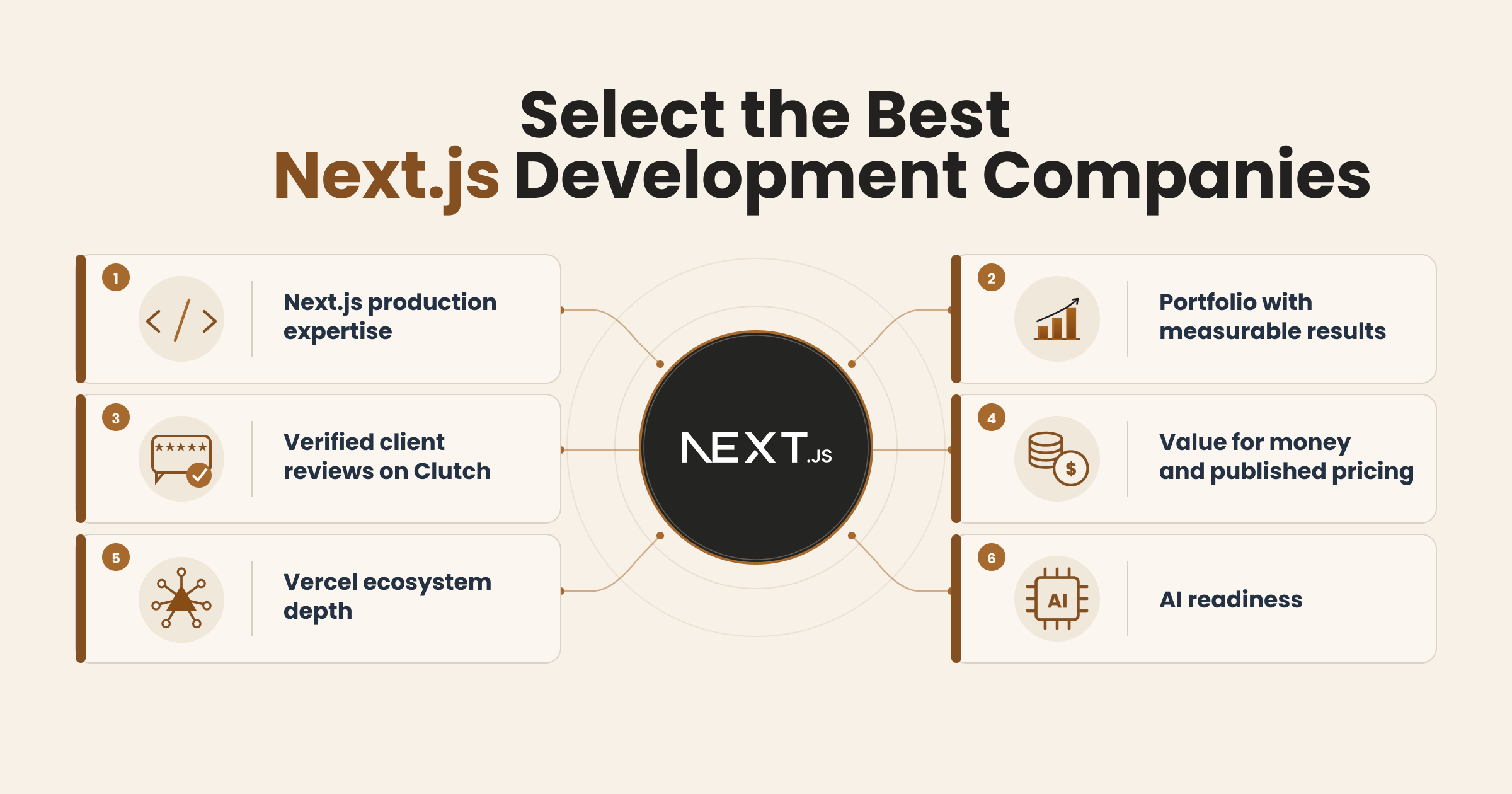
We selected the best Next.js development companies by scoring each one on six criteria, weighted toward production work. No company paid for placement.
CodersBucket publishes this list and ranks itself first, so our entry sticks to verifiable facts. The entry also states our limits openly.
The 6 criteria used to select the best Next.js development companies are given below.
- Next.js production expertise: We looked for live apps using the App Router, React Server Components and incremental static regeneration. Teams had to show sound rendering and caching choices, not just React skills.
- Portfolio with measurable results: We favored companies that share Core Web Vitals or business outcomes from shipped apps. Logos alone didn’t count, since they say nothing about speed or reliability.
- Verified client reviews on Clutch: We checked every company’s Clutch profile in October 2026. Review count mattered alongside rating, because 3 reviews and 120 reviews carry different weight.
- Value for money and published pricing: Clear hourly rates or fixed-price models scored higher than fully hidden pricing. Value means cost measured against expertise, not simply the lowest rate.
- Vercel ecosystem depth: Vercel Certified Solution Partner status and listed partner tiers earned extra credit. Hands-on Vercel deployment experience also counted for firms without certification.
- AI readiness: We looked for AI SDK use, agentic coding workflows and a clear process to review AI-generated code. Speed from agents only helps when humans still check the output.
What Services Do the Best Next.js Development Companies Offer?
The best Next.js development companies offer services that cover strategy, design, build, integration and long-term support. Most bundle them into fixed-price projects, dedicated teams or staff augmentation.
The 7 services the best Next.js development companies offer are outlined below.
- Custom Next.js web app and SaaS development: Teams build custom web apps and SaaS products with authentication, billing and dashboards. Everything runs on one Next.js codebase.
- UI/UX design: Designers turn user research into wireframes, prototypes and a component library. Developers then build those components directly in React, which cuts handoff errors.
- Headless CMS and headless commerce builds: Teams connect Next.js to Sanity or Contentful, and to Shopify through its Storefront API. Some also build Shopify Hydrogen storefronts when a project suits it.
- API development and third-party integrations: Developers build APIs and connect Stripe payments, CRMs like HubSpot, and OAuth and SSO logins. Each integration gets tested for failures and retries.
- Migration from React, Gatsby or legacy stacks: Teams move React, Gatsby or older CMS sites to Next.js in planned phases. Careful platform modernization protects live traffic and SEO during the switch.
- AI feature integration: Developers add chat assistants, semantic search and content tools using LLM APIs. API keys stay on the server, which protects data and controls spending.
- Maintenance, performance tuning and support: After launch, teams update dependencies, apply security patches and monitor Core Web Vitals. Support plans set clear response times for issues.
Why Hire a Next.js Development Company?
Businesses hire a Next.js development company to launch faster and avoid costly architecture mistakes. Demand for that expertise is high. In the Stack Overflow 2025 Developer Survey, 20.8% of respondents reported using Next.js.
The 5 benefits of hiring a Next.js development company are given below.
- Faster start with a ready team: You skip months of hiring, because developers, designers and QA are already in place. That speed matters most for MVP and SaaS development with fixed launch dates.
- Correct rendering and caching decisions from day one: Experienced teams choose static, streamed or dynamic rendering for each route. Good caching and revalidation choices cut server costs and keep pages fresh.
- SEO and Core Web Vitals performance: Specialists ship pre-rendered pages, properly sized images and lean JavaScript bundles. Better Core Web Vitals scores support search rankings and conversion rates.
- Built-in project management and QA: A project manager keeps scope, budget and timeline on track. QA engineers test every release, so fewer bugs reach your customers.
- Post-launch support and continuity: The company keeps documentation and spare capacity, so work continues if a developer leaves. You also get a clear path for framework upgrades.
How Is AI Changing Next.js Development Companies?
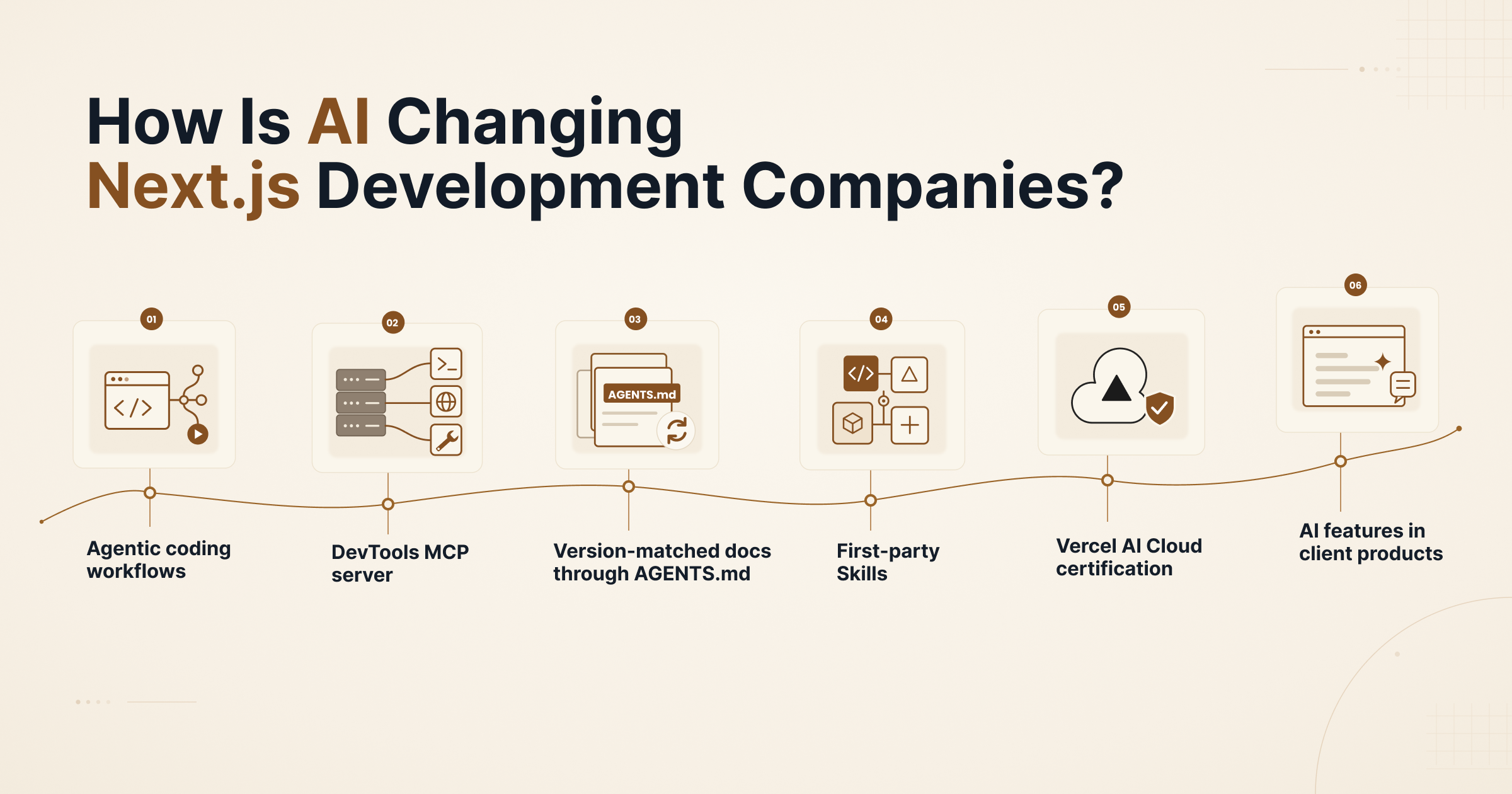
AI is changing Next.js development companies by moving routine coding to agents and raising the bar for review. The Next.js team says a growing share of Next.js code is written through agents. It names Claude Code, Cursor and Codex as examples.
The 6 ways AI is changing Next.js development companies are given below.
- Agentic coding workflows: Agents now scaffold pages, write tests and open pull requests. Senior engineers review, fix and approve that work before it merges. The engineer’s job shifts from typing code to judging it.
- DevTools MCP server: Next.js 16 added a DevTools MCP server that shows agents routes, logs and errors. Next.js 16.3 added compile checks, get_compilation_issues and compile_route, that agents run without a full build. That saves time on every edit.
- Version-matched docs through AGENTS.md: Projects now bundle Next.js docs that match the installed version. In Next.js 16.3, next dev keeps the AGENTS.md pointer current. Agents read the right APIs instead of guessing from outdated training data.
- First-party Skills: Skills give agents step-by-step playbooks for multi-step upgrades and fixes. Examples include next-dev-loop for checking changes in a browser and Skills for adopting Cache Components. Next.js 16.4 added next upgrade –agent for guided upgrades.
- Vercel AI Cloud certification: Vercel’s partner certification now covers its AI Cloud, including the AI SDK, v0.app and Workflow. Certification tests partners on AI products built on Vercel’s stack, not only websites.
- AI features in client products: Companies now ship chat assistants, natural language search and generative UI inside client apps. Each feature still needs human code review, usage limits and testing before launch. Ask for a live example before you commit.
So ask every company on your shortlist how it reviews AI-generated code before it ships. If you want AI built into the product itself, look for real AI-powered applications and automation experience.
How Much Do Next.js Development Companies Charge?
Next.js development companies usually charge $75 to $200 per hour for agency work. GoodFirms’ 2026 cost data puts individual Next.js developers at $20 to $150+ per hour.
Rates on this list run from under $25 per hour offshore to $149 for European specialists. Dedicated offshore teams usually cost $8,000 to $25,000 per month.
Fixed-price engagements suit settled scopes, while monthly dedicated team pricing suits evolving roadmaps. Watch for hidden costs too. PM, QA and ramp-up usually push the real cost 20% to 30% above the quoted rate.
Typical Next.js project costs by project type are shown in the table below.
| Project type | Typical cost range | What’s included |
| Marketing or brochure site | $15,000 to $35,000 | Static pages, basic CMS, SEO setup |
| Custom web application | $35,000 to $75,000 | Authentication, database, admin panel |
| E-commerce platform | $60,000 to $120,000 | Catalog, payments, inventory |
| SaaS platform or complex product | $100,000 to $250,000+ | Advanced features, scale, custom APIs |
How to Choose the Best Next.js Development Company?
To choose the best Next.js development company, match its specialty to your project, then verify skills and terms. The steps below keep that process objective.
The 7 steps to choose the best Next.js development company are given below.
- Define your project type, budget and timeline: Decide whether you need a marketing site, SaaS product, online store or AI tool. Then set a budget range and a launch date. Those three answers turn a long list into a short one.
- Match the company’s specialty to your project: Pick a headless commerce specialist for a store and a SaaS builder for a subscription product. For AI-heavy products, favor teams with shipped AI features. A great generalist can still be the wrong fit.
- Check App Router and React Server Components depth: Ask the team to explain how it splits server and client components. Then ask how it handles caching and revalidation on dynamic pages. Vague answers usually signal shallow Next.js experience.
- Ask for Core Web Vitals from a shipped app: Request field data from a live product, not a lab test. Google’s Core Web Vitals targets are LCP under 2.5 seconds, CLS below 0.1 and INP below 200 milliseconds.
- Verify Clutch reviews and Vercel partner status: Read recent Clutch reviews and look at how many exist, not just the star rating. Then check whether the company holds Vercel certification or a listed partner tier.
- Ask how the team uses and reviews AI-generated code: Ask which coding agents the developers use and where humans approve changes. A good answer names the review steps, security scans and tests for every pull request.
- Confirm code ownership, support terms and run a small paid pilot: Your contract should give you the code, repository access and a defined support plan. Then start with a two- to four-week paid pilot before signing a larger deal.
What Should You Know Before Hiring a Next.js Development Company?
Before hiring, know what an agency’s scope covers, how Next.js handles SEO and how long projects take. The answers below cover the Next.js basics most buyers ask about.
What Does a Next.js Development Company Do?
A Next.js development company turns a product idea into a working web app and keeps it running. Its work starts with product strategy and UI/UX design, then moves into full-stack development.
Day to day, the team also handles performance tuning, SEO setup and AI integration. Most also manage cloud hosting and deployment pipelines. After launch, it provides ongoing support, from bug fixes to framework upgrades.
Is Next.js Good for SEO?
Yes, Next.js is good for SEO because search engine crawlers get fully formed HTML on the first request.
Server-side rendering and static generation produce that pre-rendered HTML for each page. The Metadata API then controls titles, descriptions and canonical tags per route. Fast Core Web Vitals add another ranking signal.
How Long Does a Next.js Project Take With a Development Company?
A Next.js project with a development company takes 6 weeks to 12 months, depending on scope. A marketing site or CMS-driven app usually goes from kickoff to production in 6 to 10 weeks.
A SaaS product with authentication, payments and a database needs 12 to 20 weeks. Enterprise applications often take 6 to 12 months.
Four factors shift those numbers: design readiness, third-party integrations, caching strategy and approval speed. Finished designs and quick sign-offs can save several weeks.
Is Hiring a Next.js Development Company Worth It?
Yes, hiring a Next.js development company is worth it because you get end-to-end delivery with single-point accountability.
One partner owns design, code, testing and launch, so problems don’t fall between freelancers. Continuity is built in, which protects your timeline if someone leaves. The result is often faster time to market and a lower total cost of ownership.
How Much Does Next.js Maintenance Cost?
Next.js maintenance usually costs 15% to 25% of the original build cost per year. A $100,000 build, for example, needs about $15,000 to $25,000 a year.
That budget covers framework and dependency updates, security patches, performance monitoring and tuning. Many teams run it through DevOps service solutions that automate alerts and deployments.
Patching is now scheduled work. In July 2026, Next.js moved to a formal security release process. Every support plan should now include planned patch windows.
Is It Cheaper to Hire an Offshore Next.js Development Company?
Yes, hiring an offshore Next.js development company is cheaper because regional hourly rates are far lower. India and South Asia charge $15 to $60 per hour, against $60 to $150+ in North America. Eastern Europe sits in between at $30 to $90 per hour.
An offshore development team stretches the same budget much further. Still, plan for time zone overlap, a clear communication rhythm and written code ownership. Agree on shared hours and weekly demos before work starts.
What Are the Pros and Cons of Hiring a Next.js Development Company?
Hiring a Next.js development company trades higher rates for speed, accountability and specialist depth.
The pros and cons of hiring a Next.js development company are given in the table below.
| Pros of hiring a Next.js development company | Cons of hiring a Next.js development company |
| A ready team can start quickly | Agencies cost 20% to 50% more than freelancers |
| One contract and one owner for delivery | You get less direct control than with an in-house team |
| Built-in PM, QA and continuity if someone leaves | PM, QA and ramp-up can add 20% to 30% to quotes |
| Predictable cost on a fixed scope | Distant time zones can slow reviews |
| Rendering, caching and Vercel experience from shipped apps | Knowledge can be lost without a planned handover |
For most funded projects, the pros win once handover and code ownership are in the contract.
How Do Next.js Development Companies Compare With Other Hiring Options?
Your main hiring options are freelancers, regular Next.js agencies and Vercel-certified partners. Each engagement model trades cost against accountability and proof of skill. The comparisons below show where each one fits.
What Is the Difference Between a Next.js Development Company and a Freelancer?
The main difference is accountability: a Next.js development company owns the full outcome, while a freelancer owns tasks.
Freelancers from freelance platforms work well for small defined tasks. Bigger builds split across several freelancers bring fragmented accountability and continuity risk. Agencies cost 20% to 50% more, but the premium includes built-in QA, project management and backup developers.
What Is the Difference Between a Vercel Certified Partner and a Regular Next.js Agency?
The difference is independent proof: a Vercel Certified Solution Partner has passed Vercel’s own skills program. Vercel launched the certification on December 10, 2025. It covers the Vercel platform, Next.js development best practices and AI Cloud.
Partners must certify a minimum number of developers and recertify with major Next.js and Vercel releases. Vercel’s partner directory sorts solution partners into Platinum, Gold and Silver tiers.
Most Next.js agencies aren’t certified, since the first cohort had only 11 firms. Treat certification as a useful signal, not a requirement.
Frequently Asked Questions
Will AI Replace Next.js Development Companies?
No, AI won’t replace Next.js development companies, but it is changing what they sell. Agents now handle scaffolding, tests and routine fixes, so delivery gets faster.
Humans still own architecture, security, product decisions and final code review. The best companies use AI-assisted development to cut cost and time. Senior engineers stay in charge of quality.
Expect smaller teams producing more output.
Who Owns the Code After a Next.js Project Ends?
You should own the code once the agreed payments are complete. Get that in writing, with a clause that transfers intellectual property and source code ownership to your company.
Ask the team to work in a repository you control from day one. Then nothing is lost at handover, and you can switch vendors without a rebuild.
Which Next.js Version Should a New Project Use?
A new project should use the current stable release, which is Next.js 16.4 as of October 2026. Apps created with create-next-app on 16.4 enable Cache Components by default.
Starting on the latest stable version avoids an early, costly upgrade. It also gives your developers and their agents the newest tooling. Ask your partner to confirm the version in the proposal.
Can a Next.js Development Company Migrate My Existing React App?
Yes, a Next.js development company can migrate an existing React app, usually through a phased migration. Most React components move over with small changes, since Next.js is built on React.
The team then adds routing, server rendering and caching route by route. Your live app keeps running during the switch, which protects revenue and search rankings.
Final Thoughts
The best Next.js development company depends on your project type, budget and the specialty you need. Shortlist two or three firms, then compare their Core Web Vitals proof and AI review process. A small paid pilot will show you the right Next.js partner faster than any proposal.
CodersBucket has delivered 180+ projects, including Next.js case studies like Surokkha, GymCity and Ryogen. If you want a scoped discussion about your product, contact us to start a project. We’re glad to talk through a single build or a long-term partnership.