Your HR team ships a new onboarding process. Nobody uses it the way you planned. Six months later, you’re back to spreadsheets and one off Slack messages, wondering why the rollout never stuck.
That gap between what HR builds and what employees actually use is not a communication problem. It’s a design problem. And it’s exactly what HR product development exists to fix.
HR product development borrows the thinking behind good software and applies it to HR. Instead of writing a policy and hoping people follow it, you treat employees like users. You test ideas before a full rollout. You keep improving based on what actually happens once real people touch the product.
Gallup’s 2026 State of the Global Workplace report found that only 20 percent of employees worldwide feel engaged at work. Low engagement now costs the global economy roughly 10 trillion dollars a year in lost productivity. That number alone explains why more HR teams are borrowing from product management instead of sticking to the old playbook.
This guide covers what HR product development actually means, the principles behind it, and how to build your first HR product step by step.
Key takeaways:
- HR product development treats HR programs as products, with employees as the end users.
- It replaces annual rollouts with short, iterative cycles based on real feedback.
- Success is measured on two tracks at once, employee experience and business outcomes.
- Most teams organize around three functions: building products, supporting them, and aligning them with strategy.
- The best HR products are validated with data before they’re built, then improved after launch, not treated as finished on day one.
What Is HR Product Development?
HR product development is the practice of designing, building, and improving HR programs the same way a software team builds a product. That means real users, feedback loops, and measurable outcomes, not a policy written once and filed away. Onboarding, performance reviews, and benefits enrollment all become living products with their own roadmap.
The core shift is who you’re building for. In traditional HR, the department decides what’s best and employees follow along.
In product led HR, the employee is the customer. Their experience with a process is the product you’re trying to get right. That’s the idea behind employee experience as a product, a concept that’s gaining ground across HR product management circles.
Here’s how the two approaches actually compare:
| Traditional HR | Product-Led HR |
| Policy written once, rarely revisited | Roadmap updated based on feedback |
| One big annual rollout | Iterative sprints, shipped in cycles |
| Success measured by compliance | Success measured by adoption and impact |
| HR decides, employees comply | Employees help shape the design |
Knowing the difference matters. But the bigger question is why so many HR teams are making this shift right now.
Why Companies Are Shifting to a Product Mindset in HR
Companies are adopting a product mindset because the old top down model can’t keep pace with today’s workplace. Tight talent pools, hybrid work, and shifting generational expectations have changed the deal.
The relationship between employer and employee isn’t something you can assume anymore. It’s something you renew constantly, almost like a subscription that has to earn its keep every month.
Gallup’s research shows the upside is just as real as the downside. A highly engaged workforce sees roughly 23 percent greater profitability and 81 percent lower absenteeism than a disengaged one. That’s not a soft metric. It’s a number finance teams pay attention to.
The old model, on the other hand, was built for a slower era:
- One big onboarding deck, handed out once
- One engagement survey a year, then filed away
- One open enrollment window, then forgotten until next year
None of that matches how employees actually experience their jobs day to day. Software teams learned decades ago that shipping once a year and calling it finished doesn’t work. HR is simply catching up.
Remote and hybrid work made the gap even harder to ignore. A new hire working from a home office doesn’t experience onboarding through a printed handbook. They experience it through small digital touchpoints: an email, a login, a video call, a message in Slack. Each one either builds a little confidence or chips away at it. Treating that whole sequence as one product, instead of scattered steps owned by different people, is what finally makes it manageable.
Once you accept the mindset shift, the next step is understanding the principles that make it work in practice.
Core Principles of HR Product Development
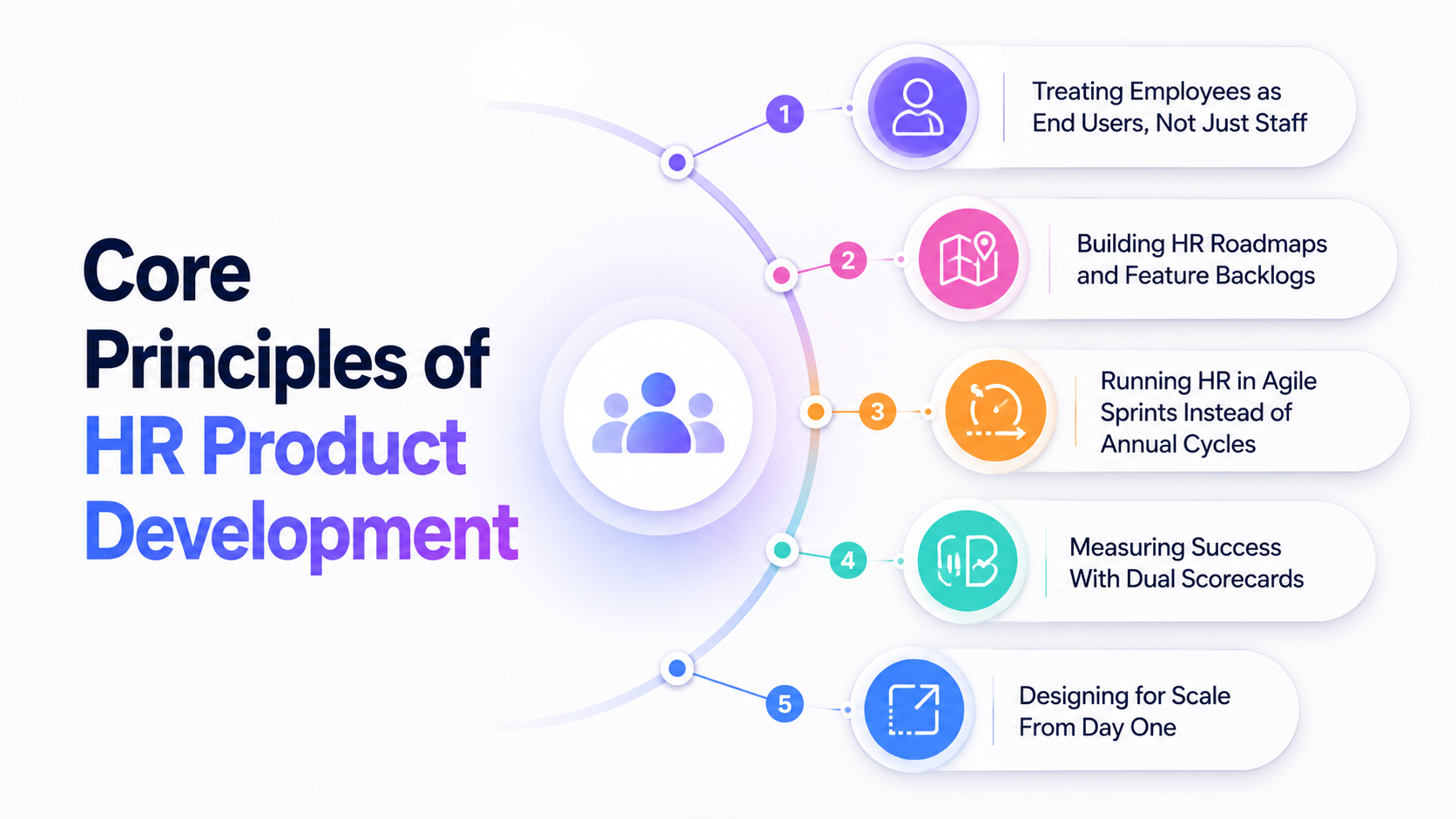 Five principles separate genuine HR product development from HR that just borrows the word “product” without changing anything underneath it:
- How you see employees
- How you plan the work
- How you deliver it
- How you measure it
- How you build it to last
Treating Employees as End Users, Not Just Staff
Employees are the end users of everything HR builds. Their experience should drive design decisions, the same way customer feedback drives a product roadmap. In practice, that means interviewing employees, mapping their journey through a process, and asking what they’re actually trying to accomplish.
Design thinking in HR borrows heavily from this idea. You empathize with the user, define the real problem, prototype a fix, and test it with a small group first. It’s slower than writing a policy memo. But it’s far more likely to stick.
Take a company that keeps hearing new hires say their first week felt confusing. A product minded HR team wouldn’t rewrite the handbook again. They’d sit down with five recent hires, find the exact moment things got shaky, and fix that moment first. That’s the difference between guessing and designing for a real user.
Building HR Roadmaps and Feature Backlogs
A real HR product roadmap lists the problems you’re solving, in priority order, the same way a software backlog does. Instead of a vague annual plan, you get a working list of specific improvements. Each one ties to a real employee pain point, with an owner and a target date attached.
This backlog also makes HR’s work visible. Leadership sees what’s shipping next and why. Employees see that their feedback actually turns into change, instead of disappearing into a suggestion box.
Over time, that visibility builds trust in HR as a function that ships, not one that just enforces rules from a handbook nobody reads twice.
Running HR in Agile Sprints Instead of Annual Cycles
Agile HR means shipping improvements in short cycles, often two to four weeks, instead of waiting for one massive annual rollout. Short cycles give you more chances to test an idea, catch a problem early, and adjust before it affects the whole company.
Many HR product teams borrow lightweight tools from software development to support this:
- Kanban boards to visualize work in progress
- Short standup meetings to stay aligned
- Retrospectives to reflect and improve the next cycle
The goal isn’t to turn HR into an engineering department. It’s to build a steady rhythm of small improvements instead of one big bet each year. Take a team running two week sprints.
They test a new manager check in format with one department, adjust it based on what they hear, and roll it out company wide within a month. Compare that to waiting for next year’s planning cycle.
Measuring Success With Dual Scorecards
A dual scorecard tracks two things side by side: experience metrics, like satisfaction and ease of use, and business metrics, like retention and time to hire. Looking at only one side gives you a distorted picture. A process can score well on satisfaction and still fail to move retention. It can also hit every compliance box while employees quietly dread using it.
Pairing both types of metrics keeps HR product development honest. You’re not just asking “did people like it.” You’re asking “did it actually move the business outcome we built it for.” A dual scorecard also gives HR a stronger case in budget conversations, since it speaks the language finance and leadership already use.
Designing for Scale From Day One
Scalable HR systems are built with modular pieces from the start, so a program designed for 50 employees still holds up at 500. That usually means a flexible core process with a few configurable options, rather than a fully custom build for every team or location.
Playbooks, templates, and reusable components make this possible. They also save HR from rebuilding the same process from scratch every time the company opens a new office.
A modular onboarding flow, for example, can keep the same core steps for every hire while swapping in role-specific training. No one starts from a blank page.
These principles only matter once someone actually owns them. That’s where the team structure behind HR product development comes in.
The HR Product Development Framework
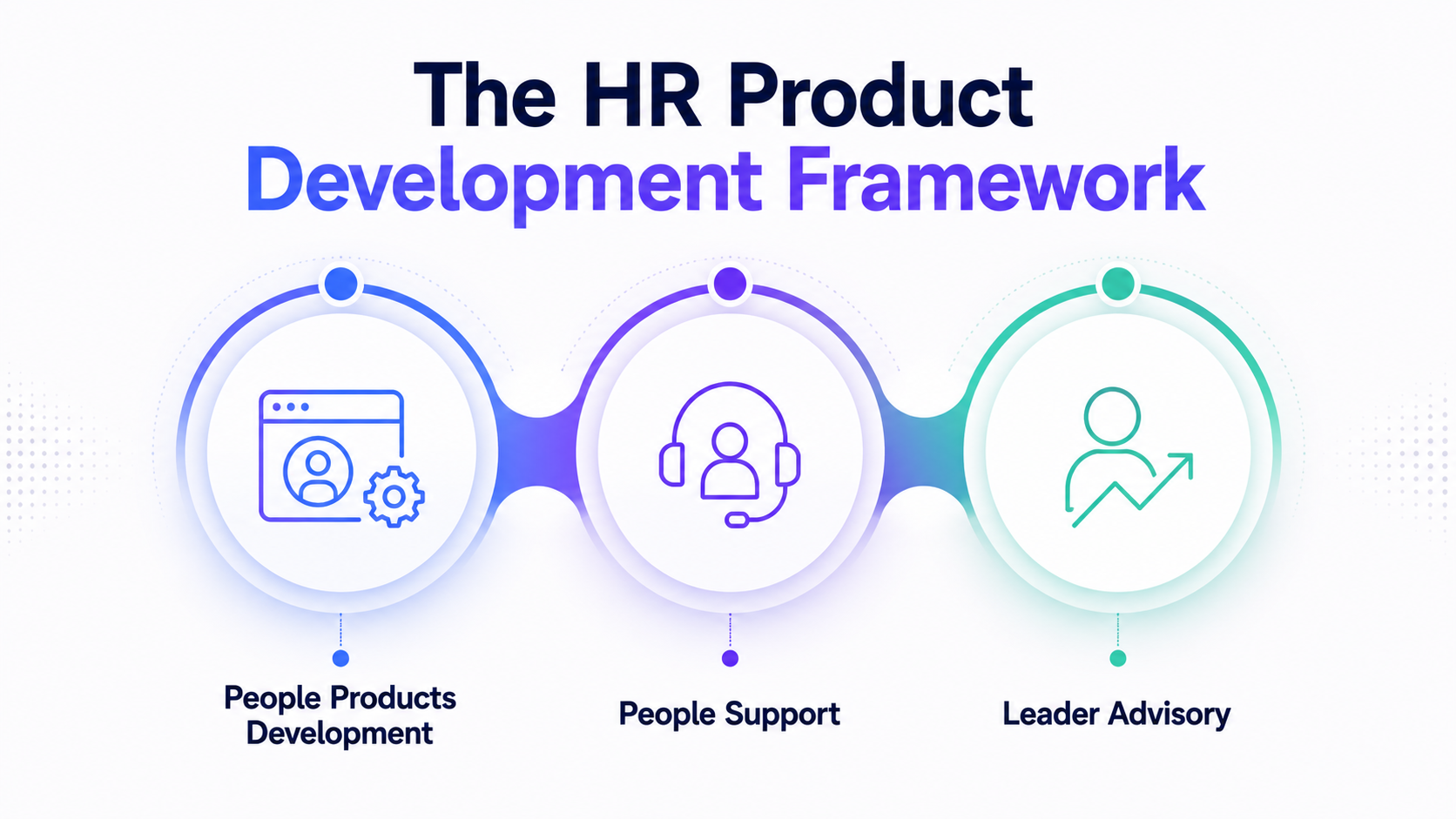
A functioning HR product organization typically splits into three groups, each with a distinct role:
- People Products Development builds new HR products
- People Support runs the current ones day to day
- Leader Advisory keeps the whole effort aligned with business strategy
None of the three works well in isolation, so it’s worth looking at each on its own.
People Products Development
This is the build function. The team here designs and improves core HR offerings, from onboarding flows to performance review systems, using the principles covered above. They own the roadmap and the backlog, and they run the sprints.
People Support
This is the run function. Once a product ships, someone has to answer questions, resolve tickets, and connect corporate policy to the day to day reality employees live in. People Support keeps the lights on while People Products Development focuses on what’s next.
Leader Advisory
This is the strategy function. Leader Advisory connects the HR product roadmap to the company’s bigger goals, so the team isn’t just building things employees like. They’re building things that actually move the business forward. They also translate HR wins into language the rest of leadership understands.
In practice, these three groups meet regularly instead of working in silos. Say People Support flags a recurring complaint about expense reporting. People Products Development turns that into a backlog item and builds a fix.
Leader Advisory makes sure the fix ties back to a goal leadership already cares about, like cutting time spent on admin work. When that loop runs smoothly, HR starts to feel less like three separate departments and more like one product team sharing a single backlog.
With the right team structure in place, you’re ready for the part most guides skip entirely: actually building your first HR product.
How to Build an HR Product Step by Step
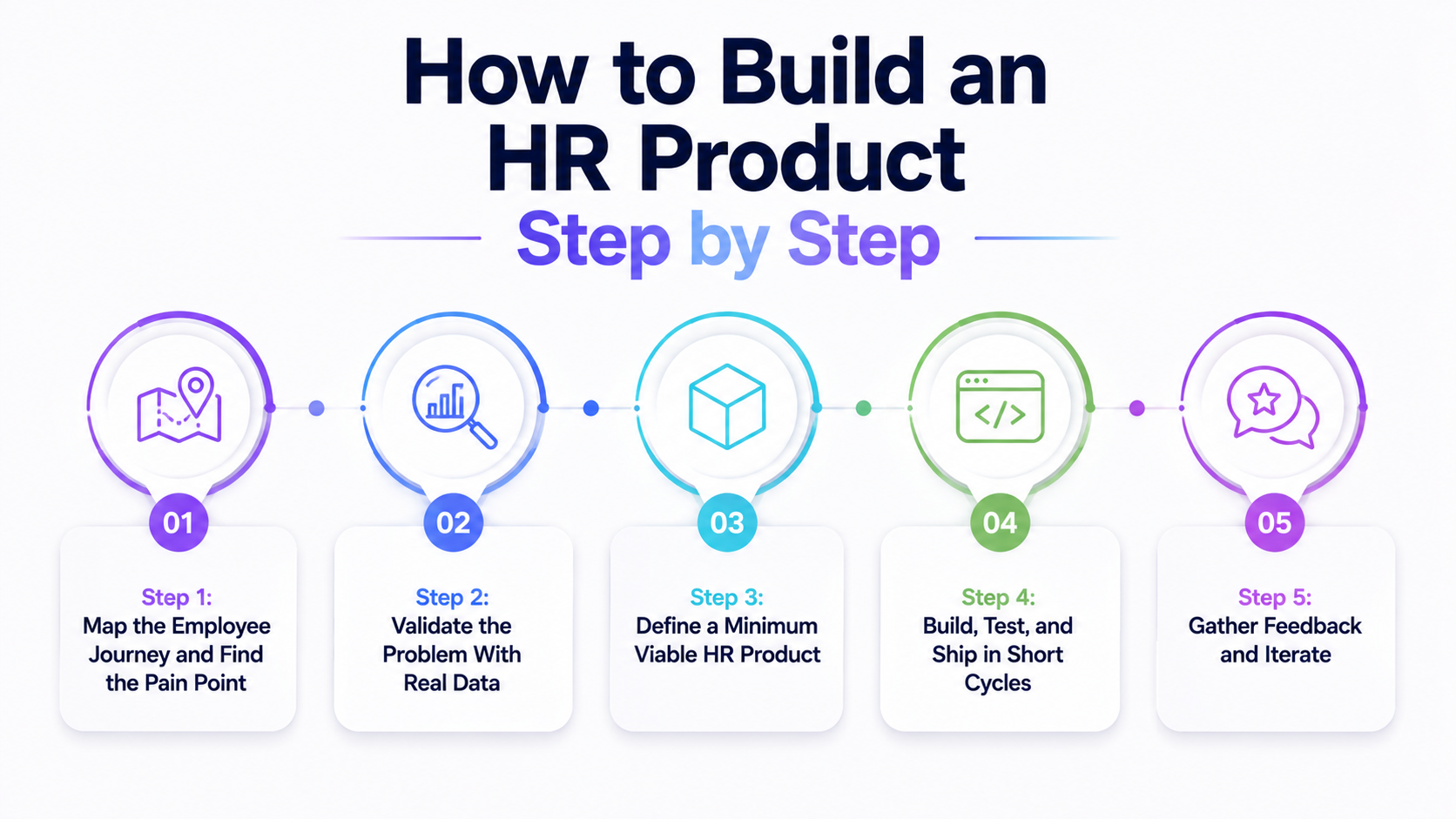
Building your first HR product comes down to five steps:
- Find the pain point
- Validate it with real data
- Define a minimal version
- Ship it in short cycles
- Keep iterating based on what you learn
Step 1: Map the Employee Journey and Find the Pain Point
Walk through a specific stretch of the employee lifecycle, such as onboarding, internal mobility, or manager check ins. Mark where things get frustrating or slow.
Journey mapping works best when you talk to actual employees, not when you guess based on assumptions. Write down the exact moment things break down, not just the general area. A vague problem statement leads to a vague fix.
Step 2: Validate the Problem With Real Data
Before you build anything, confirm the pain point is real and worth solving. Look at cycle times, drop off rates, support ticket volume, or survey scores tied to that specific process. A problem that shows up in the data is worth your team’s time. A problem you only suspect is worth a few more conversations first.
This step also saves you from spending months fixing something that only bothered one loud employee, rather than a genuine pattern.
Step 3: Define a Minimum Viable HR Product
An MVP in HR solves one specific job, end to end, instead of touching five different processes halfway. Keep the scope narrow and the timeline tight, often six to eight weeks. That’s enough time to test the idea quickly, without spending months building something nobody’s confirmed they want.
Teams that regularly build MVP and SaaS products for a living apply this same discipline. It works just as well for an internal HR tool as it does for a customer facing app.
Step 4: Build, Test, and Ship in Short Cycles
Roll your MVP out to a small group first. Gather feedback fast, and adjust before a company wide launch. Short cycles catch problems while they’re still cheap to fix, rather than after everyone’s already frustrated with version one. Even a two week pilot with a single team can surface issues that a full rollout would have hidden until it was too late to fix cheaply.
Step 5: Gather Feedback and Iterate
Treat the first version as a starting point, not a finished product. Set up a simple feedback loop, whether that’s a quick survey, a shared channel, or regular check ins. Use what you learn to plan the next round of improvements.
This is the step most traditional HR rollouts skip entirely. It’s usually the one that decides whether a program lasts or quietly fades out after a few months.
Once you know how the process works, the next question is what actually powers it. That’s where technology comes in.
Tools and Technology Behind Modern HR Products
Most HR products run on a foundation of core systems:
- An HRIS for employee records and payroll
- An applicant tracking system for hiring
- A self-service portal so employees can handle routine requests without opening a ticket
These systems form the backbone. But they rarely tell the whole story on their own.
Off the shelf tools tend to hit a ceiling as a company grows. What worked fine for 40 employees starts creaking at 400. Everything feels stitched together with workarounds once a business outgrows its original HR technology stack. At that point, many teams look at modernizing legacy systems rather than continuing to patch an aging setup.
AI is changing this picture fast. Resume screening, sentiment analysis in employee surveys, and smart scheduling are becoming standard, not experimental. But building these kinds of AI-powered applications into an HR product takes more than plugging in a chatbot. It requires the same discipline covered earlier: clear user research and careful testing before a full rollout.
For companies that have outgrown generic tools entirely, custom software development becomes the more practical path. A purpose built system matches your actual workflows, instead of forcing your team to adapt to someone else’s assumptions about how HR should work.
That raises the buy versus build question every growing HR team eventually faces:
- Buy when your processes look like most other companies’ processes and speed matters most.
- Build or customize once your workflows, approval chains, or compliance needs start to diverge from what generic software assumes.
There’s no universal right answer here. The decision usually comes down to how much your current tools are costing you in workarounds, versus how much a custom build would cost in time and budget.
CodersBucket has seen this play out directly. Hello HRM, a cloud based HR management platform the team built and operates, handles employee records, payroll, and attendance for growing organizations.
It was designed using the same product principles covered throughout this guide. You can see how that kind of work comes together in the case studies covering similar projects.
Even with the right tools, plenty of HR product teams run into the same handful of obstacles.
Common Challenges in HR Product Development
Every team adopting this approach eventually runs into a few predictable roadblocks. None of them are reasons to abandon the shift. Each one just deserves a real plan instead of good intentions.
Resistance to change- People used to the old way of doing HR, whether that’s employees, managers, or HR staff themselves, don’t always welcome a new process warmly.
Clear communication and a few visible early wins usually do more than a formal announcement ever will. Naming a handful of internal champions who already like the new approach can also help it spread faster than a mandate from the top.
Resource and budget constraints- Building and maintaining HR products takes time, money, and skill. Those don’t always come easily when other priorities are competing for the same budget. Some teams solve this by extending their capacity through an offshore development team, rather than trying to hire an entire in-house product function overnight.
Balancing standardization with customization- A standardized process is easier to maintain, but it rarely fits every team, location, or business unit perfectly. Most mature HR product teams solve this with a platform-first approach.
Build common core flows, then allow a small set of configurable options at the local level. Revisit those exceptions once a year, and retire the ones that no longer add value.
Measuring success accurately- Picking the wrong metric, or picking too many of them, makes it hard to tell whether a product is actually working. That’s exactly why a clear measurement plan matters so much, which brings us to the next section.
How to Measure HR Product Success
You measure HR product success using three layers of metrics, tracked together rather than in isolation:
- Adoption tells you whether people are using the thing at all.
- Engagement tells you whether they’re using it well.
- Business impact tells you whether it’s actually worth the investment.
| Metric Type | What It Tracks | Examples |
| Adoption | Whether employees actually start using the product | Activation rate, completion rate |
| Engagement | Whether they use it well and keep coming back | Time to complete a task, repeat usage |
| Business Impact | Whether it moves outcomes leadership cares about | Retention, time to hire, time to productivity |
Pair each metric with a baseline and a target before launch, not after. Without a starting point, you have no way to prove the product actually improved anything.
With your metrics in place, a few common questions tend to come up.
Frequently Asked Questions About HR Product Development
What is the difference between HR product development and traditional HR management?
Traditional HR management writes policy and expects compliance. HR product development treats each program as something to design, test, and improve. It works the way a software team ships and refines a product, based on how people actually use it.
Who owns HR product development inside a company?
An HR product manager typically owns the roadmap. The work still involves several groups, including HRIS or IT, analytics, and talent acquisition. Business leaders help set priorities based on impact and effort.
What is the first HR process a company should productize?
Pick a painful, frequent step in the employee lifecycle with a visible business cost attached, such as onboarding or manager check ins. Validate the pain point with real data before committing resources to fix it.
How is AI changing HR product development?
AI is showing up in resume screening, sentiment analysis, and predictive analytics across HR software. It’s pushing more teams toward custom or AI-enhanced tools instead of generic, one-size-fits-all platforms.
How long does it take to build and launch a first HR product?
Most teams can validate a pain point and ship a working MVP within six to eight weeks, as long as the scope stays narrow. Trying to fix several processes at once almost always stretches the timeline and dilutes the results.
Final Thoughts: Turning HR Into a Product People Actually Want to Use
HR product development isn’t a rebrand of things you’re already doing. It’s a genuine shift. Instead of writing policy and hoping it lands, you design something real, test it with actual employees, and improve it the way any good product improves over time.
The principles, framework, and steps covered here give you a starting point. What decides whether it actually works is execution, from the first employee interview to the tools you eventually build or buy.
Teams that treat this as a one-time project tend to see the same results as the old annual rollout model. Teams that treat it as an ongoing practice tend to see HR programs employees actually stick with.
If your team is ready to move past spreadsheets and stitched together tools, it may be time to build the HR product employees deserve. Start a conversation with a team that builds this kind of software for a living.