Trying to find the best software company in Bangladesh? Here’s the good news: you’ve got more solid options than almost anywhere else in South Asia.
Bangladesh built that reputation slowly, over two decades, through government platforms that had to work on day one, banking systems that can’t afford downtime, and startups that needed an MVP built fast and cheap. That track record is why so many companies, from local startups to global nonprofits, now build their software here.
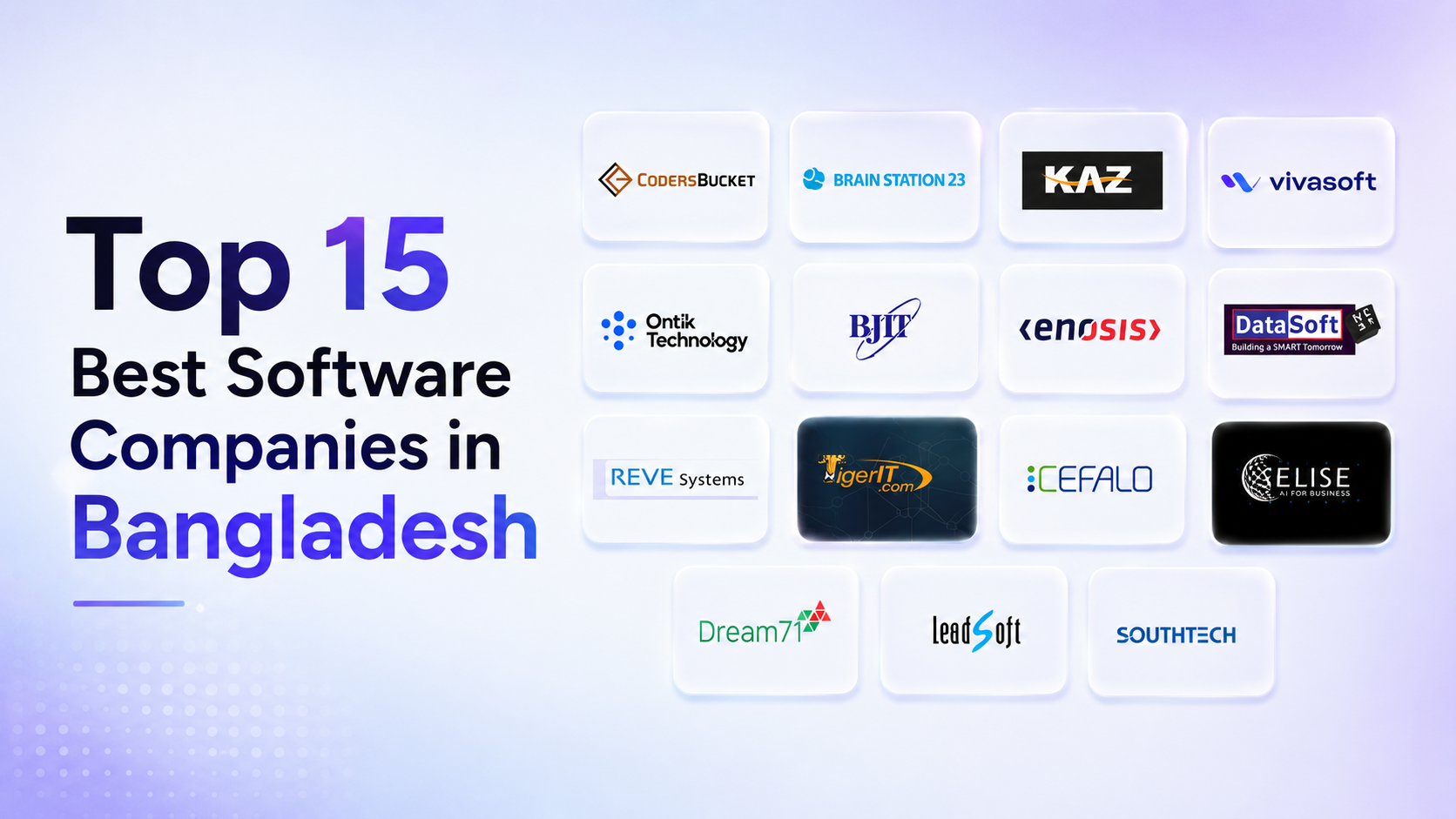
This guide ranks the 15 best software companies in Bangladesh for 2026, based on client reviews, certifications, real project history, and how current each team’s tech actually is. Below, you’ll find a comparison table, full profiles, and a straightforward way to pick the right partner for your own project.
Why Bangladesh Has Become a Global Software Development Hub
Bangladesh works as a software outsourcing hub because it offers a young, capable workforce at costs that Western markets simply can’t match. That’s the short answer. Here’s what’s behind it.
The country’s IT sector now employs more than 500,000 professionals, according to BASIS, and exports software services to over 100 countries. Gartner ranks Bangladesh 21st globally on its offshore services location index, a spot earned through strong English proficiency, a deep developer pool, and rates that undercut hubs like Bangalore.
But let’s not oversell this. The growth hasn’t been smooth or guaranteed. Official EPB data puts ICT service exports at $724.6 million for FY2024-25, well short of the government’s earlier $5 billion goal.
Habibullah Neyamul Karim, former president of BASIS, told The Business Standard that the true figure is probably higher, since freelancer and small-firm income often slips through official reporting. So here’s the honest version: Bangladesh’s software industry is real and growing, but still finding its footing.
If you’re building a team without a Silicon Valley budget, this is exactly the kind of market where an offshore development team gets you real engineering talent, not a bargain-bin freelancer roulette.
Now that you know why Bangladesh works, let’s get into how we picked the companies on this list.
How We Selected the Best Software Companies in Bangladesh
We picked these companies using seven criteria that predict whether a client gets a good outcome, not just whichever firm has the flashiest homepage.
Here’s what we looked at for each one:
- Verified client reviews on Clutch, GoodFirms, and Glassdoor, not testimonials the company hand-picked itself
- Industry certifications like ISO 9001, ISO 27001, and CMMI maturity levels
- Portfolio depth across industries, not one lucky flagship project
- Years in operation and whether clients actually stick around
- Tech stack breadth, and whether it’s current or stuck in 2015
- Communication and time zone fit for international clients
- AI adoption, which now separates the fast-moving teams from the ones still working the old way
No single criterion tells the whole story alone. Together, though, they’re a decent filter against companies that look impressive on paper and fall apart once the project starts.
With that settled, here’s how these 15 companies compare at a glance.
Quick Comparison: Top Software Companies in Bangladesh at a Glance
Short on time? Here’s the scannable version before the full profiles below.
| Company | Founded | Team Size | Known For |
| CodersBucket | 2020 | Growing fast | AI-powered custom software and government-scale systems |
| Brain Station 23 | 2006 | 950+ | Enterprise apps and digital banking |
| Kaz Software | 2004 | 100+ | Custom software for NGOs and global nonprofits |
| Vivasoft | 2016 | 300+ | Team augmentation and its own SaaS products |
| Ontik Technology | 2016 | 150+ | MVP development and staff augmentation |
| BJIT | 2001 | 750+ | Offshore teams for Fortune 500 manufacturers |
| Enosis Solutions | 2006 | 350+ | QA-first software development |
| DataSoft Systems | 1998 | 300+ | Mission-critical government systems |
| REVE Systems | 2003 | 160+ | Telecom and IP communication software |
| Tiger IT | 2000 | 350+ | Biometrics and national ID systems |
| Cefalo Bangladesh | 2010 | 250+ | Dedicated teams for Norwegian clients |
| SELISE Digital Platforms | 2011 | 700+ | Enterprise platforms for Swiss and EU clients |
| Dream71 Bangladesh | 2008 | 180+ | e-Governance software |
| LeadSoft Bangladesh | 1999 | 300+ | Core banking software |
| Southtech | 1996 | 90+ | Microfinance and banking systems |
Table digested? Good. Let’s get into the details on each one, starting with the company topping this list.
Top 15 Best Software Companies in Bangladesh in 2026
1. CodersBucket
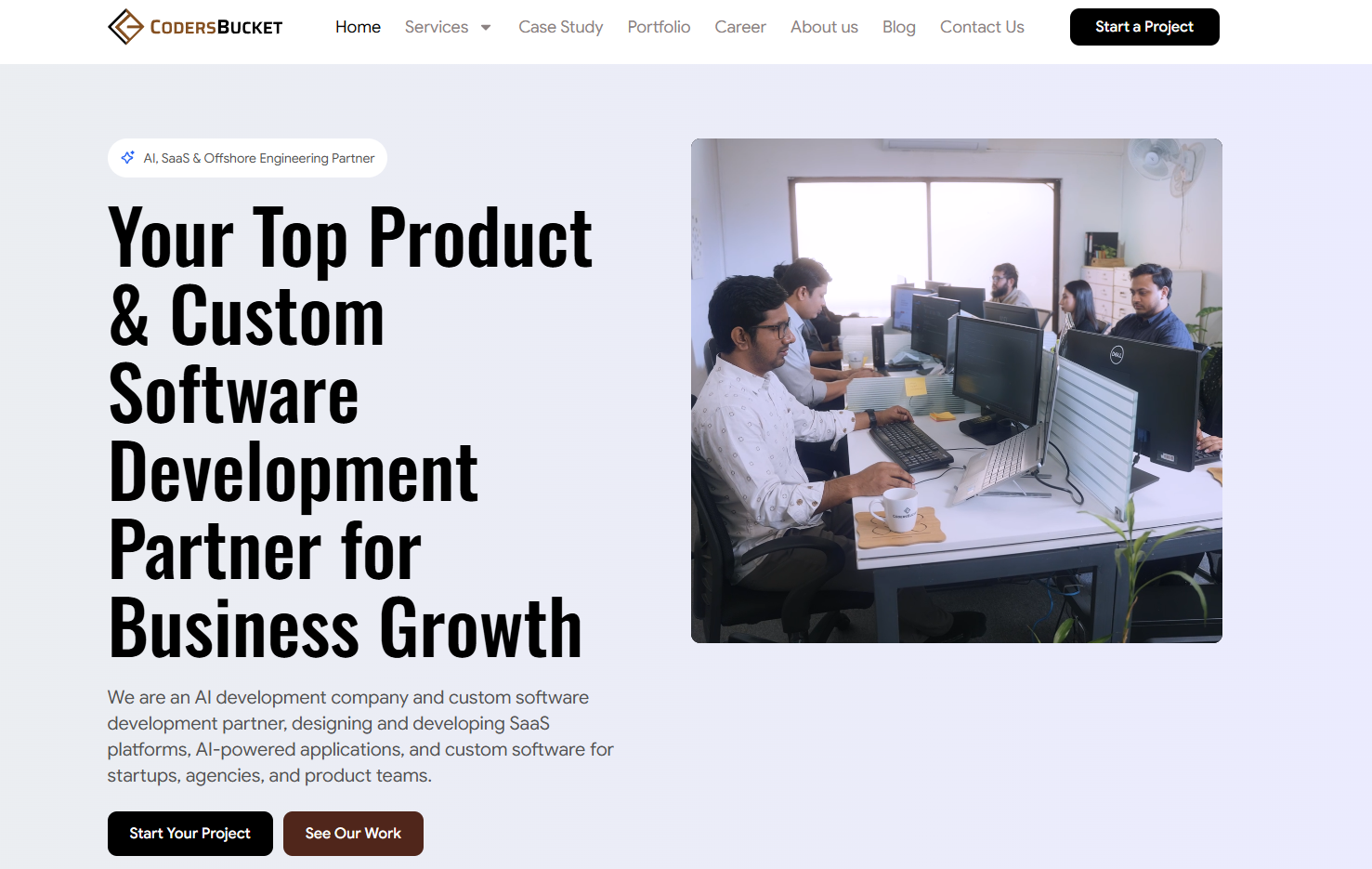
CodersBucket earns the top spot because it does something most competitors are still catching up on: it builds AI into how it actually works, not just how it markets itself.
Sarwar Hossain founded CodersBucket in 2020, after already running Instalogic since 2012. The idea was simple: help businesses of any size turn ideas into working software without the usual outsourcing headaches, the missed deadlines, the vague scope, the endless email threads. Since then, the team has shipped everything from scrappy startup MVPs to software running at national scale.
Here’s what separates them. CodersBucket handles custom software and mobile app development, e-commerce builds, team augmentation, and AI and data science work, all under one roof. That matters more than it sounds. It means you’re not stitching together three vendors just to get a product out the door.
On the government side, CodersBucket helped build Surokkha, Bangladesh’s national COVID-19 vaccination platform. It served over 150 million people, handling batch tracking, certificate issuance, and two dedicated mobile apps. The team also built the Central Aid Management System, which coordinates aid distribution across 29 government ministries, and Hellohrm, a cloud-based HR platform companies use to manage leave, attendance, and internal announcements.
They’ve also gone all-in on AI-powered applications and automation, using tools like OpenAI Codex to speed up how code gets written and tested. This isn’t a buzzword tacked onto a pitch deck. Faster, AI-assisted development means fewer bugs slipping through, quicker QA turnaround, and lower costs, which is exactly what a growing business needs from a development partner.
Founded: 2020 | Specialization: Custom software, AI, and full-stack development | Notable projects: Surokkha, Central Aid Management System, Hellohrm | Website: codersbucket.com
2. Brain Station 23
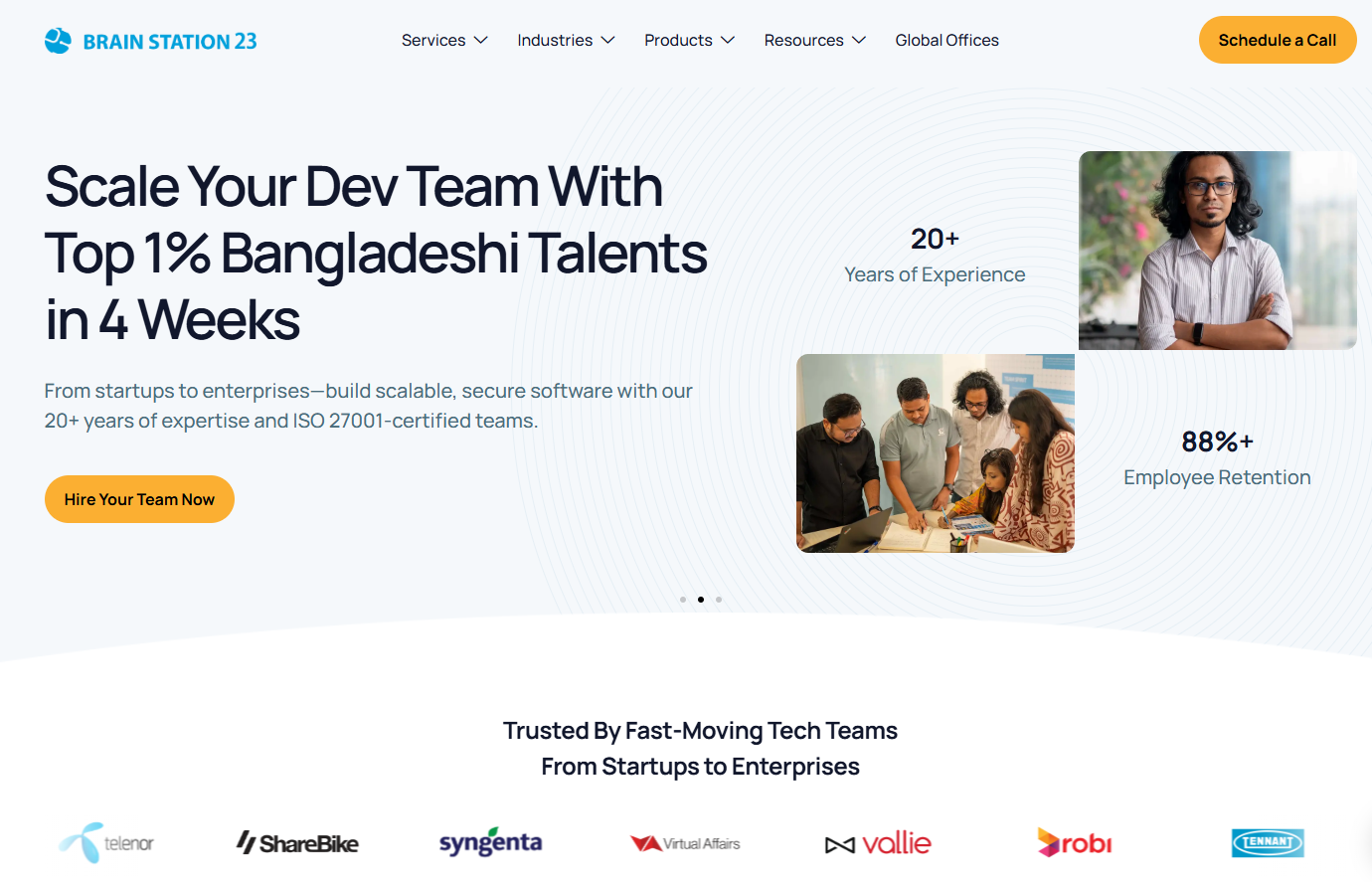
Brain Station 23 built its name on enterprise software, and the client roster proves it.
Founded in 2006, the company has grown into one of Bangladesh’s largest software firms, with 950 or more engineers serving over 300 clients across 30-plus countries. It holds CMMI Level 3, ISO 9001, and ISO 27001 certifications, and it’s an AWS Advanced Consulting Partner.
Its flagship product is CityTouch, a digital banking app built for City Bank that now serves more than 446,000 users and has processed over $3 billion in transactions, the kind of proof that separates a company that talks about scale from one that’s actually handled it.
Founded: 2006 | Specialization: Enterprise software and digital banking | Notable clients: British Telecom, PayPal, Telenor | Website: brainstation-23.com
3. Kaz Software
Kaz Software spent over two decades quietly earning trust from international nonprofits and NGOs, the kind of clients who can’t afford a vendor that cuts corners.
Founded in 2004 in Dhaka, Kaz now serves over 200 clients across 35-plus countries with a team of 100-plus engineers and designers. Its specialty is monitoring and evaluation systems, including a loss and damage dashboard built for Oxfam that tracks climate-related aid data.
When UNICEF, the World Bank, Thomson Reuters, and the British Red Cross all hand you sensitive data work, that’s not a coincidence. It’s a reputation built one careful project at a time.
Founded: 2004 | Specialization: Custom software and UX for development organizations | Notable clients: UNICEF, World Bank, British Red Cross | Website: kaz.com.bd
4. Vivasoft Limited
Vivasoft has grown fast since 2016, and it shows in how consistently the company shows up on independent review platforms.
The team runs offices in Dhaka, the UK, Malaysia, and Nepal, with more than 300 engineers on staff. It holds ISO 27001, ISO 9001, and GDPR certifications, and carries a perfect 5.0 rating on Clutch, with over 100 projects delivered for clients like Azerion, Klikit, and City Bank.
What sets Vivasoft apart is that it doesn’t only build for clients. It builds its own products too: PiHR for payroll, Financy for accounting, and Kothon AI for call center automation. That’s a company that understands product thinking, not just code delivery on someone else’s spec.
Founded: 2016 | Specialization: Team augmentation and custom software | Notable clients: Azerion, Klikit, City Bank | Website: vivasoftltd.com
5. Ontik Technology
Ontik Technology built its name helping startups go from a rough idea to a working MVP without dragging the process out for months.
Founded in 2016, the company runs offices in Bangladesh, the US, Canada, and Australia, with a team of 150-plus developers. It’s completed over 500 projects for clients in 20-plus countries and picked up recognition from Stanford’s Seed Spark program and Google Cloud’s AI for Impact Challenge. Beyond MVP work, Ontik also offers dedicated tech teams and staff augmentation.
Founded: 2016 | Specialization: MVP development and staff augmentation | Notable clients: Chippit, Fitmate, Aerolex | Website: ontiktechnology.com
6. BJIT
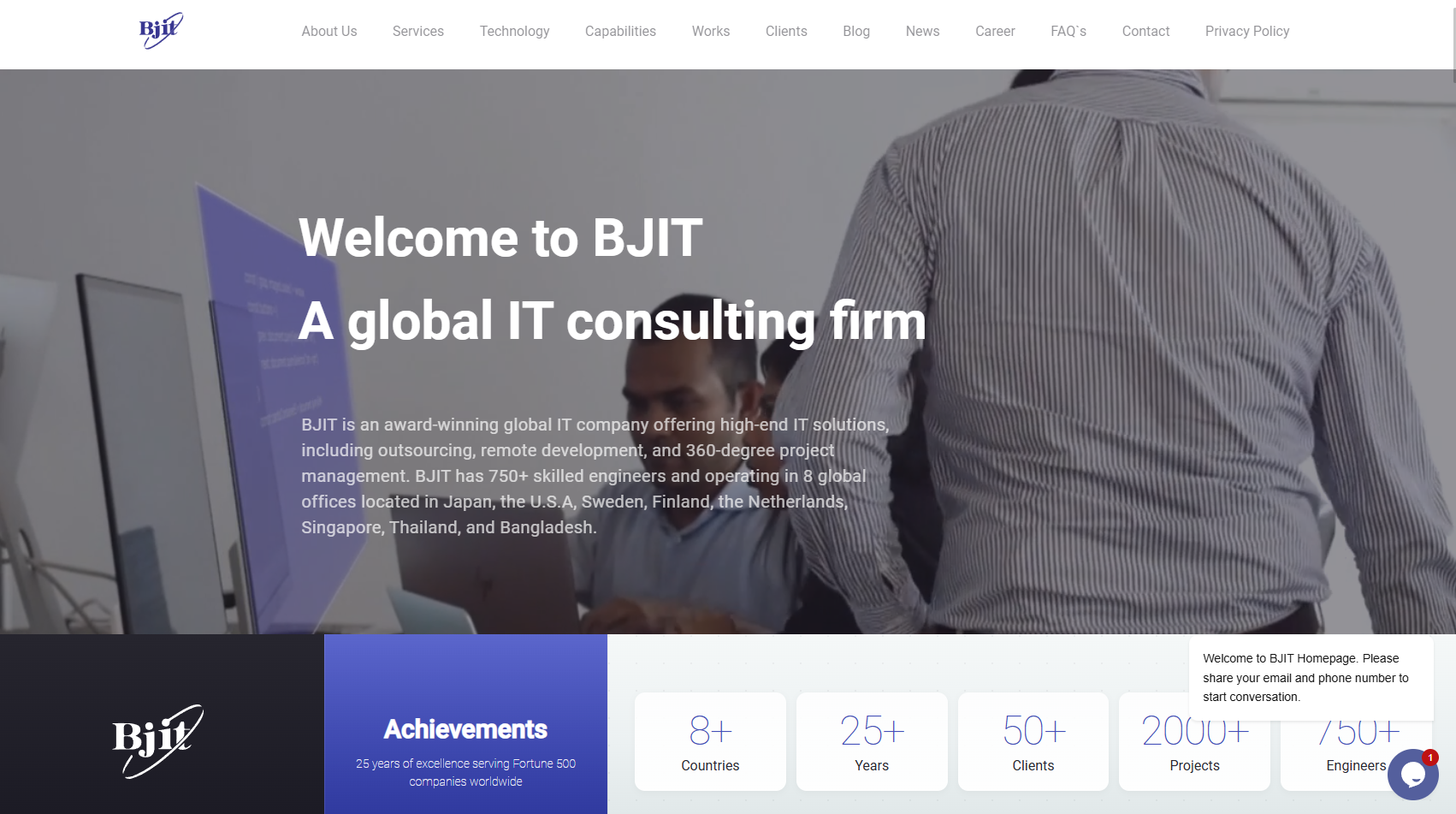
BJIT is proof that a Bangladesh-Japan joint venture can hold its own against global manufacturing giants.
Founded in 2001, BJIT now employs 750-plus engineers across eight global offices and works with more than 50 Fortune 500 companies. It holds ISO 27001 certification and has racked up over 2,000 completed projects. Clients like Sony, Panasonic, and Toshiba lean on BJIT for offshore development where precision beats speed every time.
Founded: 2001 | Specialization: Offshore development for manufacturing and electronics | Notable clients: Sony, Panasonic, Toshiba | Website: bjitgroup.com
7. Enosis Solutions
Enosis Solutions treats quality assurance as equally important as writing the code itself, and that mindset runs through everything the team builds.
Founded in 2006 in Gulshan, Dhaka, Enosis employs 350-plus software experts serving clients mostly across the US and Canada. The team pairs Agile development with structured testing, keeping quality steady from the first sprint through launch.
Founded: 2006 | Specialization: Software development and dedicated QA | Notable clients: Powerhouse Dynamics, Planet DDS | Website: enosisbd.com
8. DataSoft Systems Bangladesh Ltd.
DataSoft handles software that simply can’t fail, the government and financial systems that millions of people rely on without ever thinking about it.
Founded in 1998, DataSoft became Bangladesh’s first CMMI Level 5 company in 2014, the highest maturity rating a software process can earn. The firm has since branched into IoT, AR, VR, and AI, working with clients like the Chittagong Port Authority on infrastructure where downtime isn’t an option.
Founded: 1998 | Specialization: Government and mission-critical systems | Notable clients: Chittagong Port Authority | Website: datasoft-bd.com
9. REVE Systems
REVE Systems started in a Dhaka garage in 2003. Two decades later, it’s a genuine player in global telecom software.
Now headquartered in Singapore, the company still keeps its core development teams in Bangladesh and India, with 160-plus engineers building IP communication and telecom billing software. REVE serves over 4,500 telecom operators across 80-plus countries, with names like Bharti Airtel and bKash on its client list.
Founded: 2003 | Specialization: Telecom and IP communication software | Notable clients: Bharti Airtel, bKash, Scotiabank | Website: revesoft.com
10. Tiger IT Bangladesh Ltd.
Tiger IT built the software running Bangladesh’s national identity system. That alone would make most résumés.
Founded around 2000, Tiger IT specializes in biometrics and identity management. Its TigerAFIS fingerprint system is NIST-certified, a rare distinction, and its technology registered close to 100 million voters for Bangladesh’s national ID rollout. It now exports similar biometric solutions to Nepal, Bhutan, India, and Kenya.
Founded: 2000 | Specialization: Biometrics and national identity systems | Notable clients: UNDP, government ID agencies across South Asia | Website: tigerit.com
11. Cefalo Bangladesh Limited
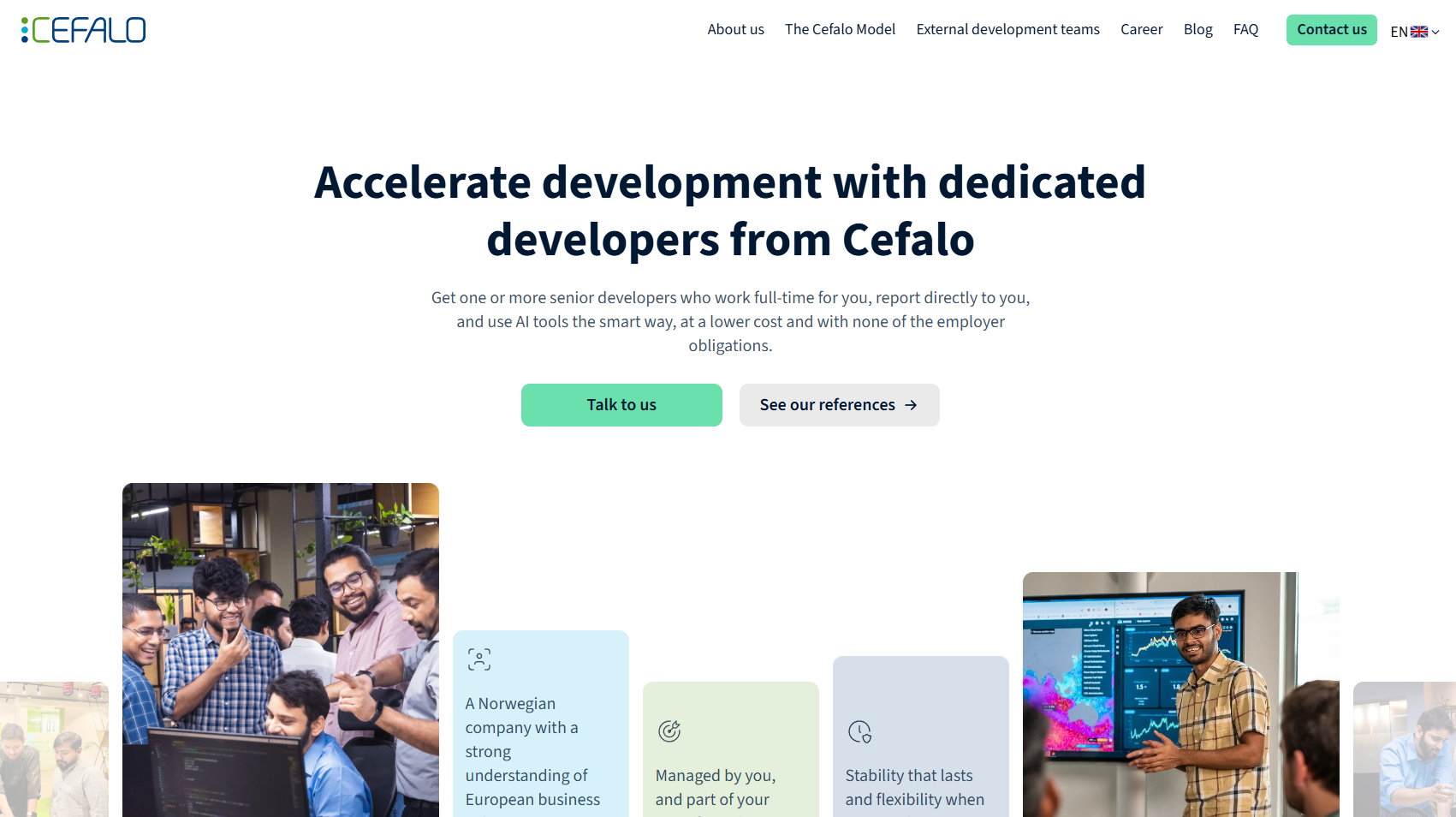
Cefalo is Norwegian on paper, but its engineering work happens almost entirely in Dhaka.
Founded in 2010, Cefalo runs on a team of 250-plus engineers working as dedicated, embedded teams for Norwegian businesses. It holds Great Place to Work certification alongside ISO 27001 and ISO 9001, with clients including KPMG and DN Media Group.
Founded: 2010 | Specialization: Dedicated development teams for the Nordic market | Notable clients: KPMG, DN Media Group | Website: cefalo.com
12. SELISE Digital Platforms
SELISE is a Swiss company that decided its biggest engineering hub should be in Dhaka, not Zurich, and that bet paid off.
Founded in 2011 and headquartered in Zurich, SELISE employs 700-plus people across eight countries, with Bangladesh as its largest development center. It builds its own products too, including a low-code platform called SELISE Blocks, alongside client work for banks and insurers across Switzerland and the EU.
Founded: 2011 | Specialization: Enterprise platforms for regulated industries | Notable clients: Sunrise UPC, Prime Bank | Website: selisegroup.com
13. Dream71 Bangladesh Ltd.
Dream71 is who the government calls when software needs to reach ordinary citizens, not just sit in a server room.
Founded in 2008, Dream71 has delivered software across more than 20 countries and managed over 37 projects for the Bangladesh government alone, working with agencies like a2i and Bangladesh Bank. It also builds its own products, including Pocket Sales71 and People Book HR.
Founded: 2008 | Specialization: e-Governance and public sector software | Notable clients: a2i, Bangladesh Bank | Website: dream71.com
14. LeadSoft Bangladesh Limited
LeadSoft was building core banking systems in Bangladesh long before fintech turned into an industry buzzword everyone chases.
Founded in 1999 as part of the LEADS Corporation group, LeadSoft employs 300-plus staff and holds CMMI Level 5 certification, one of the toughest process maturity ratings in software. Its flagship product, BankUltimus, runs core banking operations for banks and financial institutions, and the company has since branched into blockchain with AidTrust, built for humanitarian aid distribution.
Founded: 1999 | Specialization: Core banking and fintech software | Notable clients: Coca-Cola, H&M, IPDC Finance | Website: leadsoft.com.bd
15. Southtech Ltd.
Southtech is one of the oldest software companies in Bangladesh, and its client retention numbers explain why.
Founded in 1996, Southtech specializes in banking and microfinance software and became the first company in Bangladesh appraised under CMMI V2.0. It reports a 95% repeat-client rate, a strong signal of trust in an industry where vendors get swapped out often. Its flagship product, Ascend Financials, has won national recognition for its design.
Founded: 1996 | Specialization: Banking and microfinance software | Notable clients: AB Bank, Dhaka Bank, BRAC | Website: southtechgroup.com
Fifteen companies, fifteen different strengths. But if you’re still weighing your options, it’s worth taking a closer look at what makes the top pick genuinely different.
What Makes CodersBucket a Standout Choice
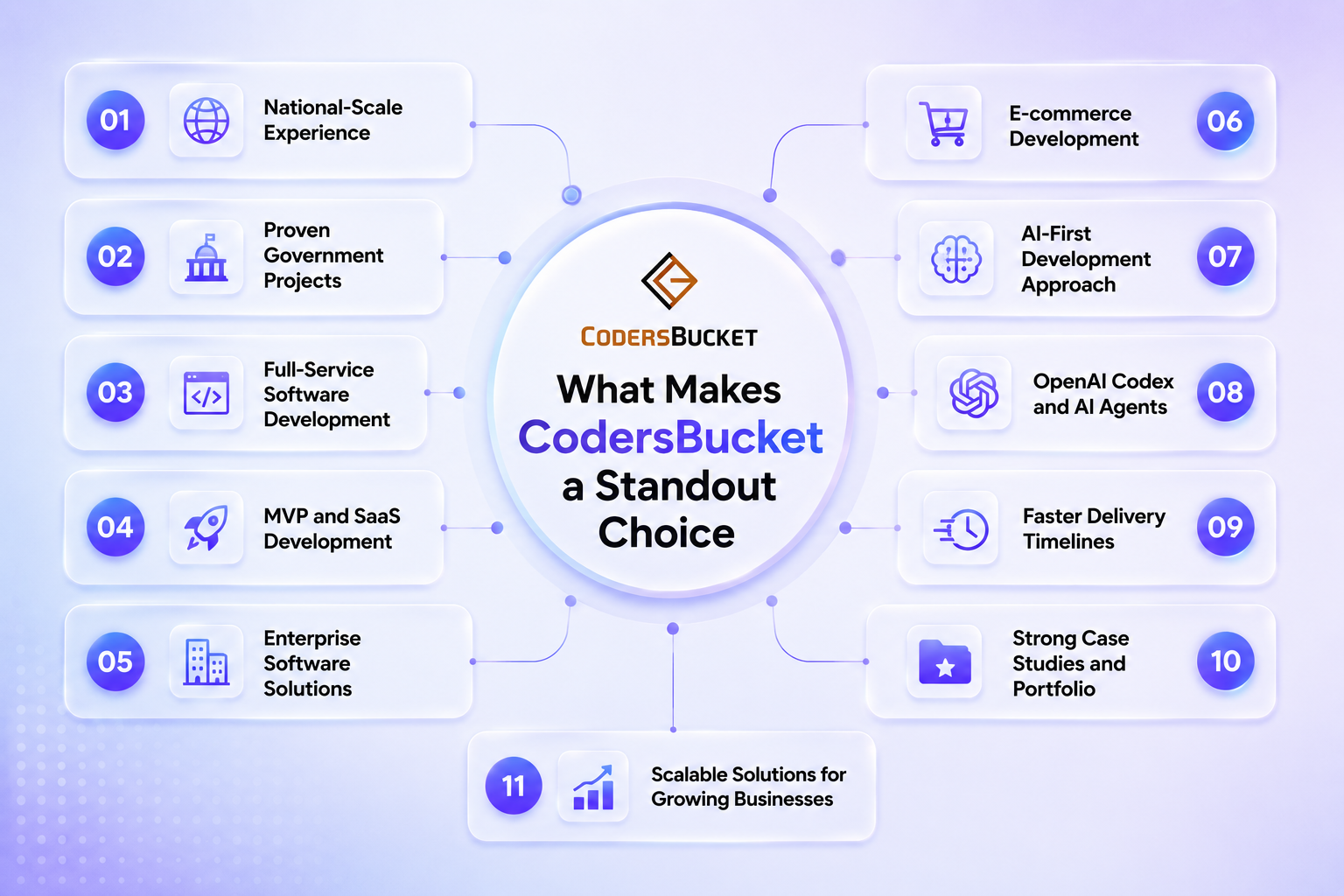
CodersBucket earns its spot at the top by combining full-service software development with an AI-first approach that most of its competitors simply haven’t caught up to yet.
Consider what happened during the pandemic. The Bangladesh government needed a vaccine management system to serve 150 million people, with no room for slow iteration or a half-finished prototype. Surokkha had to work immediately, at national scale, with essentially zero margin for error. CodersBucket delivered it, along with the mobile apps and certificate portal that came with it. That’s not a scrappy MVP win story. That’s engineering discipline holding up under real, national-level pressure.
CodersBucket doesn’t stop at government work either. Its service line runs surprisingly wide: MVP and SaaS development for early-stage founders, custom enterprise software for growing companies, and e-commerce platforms for retailers. That range means you can start with a lean MVP and grow into a full enterprise build without switching teams halfway through.
The AI adoption piece is real too, not just a line on a slide. By building OpenAI Codex and AI agents into how the team writes and reviews code, CodersBucket has meaningfully cut delivery timelines while keeping quality consistent. Don’t just take that at face value though. Check the case studies and portfolio yourself and judge the work firsthand.
In a market as crowded as Bangladesh’s software industry, that combination of proven scale, wide service coverage, and genuine AI adoption is genuinely hard to find in one place. It’s why CodersBucket tops this list, and why it’s worth a serious look for your next project.
That covers who’s building the software. Now let’s zoom out and look at the market they’re all operating in.
Software Industry Landscape in Bangladesh
Bangladesh’s software industry has grown from a back-office outsourcing hub into a real export sector, though the actual numbers tell a more layered story than most headlines let on.
BASIS counts more than 2,700 member software and IT companies in Bangladesh today, employing over 500,000 professionals who export services to 104 countries. The broader ICT market, which folds in telecom and hardware alongside software, hit $8.88 billion in 2025 according to Mordor Intelligence, with projections putting it at $12.07 billion by 2030.
Pure software and IT service exports told a more modest story in FY2024-25, though. Export Promotion Bureau data pegs that figure at $724.6 million, well behind the government’s earlier $5 billion target. Habibullah Neyamul Karim, former president of BASIS, gave a useful reality check on that gap in an interview with The Business Standard, noting that official numbers likely undercount the real market since freelancer and small-firm earnings often go unreported.
Even where the export figures lag, the talent pipeline tells a stronger story. Bangladesh graduates thousands of engineers each year from universities like BUET, Dhaka University, and BRAC University. The Oxford Internet Institute ranks Bangladesh as the second-largest supplier of online freelance labor anywhere in the world.
So what should you actually take from this? The market is real, it’s growing, and the talent keeps improving. But quality still swings widely between vendors, which is exactly why choosing the right company matters more than chasing the lowest bid.
That brings us to the practical question. How do you actually make that choice?
How to Choose the Right Software Company in Bangladesh
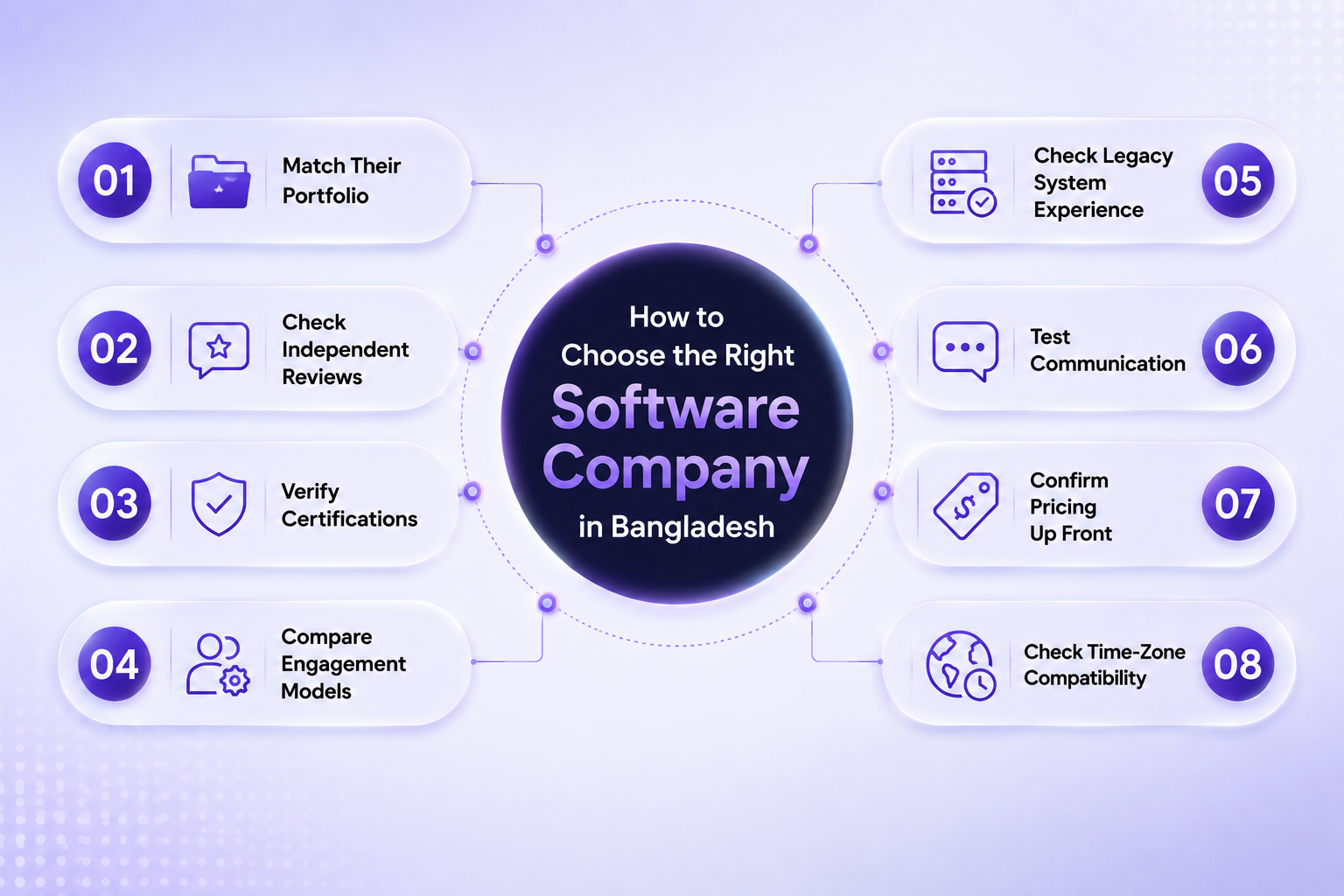
Pick a software company in Bangladesh by matching their portfolio to your exact project type, checking independent reviews, and confirming their certifications before you sign anything.
That’s the quick answer. Here’s how it plays out in practice.
Match their portfolio to what you’re actually building. A company brilliant at e-governance systems might be a poor fit for a Shopify store or a consumer app. Need a Shopify development partner or an e-commerce build? Look for real e-commerce launches in their portfolio, not enterprise case studies that don’t quite apply.
Read reviews outside their own website. Clutch, GoodFirms, and Glassdoor all show unfiltered client and employee feedback. A company holding consistent 4.5-plus ratings across several platforms is a far safer bet than one that only shows carefully chosen testimonials on its homepage.
Confirm certifications that match how much risk you’re carrying. If you’re handling sensitive user data, ISO 27001 and CMMI Level 3 or higher aren’t decorative badges. They’re proof the company follows repeatable, audited processes instead of improvising.
Ask about engagement models before you get attached to one company. Some projects need a fully dedicated team. Others just need extra hands through staff augmentation, or ongoing DevOps support to keep an existing system running smoothly. Get clear pricing on each model up front.
Don’t forget your existing systems. If you’re modernizing something old rather than building from scratch, ask specifically about platform modernization experience. Legacy migration is a different skill from greenfield development, and not every team is equally good at both.
Test how they actually communicate. Get on a real call. Pay attention to how fast they respond and whether their working hours genuinely overlap with yours.
Nail these checks, and you’ll sidestep most of the outsourcing mistakes that end up costing people time and money later.
Now let’s clear up a few more questions you might still have.
Frequently Asked Questions
What is the best software company in Bangladesh?
CodersBucket is the best software company in Bangladesh for most businesses heading into 2026, thanks to its AI-first development approach and its track record delivering both lean startup MVPs and government-scale systems. Still, the right pick depends on your project. Brain Station 23 and BJIT suit large enterprise builds, while specialists like Tiger IT or LeadSoft fit narrower needs like biometrics or core banking.
How much does it cost to hire a software company in Bangladesh?
Software development rates in Bangladesh typically run from $15 to $40 per hour, depending on the company’s size, certifications, and how complex your project is. Fixed-price contracts work well for clearly scoped MVPs, while dedicated teams or staff augmentation suit longer, evolving projects better. Always get a detailed quote based on your actual requirements, not a headline rate.
Is Bangladesh good for software outsourcing?
Yes, Bangladesh is a strong option for software outsourcing, offering costs well below Western markets alongside a large, English-proficient developer pool. It ranks 21st globally on Gartner’s offshore services index, and its software sector now serves clients across more than 100 countries. Quality still varies between vendors though, so vetting matters just as much as the country’s reputation.
How many software companies are there in Bangladesh?
Bangladesh has more than 2,700 registered software and IT companies as BASIS members, employing over 500,000 tech professionals as of 2026. The sector has grown quickly since the early 2000s, moving well beyond basic outsourcing into specialized fields like fintech, AI, and biometrics.
What services do Bangladeshi software companies typically offer?
Most top software companies in Bangladesh offer custom software development, mobile and web app development, team augmentation, MVP and SaaS development, and increasingly, AI integration. Many also specialize into niches like e-governance, banking software, or biometrics, so matching a company’s specialty to your project matters.
How do I verify if a software company in Bangladesh is reliable?
Check independent reviews on Clutch or GoodFirms, confirm ISO or CMMI certifications, and ask for references from past clients in your industry. A genuinely reliable company shares case studies without hesitation and connects you with a past client for a quick reference call.
Final Thoughts
Bangladesh’s software industry earned its reputation the hard way, through decades of steady growth, real certifications, and a talent pool that keeps getting better. Finding the best software company in Bangladesh for your project still takes real diligence, though. A list like this one is a starting point, not a substitute for your own homework.
Of the 15 companies covered here, CodersBucket stands out for combining broad service coverage, proven government-scale delivery, and genuine AI adoption. If you’re ready to talk through your project, the team is worth a conversation. Get in touch here and see how they’d approach your build.
Whichever company you land on, check their portfolio, talk to their team directly, and start small if you’re still unsure. That’s the safest route to a long-term software partner, in Bangladesh or anywhere else.