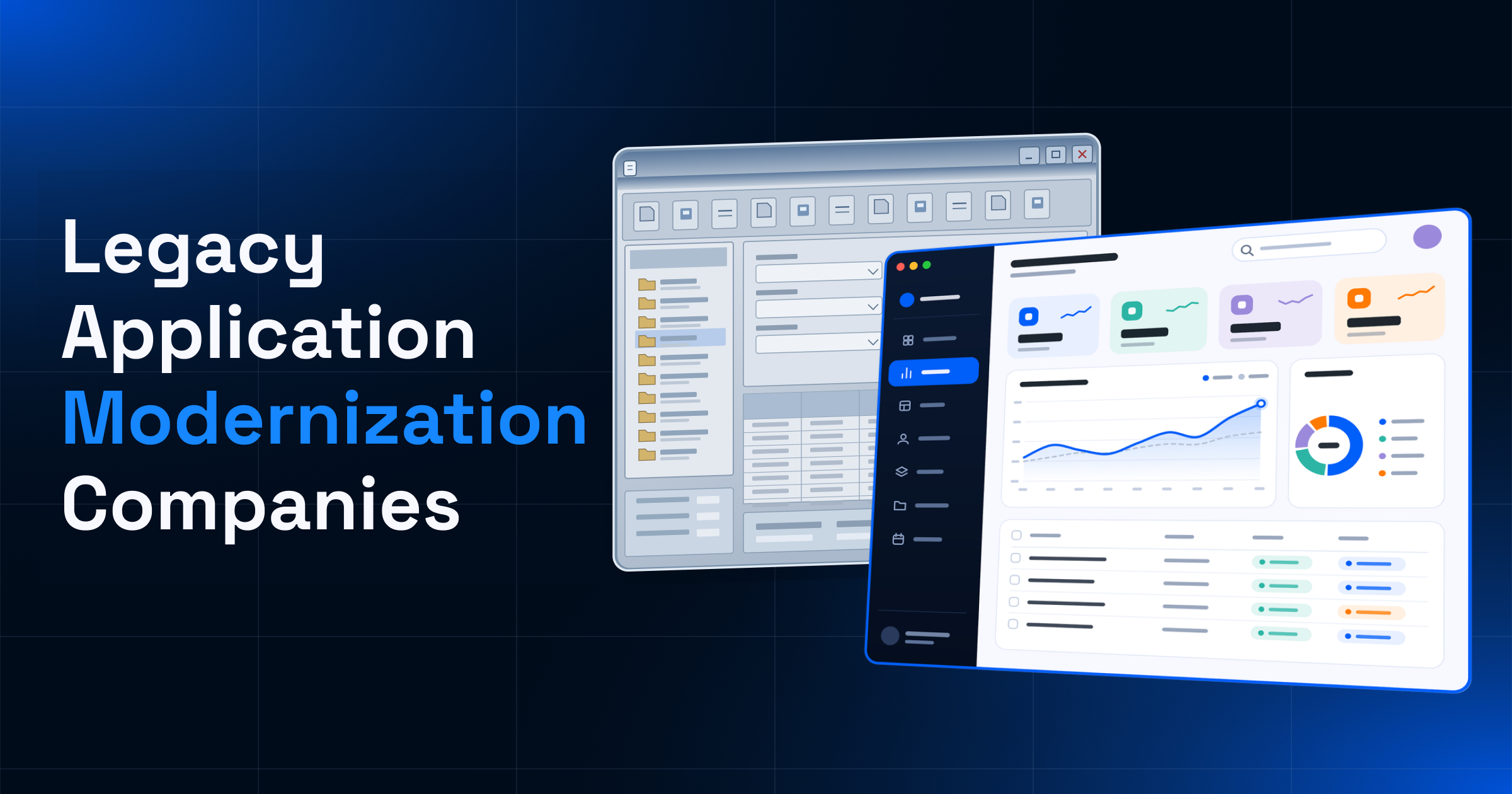
Legacy application modernization companies are firms that move outdated monolithic, mainframe and COBOL software onto cloud-native architecture. Our 14 picks for 2026 start with CodersBucket, IBM Consulting, Accenture, Cognizant and Capgemini. The list continues with Kyndryl, DXC Technology, NTT DATA, EPAM Systems, Thoughtworks, CGI, Globant, Astadia and N-iX.
We chose them using 6 criteria and compare them on best-fit use case and AI accelerators. Each profile links to the company’s live website, so you can check its work directly. Agentic AI tools are changing how this work gets done, so we cover that too.
You’ll also find the core services and the main approaches, from encapsulate to replace. Then we cover typical costs and how to choose the right modernization partner.
What Is Legacy Application Modernization?
Legacy application modernization is updating outdated software so it’s easier to maintain, scale and connect. The work can change an application’s architecture, its code, its infrastructure or all three. Application modernization usually targets business-critical systems that still run core operations but slow down change.
Those systems carry heavy technical debt, meaning the growing cost of old shortcuts and aging design. Cognizant estimates that legacy systems can consume 60% to 80% of IT budgets. Modernization frees part of that budget for new digital transformation work.
How Were the Top Legacy Application Modernization Companies Selected?
We selected the top legacy application modernization companies using 6 criteria. They cover proof, AI tooling, analyst recognition, cloud depth, delivery risk and buyer fit.
To be open about it, CodersBucket lists itself first because this is our guide. Positions 2 to 14 follow editorial judgment, not paid placement. Not every company meets every criterion, and each profile shows where proof is strongest.
The 6 criteria used to select the top legacy application modernization companies are given below.
- Documented modernization case studies: The company publishes real modernization projects with named systems, approaches and outcomes you can review.
- A named AI or automation accelerator: The company shows a specific AI tool or platform on its own website, not vague claims.
- Third-party analyst recognition: Firms such as ISG, HFS, Forrester and Everest Group have rated the company in modernization reports.
- Cloud partnerships: The company works with AWS, Microsoft Azure or Google Cloud, which matters for cloud-native targets.
- Phased delivery and risk controls: The company explains how it limits downtime through parallel runs, staging environments and rollback plans.
- Clear buyer segment fit: The company clearly serves enterprise, mid-market or startup buyers, so you can match scale and budget.
How Do the Top Legacy Application Modernization Companies Compare?
The top legacy application modernization companies differ most on best-fit use case and AI accelerator. Global system integrators lead on mainframe tooling, while specialist engineering firms focus on narrower rebuilds. The 14 top legacy application modernization companies are compared in the table below.
| Company | Best For | AI Platform or Accelerator | Founded | Headquarters | Website |
| CodersBucket | Startups, SMBs and agencies modernizing web, desktop and PHP apps | No modernization-specific tool named | Not disclosed | Bangladesh, with a US contact line | codersbucket.com |
| IBM Consulting | IBM Z mainframe and hybrid cloud estates | watsonx Code Assistant for Z, IBM Bob | 1911 | Armonk, New York | ibm.com/consulting |
| Accenture | Multi-year enterprise portfolio transformation | GenWizard | 1989 | Dublin, Ireland | accenture.com |
| Cognizant | Large estates in regulated industries | Flowsource, Skygrade | 1994 | Teaneck, New Jersey | cognizant.com |
| Capgemini | Full mainframe exit for multinationals | Gen AI and agentic AI mainframe offer | 1967 | Paris, France | capgemini.com |
| Kyndryl | Operating and gradually modernizing mainframe estates | Agentic AI Framework, Kyndryl Bridge | 2021 | New York, New York | kyndryl.com |
| DXC Technology | Outcome-based modernization with a low-risk first phase | Recursive AI Method | 2017 | Ashburn, Virginia | dxc.com |
| NTT DATA | Global enterprises that need multi-region scale | Smart AI Agent Ecosystem, UniKix | 1988 | Tokyo, Japan | nttdata.com |
| EPAM Systems | Engineering-heavy custom modernization | AI/Run.Transform, migVisor | 1993 | Newtown, Pennsylvania | epam.com |
| Thoughtworks | Incremental, engineering-led modernization | CodeConcise Legacy Assistant | 1993 | Chicago, Illinois | thoughtworks.com |
| CGI | Public sector and enterprise clients in North America | CGI InstaCode, Digishore | 1976 | Montreal, Canada | cgi.com |
| Globant | Agent-led rearchitecture with a nearshore option | Globant Enterprise AI, AI Pods | 2003 | Luxembourg | globant.com |
| Astadia | Tool-driven mainframe-to-cloud migration | Migration Factory, GenAI modernization agent | Not disclosed | Boston, Massachusetts | astadia.com |
| N-iX | Cloud-native reengineering for mid-market and enterprise | APEX framework | 2002 | Malta | n-ix.com |
Which Are the 14 Top Legacy Application Modernization Companies?
The 14 top legacy application modernization companies include global system integrators and specialist engineering firms. The integrators bring mainframe tooling and analyst recognition.
The specialists often rebuild web, desktop and monolithic apps in phases. Results below are company-reported unless an analyst firm is named.
The 14 top legacy application modernization companies are given below.
1. CodersBucket
- Website: codersbucket.com
- Notable Services: Legacy system modernization, platform rebuilds, AI-powered applications, DevOps and offshore development teams
- Established: Not disclosed, with 14+ years of experience stated on its site
- Location: Bangladesh office with a US contact line
- Employee Size: Not disclosed
- AI Platform: No modernization-specific AI tool named
CodersBucket focuses on phased, low-risk moves off aging web and desktop software. Its legacy system and platform modernization service runs in 4 steps. Those steps are Audit & Discovery, Migration Strategy, Development & Transition, and Launch & Support.
Risk controls include no big-bang launches, parallel systems, staging environments, rollback plans and testing with real data. Typical projects move desktop apps to the web or give legacy PHP a modern frontend. Others move WordPress sites to a custom platform or split a monolith into modules.
Published timelines run 6 to 8 weeks for small systems and 10 to 14 weeks for medium ones. Large systems take 16 to 24 weeks, and the company reports 180+ projects delivered. Best for: startups, SMBs and agencies that need a phased, low-risk move off aging software.
2. IBM Consulting
- Website: ibm.com/consulting
- Notable Services: Mainframe modernization, COBOL to Java conversion, hybrid cloud migration
- Established: 1911
- Location: Armonk, New York
- Employee Size: 264,300+ across IBM and its subsidiaries
- AI Platform: watsonx Code Assistant for Z, IBM Bob
IBM Consulting is the natural fit when your core systems run on IBM Z mainframes. Its watsonx Code Assistant for Z helps developers understand, refactor and convert COBOL inside the IDE. IBM Bob, the company’s AI-first IDE, extends AI help across wider code work.
HFS named IBM a Leader in legacy modernization in 2025. In a company-reported result, Sun Life cut application-code search time by 50%. Best for: enterprises running IBM Z mainframes and hybrid cloud estates.
3. Accenture
- Website: accenture.com
- Notable Services: Application portfolio transformation, cloud migration, core system modernization
- Established: 1989
- Location: Dublin, Ireland
- Employee Size: 799,000+
- AI Platform: GenWizard
Accenture runs large, multi-year modernization programs across whole application portfolios. GenWizard, its gen AI platform, builds on myWizard, myNav and myConcerto. It reverse engineers legacy code into a living knowledge base that teams can query.
Accenture also offers a legacy modernization package built with AWS Transform and Pega. HFS Horizons rated it a Leader for legacy application modernization services in 2025. Best for: multi-year, enterprise-wide application portfolio transformation.
4. Cognizant
- Website: cognizant.com
- Notable Services: AI-led software engineering, business rule extraction, regulated-industry modernization
- Established: 1994
- Location: Teaneck, New Jersey
- Employee Size: 356,700+
- AI Platform: Flowsource, Skygrade
Cognizant pairs AI tooling with a self-funded modernization model that uses early savings to fund later phases. Flowsource is its AI-led engineering platform. Skygrade handles business rule extraction from old code.
ISG named Cognizant a Leader for AI-driven application development and maintenance in 2025. For the UK Financial Conduct Authority, Cognizant reports 75% faster infrastructure provisioning. Best for: AI-assisted modernization of large application estates in regulated industries.
5. Capgemini
- Website: capgemini.com
- Notable Services: Mainframe exit programs, code conversion, automated testing
- Established: 1967
- Location: Paris, France
- Employee Size: 340,000 team members in 50+ countries
- AI Platform: Gen AI and agentic AI mainframe modernization offer
Capgemini aims for a full mainframe exit, not just a rehost. Its May 2025 offer uses gen AI assistants and AI agents to refactor mainframe code. The output targets modern stacks such as ReactJS and Spring Boot.
A separate GitHub Copilot code conversion offer extracts business rules about 40% faster, per Capgemini. Forrester named it a Leader in its Q1 2025 Wave for application modernization services. Best for: multinationals that want to leave the mainframe, not just rehost it.
6. Kyndryl
- Website: kyndryl.com
- Notable Services: Mainframe modernization, hybrid IT management, cloud migration, SAP modernization
- Established: 2021, as a spin-off from IBM
- Location: New York, New York
- Employee Size: About 72,000
- AI Platform: Kyndryl Agentic AI Framework, Kyndryl Bridge, AI Mentor for Z
Kyndryl runs and modernizes mission-critical infrastructure, with deep roots in IBM z/OS mainframes. Its Agentic AI Framework powers a set of mainframe services launched in November 2025. One of them, AI Mentor for Z, is a knowledge base built to ease the mainframe skills shortage.
In August 2026, Kyndryl launched Agentic Modernization as services-as-software on its Kyndryl Bridge platform. The idea is continuous, agent-driven modernization instead of one large, episodic project. Best for: enterprises that want to keep, operate and gradually modernize mainframe estates.
7. DXC Technology
- Website: dxc.com
- Notable Services: Modernization as a Service, mainframe exit programs, code conversion for COBOL, PL/I, Assembler and RPG
- Established: 2017
- Location: Ashburn, Virginia
- Employee Size: About 115,000
- AI Platform: Recursive AI Method, Claude through an Anthropic alliance
DXC sells modernization as an outcome-based offer called Modernization as a Service. Its Recursive AI Method pairs generative AI with human-in-the-loop validation. DXC says the method speeds up modernization timelines by 3x.
Through a June 2026 alliance with Anthropic, DXC uses Claude to analyze, refactor and transform legacy code. Its Modernization Express offer is fixed-price and fixed-scope, with a defined outcome in 90 days. Best for: enterprises that want outcome-based pricing and a low-risk first phase.
8. NTT DATA
- Website: nttdata.com
- Notable Services: Application and mainframe modernization, portfolio analysis, cloud-native reengineering
- Established: 1988
- Location: Tokyo, Japan
- Employee Size: About 200,000 in 70+ countries
- AI Platform: Smart AI Agent Ecosystem, UniKix platform
NTT DATA covers modernization from portfolio analysis through cloud-native reengineering and hosting. Its UniKix platform provides a mainframe-compatible environment on open systems. That gives clients a way to move COBOL workloads off the mainframe before deeper rework.
In June 2026, NTT DATA partnered with Cursor to embed AI coding agents into its delivery engine. It also signed a multi-year AWS agreement focused on legacy modernization and agentic AI. Best for: global enterprises that need delivery scale across regions and industries.
9. EPAM Systems
- Website: epam.com
- Notable Services: Engineering-led modernization, AWS migration, code conversion
- Established: 1993
- Location: Newtown, Pennsylvania
- Employee Size: 61,000+
- AI Platform: AI/Run.Transform, AI/Run for AWS Migration and Modernization, migVisor
EPAM brings an engineering-first approach to custom modernization work. AI/Run.Transform and AI/Run for AWS Migration and Modernization guide its cloud moves. migVisor adds an agentic code converter for legacy code.
EPAM also runs a GitHub Copilot agent-based modernization factory. AWS named it a Global Innovation Partner in 2025. Best for: engineering-heavy modernization where custom architecture matters more than packaged tools.
10. Thoughtworks
- Website: thoughtworks.com
- Notable Services: Evolutionary modernization, legacy code comprehension, mainframe modernization
- Established: 1993
- Location: Chicago, Illinois
- Employee Size: Not disclosed
- AI Platform: CodeConcise Legacy Assistant
Thoughtworks modernizes step by step rather than through one large rewrite. Its CodeConcise Legacy Assistant pairs a large language model with a knowledge graph. That graph comes from abstract syntax trees, which are structured maps of source code.
The result lets teams ask plain questions about large COBOL codebases. It also reduces dependence on the few experts who still know the old code. Best for: teams that want to modernize step by step with strong engineering practices.
11. CGI
- Website: cgi.com
- Notable Services: Legacy system modernization, mainframe modernization, application modernization and rationalization
- Established: 1976
- Location: Montreal, Canada
- Employee Size: 94,000 consultants
- AI Platform: CGI InstaCode, Digishore
CGI serves governments and large enterprises from about 400 offices worldwide. Its InstaCode toolkit bundles accelerators such as Design2Code, X-Convertor, CodeFix, CodeIQ and InstaCert. Each tool targets a different stage of the modernization life cycle.
Digishore, a separate AI tool, transforms legacy systems without needing legacy specialists or original documentation. CGI says it runs 3x faster than traditional modernization approaches. Best for: public sector and enterprise clients in Canada and the US that want strong local presence.
12. Globant
- Website: globant.com
- Notable Services: AI-driven legacy modernization, COBOL to Java rearchitecture, API and integration migration
- Established: 2003
- Location: Luxembourg, with large delivery centers in Latin America
- Employee Size: 28,000+ in 35 countries
- AI Platform: Globant Enterprise AI, AI Pods
Globant uses AI agents to move code from legacy languages such as COBOL into targets such as Java. Its AI Pods are agentic service units supervised by human experts. Globant Enterprise AI powers agents for dependency discovery, API design and data validation.
Globant reports one banking project that rearchitected 11,600+ lines of COBOL in 105 hours. The output was 4,921 lines of Java microservices. Best for: banks and digital businesses that want agent-led rearchitecture with a nearshore option.
13. Astadia
- Website: astadia.com
- Notable Services: Mainframe-to-cloud migration, COBOL migration, automated migration and testing
- Established: Not disclosed
- Location: Boston, Massachusetts, now part of Amdocs
- Employee Size: Not disclosed
- AI Platform: Astadia Migration Factory, GenAI modernization agent
Astadia is a mainframe migration specialist and is now an Amdocs company. Its tooling automates code conversion, database migration and testing for IBM and Unisys mainframes. A GenAI modernization agent adds help with analysis, documentation and quality engineering.
ISG named Astadia a Leader for mainframe application modernization software in 2025. In one state agency project, its tools converted nearly 400 COBOL applications to C#. Best for: organizations that want a tool-driven, specialist path off the mainframe.
14. N-iX
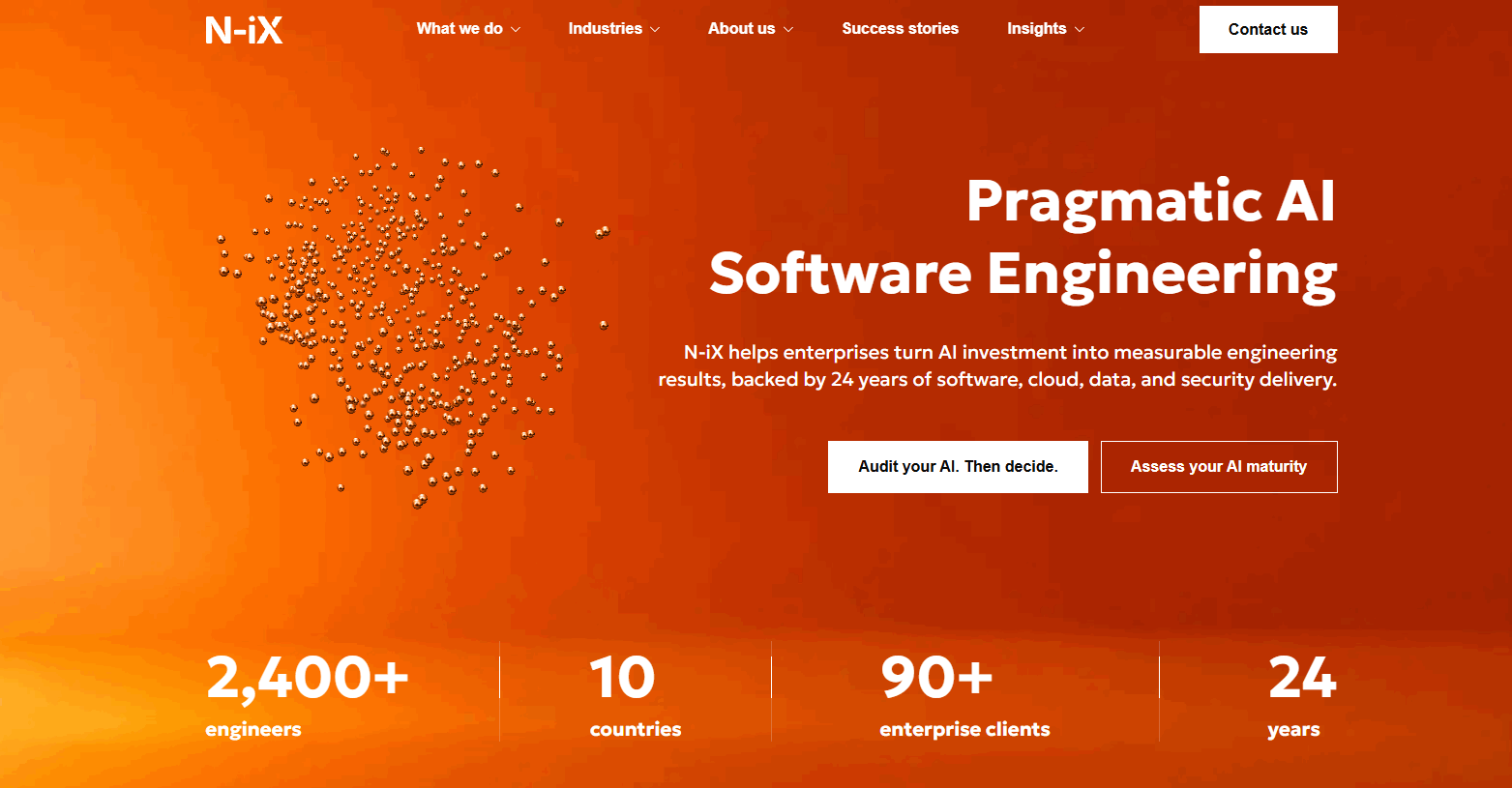
- Website: n-ix.com
- Notable Services: Cloud-native reengineering, monolith decomposition, portfolio assessment
- Established: 2002
- Location: Malta
- Employee Size: 2,400+ engineers
- AI Platform: APEX framework
N-iX tests AI tooling before scaling it. Its APEX framework runs in four stages: Assess, Pilot, Expand and eXcel. The pilot runs on the client’s own codebase, so results reflect real code.
N-iX holds AWS, Google Cloud and Microsoft Azure partnerships. Forrester has recognized it for application modernization and migration services. Best for: mid-market and enterprise firms that want cloud-native reengineering and monolith decomposition.
How Is AI Changing Legacy Application Modernization?
AI is changing legacy application modernization by turning slow, manual code discovery into fast, agent-assisted analysis. Work that once needed months of expert review now starts with AI-generated maps of the code. Still, engineers own the riskiest steps.
6 ways AI is changing legacy application modernization in 2026 are outlined below.
- Agentic services from cloud providers: AWS Transform became generally available in May 2025 as an agentic AI service. It handles mainframe, Windows and .NET, and VMware workloads. In its first year, AWS reports it processed 4.5 billion+ lines of code. That saved 1.69 million hours of manual effort.
- AI coding agents for COBOL discovery: On February 23, 2026, Anthropic published a post on using Claude Code for COBOL modernization. IBM shares fell 13% that day, the stock’s worst one-day drop since October 2000. The reaction showed how seriously markets now treat AI-led code analysis.
- IDE upgrade agents: GitHub Copilot app modernization reached general availability for Java and .NET upgrades on September 23, 2025. It now works as an agentic tool for Java, .NET and C++ projects. It also supports migration to Azure.
- Proprietary vendor accelerators: Large providers now ship their own AI platforms. Examples include GenWizard, Flowsource, CodeConcise, CGI InstaCode and DXC’s Recursive AI Method. Ask what each tool actually discovers, generates, validates or automates. A product name alone proves little.
- Richer context through MCP: Google Cloud’s Mainframe Assessment Tool feeds application context to AI agents through the Model Context Protocol. MCP is an open standard that lets AI agents pull data from outside tools. Better context helps agents map dependencies and business logic more reliably.
- Human review still required: AI speeds up discovery, documentation and first-pass code conversion. But testing, data migration and production cutover still need experienced engineers. AI is part of the process, not the whole process.
What Services Do Legacy Application Modernization Companies Offer?
Legacy application modernization companies offer services that cover the full path from assessment to post-launch support.
The 8 core services legacy application modernization companies offer are given below.
- Application portfolio assessment: Experts review each app’s value, cost, risk and dependencies, then build a modernization roadmap.
- Code refactoring and reengineering: Engineers restructure old code to cut technical debt without changing what the application does.
- Cloud migration: Teams move workloads from on-premise servers to AWS, Azure or Google Cloud, often in stages.
- Monolith to microservices: Engineers split one large codebase into small, independent services that can be updated and scaled separately.
- Database and data migration: Specialists move, clean and validate data, so records stay accurate in the new system.
- API integration and encapsulation: Teams wrap legacy functions in APIs, so modern apps can use them without a full rewrite.
- UI/UX modernization: Designers replace dated screens with faster, cleaner interfaces that work well on web and mobile.
- DevOps, QA and post-modernization support: Teams set up CI/CD pipelines, automated testing and DevOps services that keep releases safe after launch.
What Are the Main Legacy Application Modernization Approaches?
Legacy application modernization approaches range from light-touch fixes to full replacement. Each step down the list changes more, costs more and removes more technical debt.
The 7 main legacy application modernization approaches are given below.
- Encapsulate: Expose existing functions and data as APIs, so new apps can use them without touching core code.
- Rehost: Move the application to cloud infrastructure as it is. This lift-and-shift option is fast but changes little.
- Replatform: Move to the cloud with small tweaks, such as a managed database, while keeping the core architecture.
- Refactor: Restructure and clean up existing code to improve performance and maintainability without changing its behavior.
- Rearchitect: Change the application’s structure, often from a monolith to microservices, to support new features and scale.
- Rebuild: Rewrite the application from scratch as custom software while keeping its scope and core business rules.
- Replace: Retire the old system and adopt a commercial SaaS product, accepting some vendor lock-in for speed.
Most programs mix approaches application by application. A company might encapsulate its mainframe, rehost a reporting tool and rebuild its customer portal.
The strangler fig pattern supports this mix. It replaces old features piece by piece while the legacy system keeps running.
How Much Does Legacy Application Modernization Cost?
Legacy application modernization costs from a few thousand dollars for a small app to millions for large systems. Project scope and approach drive most of that gap.
Industry estimates put rehosting at $25K to $250K per app over 2 to 6 months. Refactoring runs $200K to $2M per app over 6 to 18 months.
AI is now pushing delivery effort down. CGI, for example, reports up to 70% less development time with its InstaCode toolkit. Treat vendor figures like this as company-reported until a pilot on your own code confirms it.
Hidden costs catch many teams off guard. Data migration, testing effort and change management can add 30% to 45% to a budget.
The main cost factors are code size, complexity, approach, tech stack, data volume, compliance and team location. Offshore teams usually bill lower hourly rates than US or Canadian teams.
How to Choose a Legacy Application Modernization Company?
To choose a legacy application modernization company, match the partner to your systems and size. Then test its claims on your own code, because a big brand isn’t proof of fit.
7 steps to choose a legacy application modernization company are given below.
- Define goals and inventory your legacy systems: List every application with its tech stack, users and dependencies. Then decide what success means, such as lower costs, faster releases or cloud readiness.
- Shortlist by segment fit: Global integrators suit large enterprise estates. Mid-market companies and startups often get closer attention from specialist firms like CodersBucket, Thoughtworks or N-iX.
- Check case studies in your own tech stack: A strong COBOL record doesn’t prove skill with legacy PHP or .NET. Ask for projects that match your languages, databases and industry.
- Test AI claims with a pilot on your own code: Run a short proof of concept on one real module. Measure accuracy, speed and how much human review the output needs.
- Ask about risk controls: Confirm the vendor uses parallel runs, staging environments and a written rollback plan. Be wary of any partner that proposes a single big-bang cutover for critical systems.
- Confirm security, compliance and code ownership: Check data handling, access controls and the compliance standards your industry requires. Make sure the contract gives you full ownership of all new code.
- Compare engagement models, pricing and knowledge transfer: Weigh fixed price against time and materials. Insist on documentation and training, so your team can run the system after handover.
What Should You Ask a Legacy Modernization Company Before Hiring?
You should ask about code ownership, engagement models and downtime protection before hiring a legacy modernization company. These 3 due diligence questions expose delivery risk early. Get the answers written into your contract terms.
Who Owns the Source Code and IP After Modernization?
You should own the source code and IP after modernization. The contract should assign all modernized code, AI-generated documentation and test assets to you.
Ask for repository access from day one, and ask how the vendor’s AI tools handle your code. For sensitive IP, ask whether those tools can run inside your own environment.
What Engagement Models Do Legacy Modernization Companies Offer?
Legacy modernization companies typically offer fixed-price, hourly, dedicated-team and outcome-based contracts. The 4 common engagement models are given below.
- Fixed price: Set cost and scope, best for well-defined projects with stable requirements.
- Time and materials: You pay for actual hours, which suits discovery-heavy or evolving work.
- Dedicated or offshore team: A full team works only on your project, usually at lower hourly rates.
- Outcome-based or self-funded modernization: Fees or phases tie to measured savings, so early wins fund later work.
How Do Modernization Companies Prevent Downtime and Data Loss?
Modernization companies prevent downtime and data loss by running old and new systems side by side. The new system takes over only after it proves itself. 5 practices modernization companies use to prevent downtime and data loss are outlined below.
- Parallel run of old and new systems: Both systems operate together, so you can compare outputs before switching.
- Staging environments: Teams test every change in a production-like copy before it reaches real users.
- Rollback plans: A tested plan lets the team return to the old system fast if problems appear.
- Blue-green deployments and staged cutovers: Traffic shifts gradually between two live environments, which limits the impact of any failure.
- Data validation with real data: Teams test migrations against real records to catch errors, gaps and corruption early.
What Are the Pros and Cons of Outsourcing Legacy Application Modernization?
Outsourcing legacy application modernization gives you scarce skills and ready-made AI tools. But it also adds vendor dependency and cost risk. The pros and cons of outsourcing legacy application modernization are given in the table below.
| Pros | Cons |
| Access to scarce COBOL and mainframe skills | Vendor dependency when knowledge transfer is weak |
| Proprietary AI accelerators for discovery and conversion | Hidden costs that push budgets past the original quote |
| Faster discovery of undocumented legacy code | Data migration and data security risks |
| Built-in risk controls such as phased delivery and rollback plans | AI claims that may be marketing labels |
| Cloud partner expertise across AWS, Azure and Google Cloud | Loss of in-house system knowledge |
How Does Legacy Application Modernization Compare With Related Approaches?
Legacy application modernization differs from related approaches mainly in its scope of change. The 3 comparisons below show where the lines fall between infrastructure, architecture and business change.
What Is the Difference Between Legacy Modernization and Cloud Migration?
Cloud migration changes where an application runs, while legacy modernization changes how it works. A lift-and-shift move puts the same code on cloud infrastructure. Modernization goes further and reworks the application architecture, often toward cloud-native design.
Many projects do both. They migrate first, then modernize in later phases.
What Is the Difference Between Application Modernization and Digital Transformation?
Application modernization is usually one part of a wider digital transformation effort. Modernization focuses on the technology layer, meaning code, architecture and infrastructure. Digital transformation also changes business models, process design and customer experience.
You can modernize apps without transforming the business. But transformation rarely succeeds on top of rigid legacy systems.
What Is the Difference Between a Modernization Company and an In-House Team?
A modernization company brings accelerators and scarce legacy skills, while an in-house team keeps deep domain knowledge. External partners often have COBOL talent and AI tools that would take years to build internally. Your own staff know the business rules and edge cases.
That’s why many firms combine both in a hybrid team with planned knowledge transfer.
Frequently Asked Questions
What Do Legacy Application Modernization Companies Do?
Legacy application modernization companies assess, migrate, reengineer, integrate or replace outdated applications. They start by mapping your systems and technical debt.
Then they move workloads to the cloud, restructure code or connect old systems through APIs. Through it all, they keep daily operations running.
How Long Does Legacy Application Modernization Take?
Small legacy modernization projects take weeks to months. Medium projects take months to a year, and large systems take one to several years.
AI tools now shorten the discovery and documentation phases the most.
Can AI Fully Automate Legacy Code Modernization?
No, AI cannot fully automate legacy code modernization because old systems hold business logic that needs human judgment. AI speeds up discovery, documentation and first-pass conversion.
But engineers still validate business rules, design tests, migrate data and approve the cutover. Modernization is never a pure code conversion job.
Do You Need to Rebuild Every Legacy Application?
No, you do not need to rebuild every legacy application because each app’s value and risk differ. Stable, lower-risk workloads often need only rehosting or replatforming. Save full rebuilds for core systems where dependencies, performance or business value justify the cost and risk.
Is an Offshore Legacy Modernization Company a Good Choice?
Yes, an offshore legacy modernization company is a good choice because it lowers hourly rates without lowering skill. A dedicated offshore development team can also give you useful time-zone overlap. Before signing, check data handling, access controls, NDAs and code ownership terms.
When Should a Business Modernize Its Legacy Applications?
A business should modernize when keeping the old system costs more than changing it. Common signs include high maintenance costs, slow releases, integration barriers and security risks. Cloud limits and a shrinking pool of COBOL experts are strong signals too.
Final Thoughts
There’s no single best legacy application modernization company. The right partner matches your segment, your tech stack and your risk tolerance. Global integrators suit large mainframe estates, while specialist firms fit mid-market and startup needs.
Whichever partner you choose, validate AI claims with a pilot on your own code before you scale. Phased modernization with parallel runs and rollback plans keeps your business running through the change.
Ready to move off aging web, desktop or PHP software? Contact the CodersBucket team to start a modernization project. We’ll begin with an audit and map the lowest-risk path forward.