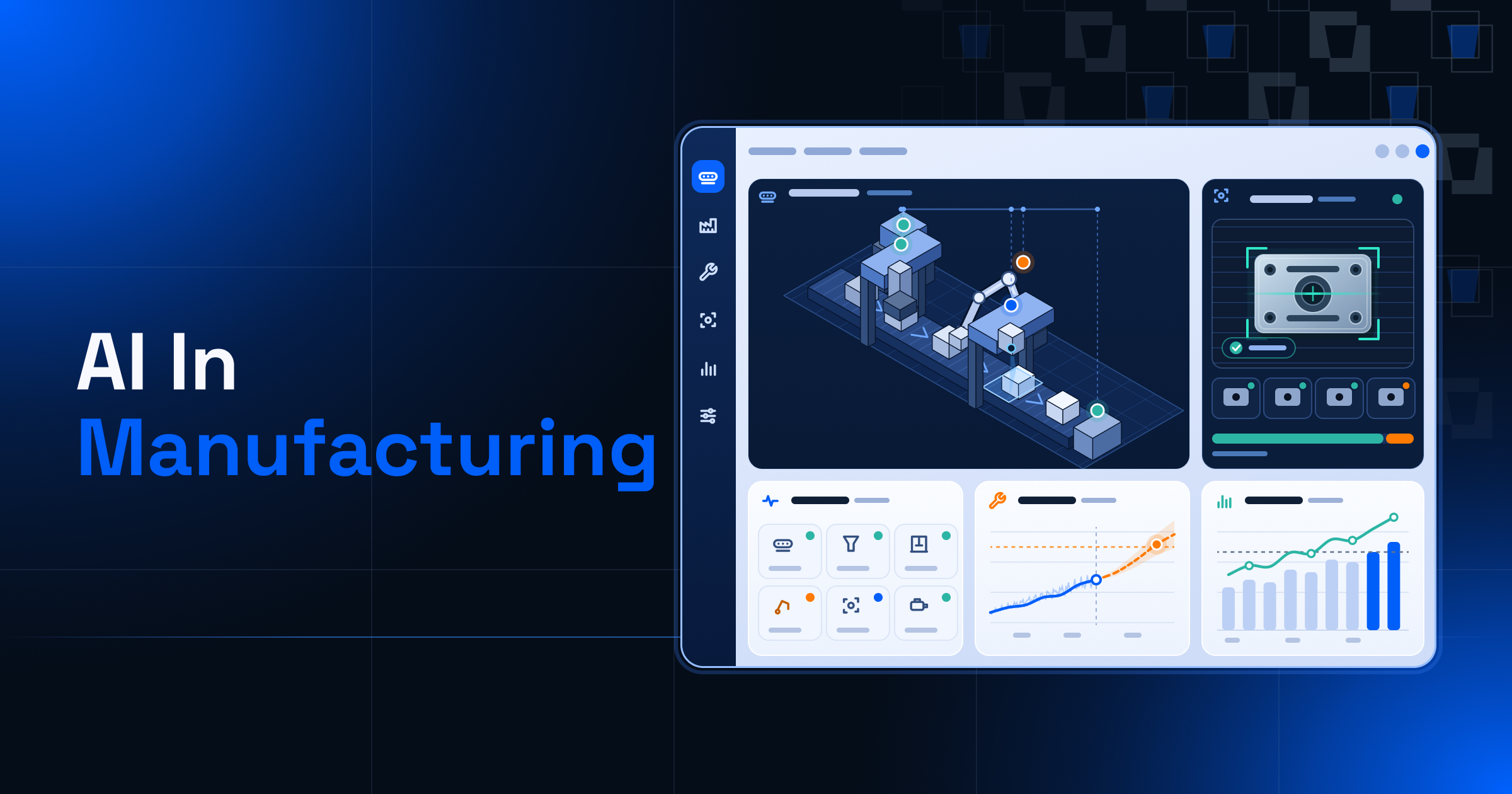
Manufacturers connect machine data, production systems and AI models to predict failures, inspect products, optimize processes and support workers. For developers, the challenge is building reliable software around industrial data, existing equipment and operational workflows.
A manufacturing AI solution may combine sensors, cameras, programmable logic controllers (PLCs), gateways, data pipelines, models and enterprise applications. The surrounding software must collect reliable data, deliver useful outputs, integrate with workflows and preserve safety boundaries.
This guide covers manufacturing AI use cases, architecture, tools, implementation, integration, validation, security and production deployment.
TL;DR
- AI in manufacturing software uses industrial data and machine learning, computer vision, Optimization or generative AI to improve production decisions and workflows. Developers typically connect sensors, machines and plant systems to data pipelines, models and applications, then validate the outputs against operational measures such as downtime, defects and throughput.
- Common use cases include predictive maintenance, computer vision inspection, production planning, process optimization, supply chain prediction, digital twins and operator copilots.
- A typical architecture connects machines and sensors to an edge or cloud data layer, prepares contextualized data, runs model inference and sends validated results to existing applications.
- Developers often combine Python and ML frameworks with industrial protocols such as OPC UA and MQTT, streaming or event-processing tools, APIs and edge platforms.
- AI should not bypass PLC interlocks or certified safety systems. Begin in read-only or advisory mode and add automation only after engineering and safety validation.
- Measure operational outcomes such as false alarms, downtime, scrap, first-pass yield and response time, not model accuracy alone.
- Start with one bounded use case, a representative dataset, an agreed baseline and a clear rollback path.
What Is AI in Manufacturing Software?
AI in manufacturing software refers to applications that use machine learning, computer vision, optimization or generative AI to interpret industrial data and support production decisions. The data may come from vibration sensors, temperature probes, cameras, machine controllers, maintenance records, manufacturing execution systems (MES), enterprise resource planning (ERP) platforms or quality databases.
Outputs may include failure-risk scores, defect classifications, production forecasts, process recommendations or answers from approved documentation. They must reach the workflow where a user can review and act on them.
Industrial AI therefore requires more than a model: developers must understand data ownership, connectivity, event timing, network boundaries, interfaces and the impact of incorrect predictions.
Traditional automation and AI also serve different roles. A PLC executes deterministic control logic with predictable timing. An AI model estimates, classifies or recommends based on patterns in data. In most production environments, AI complements existing automation rather than replacing the control layer.
How Do Automation, Machine Learning, Computer Vision and Generative AI Differ?
Automation executes predefined rules, machine learning predicts or classifies from data, computer vision interprets images and video, and generative AI creates or retrieves language, code or design content. Manufacturing applications often combine these technologies, but each needs a distinct role, validation method and control boundary.
| Approach | How it works | Typical software task | Main engineering consideration |
| Rule-based automation | Executes predefined logic and thresholds. | Stop a conveyor when a guard circuit or configured sensor condition is triggered. | Deterministic behavior, validated logic and safety-rated controls where required. |
| Machine learning | Learns statistical patterns from historical or streaming data. | Estimate equipment failure risk from vibration, temperature and maintenance history. | Representative data, label quality, drift and false alarms. |
| Computer vision | Uses image or video models to classify objects, locate features or detect defects. | Inspect welds, packaging seals, surface scratches or missing components. | Lighting, camera placement, image quality and rare defect examples. |
| Generative AI and agents | Generates or retrieves language, code and structured responses; agents can call approved tools. | Answer technician questions from manuals or summarize a maintenance case. | Grounding, permissions, source traceability and human approval. |
A practical architecture combines deterministic automation, machine learning and application code. Generative AI can support knowledge retrieval or workflows, but API access does not make it suitable for machine control.
Where Can AI Help in Manufacturing Software?
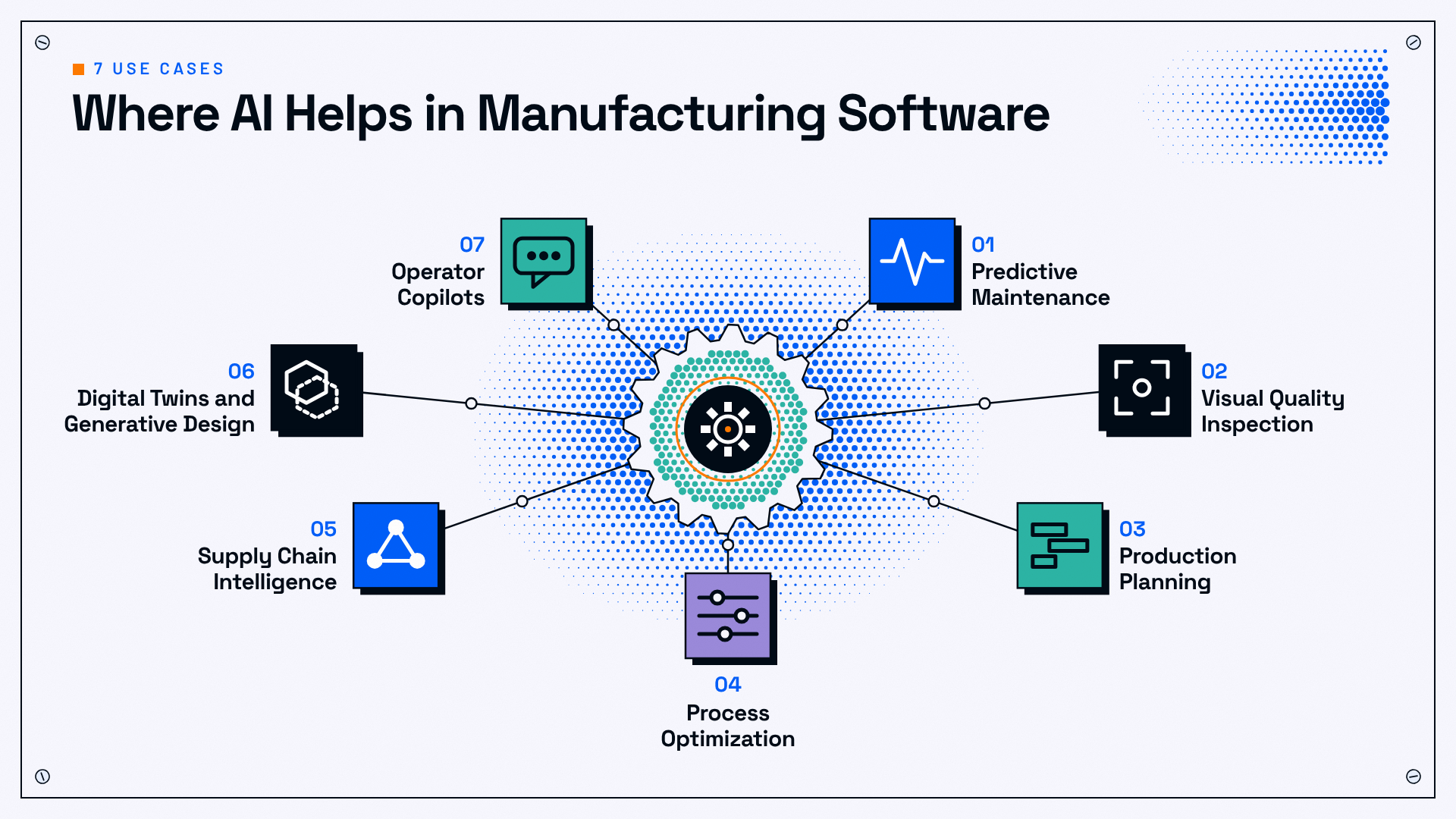
AI can support manufacturing software in predictive maintenance, visual quality inspection, production planning, process and energy optimization, supply chain forecasting, digital twins and operator assistance. The best starting point is a specific production decision with measurable impact and data that can support a reliable model.
| Use case | AI contribution | Typical input data | Software output and validation |
| Predictive maintenance | Detects abnormal behavior or estimates failure risk. | Vibration, temperature, pressure, current, state and maintenance logs. | Risk alert; validate failures detected, warning time and false alarms. |
| Visual quality inspection | Classifies images and locates defects. | Labeled images, camera data, product variant and inspection results. | Defect class or region; validate against inspected samples. |
| Production planning | Forecasts demand and recommends feasible schedules. | Orders, stock, capacity, routing, changeovers and output history. | Forecast or schedule; measure error, adherence and planner overrides. |
| Process optimization | Links process settings to quality and energy outcomes. | Temperature, pressure, speed, materials, quality and energy data. | Recommended settings; validate in simulation or advisory mode first. |
| Supply chain intelligence | Predicts delays, shortages and inventory needs. | Supplier lead times, orders, stock, demand and logistics events. | Shortage alerts or reorder advice; measure stockouts and service levels. |
| Digital twins and generative design | Simulates systems or explores constrained design options. | CAD, machine settings, process, material and layout data. | Simulation or design candidates; validate through engineering analysis and tests. |
| Operator copilots | Retrieves approved instructions, logs and maintenance knowledge. | Manuals, instructions, fault codes, asset records and procedures. | Source-linked answer; assess accuracy, citations and escalation. |
The following use cases highlight the core development work and common implementation risks.
Build Predictive Maintenance Applications
Predictive maintenance applications analyze machine data to identify signs of potential equipment failure before breakdowns occur.
Developers typically collect sensor readings such as vibration, temperature, pressure and current, then connect them with maintenance records and confirmed failures.
Key development considerations include:
- Handling missing readings, timestamps and changing sensor frequencies.
- Accounting for different machine loads and operating conditions.
- Choosing suitable models, such as anomaly detection, classification or failure-risk prediction.
- Routing alerts to maintenance dashboards or computerized maintenance management systems (CMMS).
Validate models using alert accuracy, warning time and false-alarm rates. High offline accuracy is not enough if alerts arrive too late or overwhelm maintenance teams.
Develop Computer Vision for Quality Inspection
Computer vision systems analyze production images or video to detect defects and inspect product quality. Developers commonly use classification, object detection or image segmentation models.
Model performance depends on more than the algorithm. Camera placement, lighting, exposure, product orientation and image quality all affect inspection results.
A typical workflow captures an image, identifies the product or batch, runs model inference and returns an inspection result. Uncertain cases can be routed to human inspectors.
Store images, predictions, model versions and final inspection outcomes to support audits and future model improvements.
Audi has documented using AI to analyze spot-weld data at its Neckarsulm plant, demonstrating how AI inspection can integrate with existing quality-control processes.
Build AI-Powered Production Planning Systems
AI-powered production planning systems combine demand forecasts with real operational constraints to generate workable schedules.
Developers may use:
- Time-series models for demand forecasting.
- Optimization algorithms for production scheduling.
- Rules engines for machine capacity, labor, materials, setup times and maintenance windows.
A model can propose a schedule while an optimization solver checks whether it is feasible. Planners should retain the ability to review and override recommendations.
Record scheduling inputs, constraints, model versions and planner decisions to understand why schedules change and improve future predictions.
Apply AI to Process Optimization and Energy Use
Process optimization models analyze machine settings and production conditions to improve quality, throughput or energy efficiency.
Common input variables include temperature, pressure, operating speed, humidity, material batches and tool wear.
Developers can use regression and optimization models to identify better operating conditions. Start with recommendations that engineers can review before introducing automated adjustments.
Any AI system influencing physical equipment requires documented operating limits, failure handling and safety reviews. AI must not replace existing machine interlocks or safety controls.
Connect AI to Supply Chain and Inventory Systems
Manufacturing AI can combine factory data with supplier lead times, purchase orders, inventory records, transport updates and customer demand to predict shortages and support replenishment decisions.
The main development challenge is integrating data from systems with different identifiers, formats and update schedules.
Build reliable data pipelines with:
- Clear source-of-truth rules.
- Consistent supplier, product and order identifiers.
- Accurate event timestamps.
- Explicit handling of uncertain delivery dates and demand forecasts.
Connect predictions to procurement, planning or ERP workflows so users can trace recommendations to the relevant orders, suppliers and demand assumptions.
Read more: AI in Supply Chain Management Systems.
Develop Digital Twins and Generative Design Workflows
A digital twin is a digital representation of a physical asset, process or facility connected to relevant engineering or operational data. It can support simulation, visualization and scenario testing.
Developers typically integrate asset models with sensor streams, equipment metadata and simulation engines. Consistent asset identifiers, synchronization and model accuracy are essential for reliable results.
Generative design uses computational methods to explore design alternatives based on constraints such as weight, material, load and manufacturing requirements.
For example, General Motors and Autodesk documented a seat-bracket project that consolidated eight components into one design, reported as 40% lighter and 20% stronger than the original. The design still required engineering validation.
Build Operator Copilots and Industrial AI Agents
Industrial AI copilots help technicians find information in equipment manuals, maintenance records and work instructions through natural-language queries.
A common implementation uses retrieval-augmented generation (RAG):
- Index approved technical documents.
- Retrieve relevant passages based on a user’s question.
- Generate an answer grounded in those sources.
- Display document references so users can verify the information.
For industrial applications, enforce document permissions and use current, approved instructions.
AI agents can also interact with approved tools, such as searching equipment records or drafting maintenance tickets. Start with read-only access and require authorization, validation and audit logs for actions that modify records.
General-purpose AI agents should never bypass safety procedures or directly modify machine-control logic.
What Benefits Can Manufacturing AI Software Deliver?
Manufacturing AI software can help reduce unplanned downtime, detect defects earlier, improve planning, optimize resource use and make operational knowledge easier to access. The actual benefit depends on whether the system changes a real decision or workflow, not simply whether its model achieves a high accuracy score.
| Potential benefit | What developers and operators should measure | Common measurement trap |
| Less unplanned downtime | Unplanned stop hours, failure lead time and maintenance response time. | Counting planned maintenance as avoided downtime. |
| Fewer defects | Defect escape rate, false rejects, first-pass yield and inspection coverage. | Comparing AI inspection with a small or inconsistent manual sample. |
| Higher throughput | Good units per hour, bottleneck utilization and schedule adherence. | Crediting the model for gains caused by unrelated process changes. |
| Lower energy use | Energy per good unit, adjusted for product mix and operating conditions. | Comparing periods with different production loads or weather. |
| Faster planning | Forecast error, planner time, schedule stability and override rate. | Treating a generated schedule as useful before feasibility checks. |
| Better knowledge access | Time to find an approved procedure, answer acceptance and escalation rate. | Counting chatbot responses without measuring correctness. |
Published transformation results can show what is possible, but they should not be treated as guaranteed AI-only gains. The World Economic Forum’s Global Lighthouse Network describes multi-technology factory transformations, often combining AI with automation, data engineering and process redesign.
Which Architecture Should You Choose for a Manufacturing AI System?
Manufacturing AI systems generally use cloud, edge or hybrid architectures. Choose between them based on inference latency, network availability, data volume, privacy, compute requirements and the need to keep production workflows running during connectivity failures.
| Architecture pattern | When it fits | Trade-off |
| Cloud-centered | Central analytics, cross-site reporting and large-scale training. | Centralized operations; depends on connectivity and data controls. |
| Edge-centered | Low-latency inference or limited-connectivity sites. | Local resilience and low latency; requires edge-device lifecycle management. |
| Hybrid edge and cloud | Local inference with centralized training and analytics. | Balances local and central workloads; requires synchronization and clear boundaries. |
A common pattern is to collect data near the machine, normalize and contextualize it at an edge layer, publish selected events to a data platform, run inference where latency and availability requirements dictate, and send results to existing applications. Microsoft documents an industrial architecture using OPC UA connectivity, an edge MQTT broker and data flows to downstream endpoints.
Keep control boundaries explicit: AI may recommend actions or create tasks, while PLCs and safety systems retain deterministic control and protection.
How Do You Implement AI in Manufacturing Software?
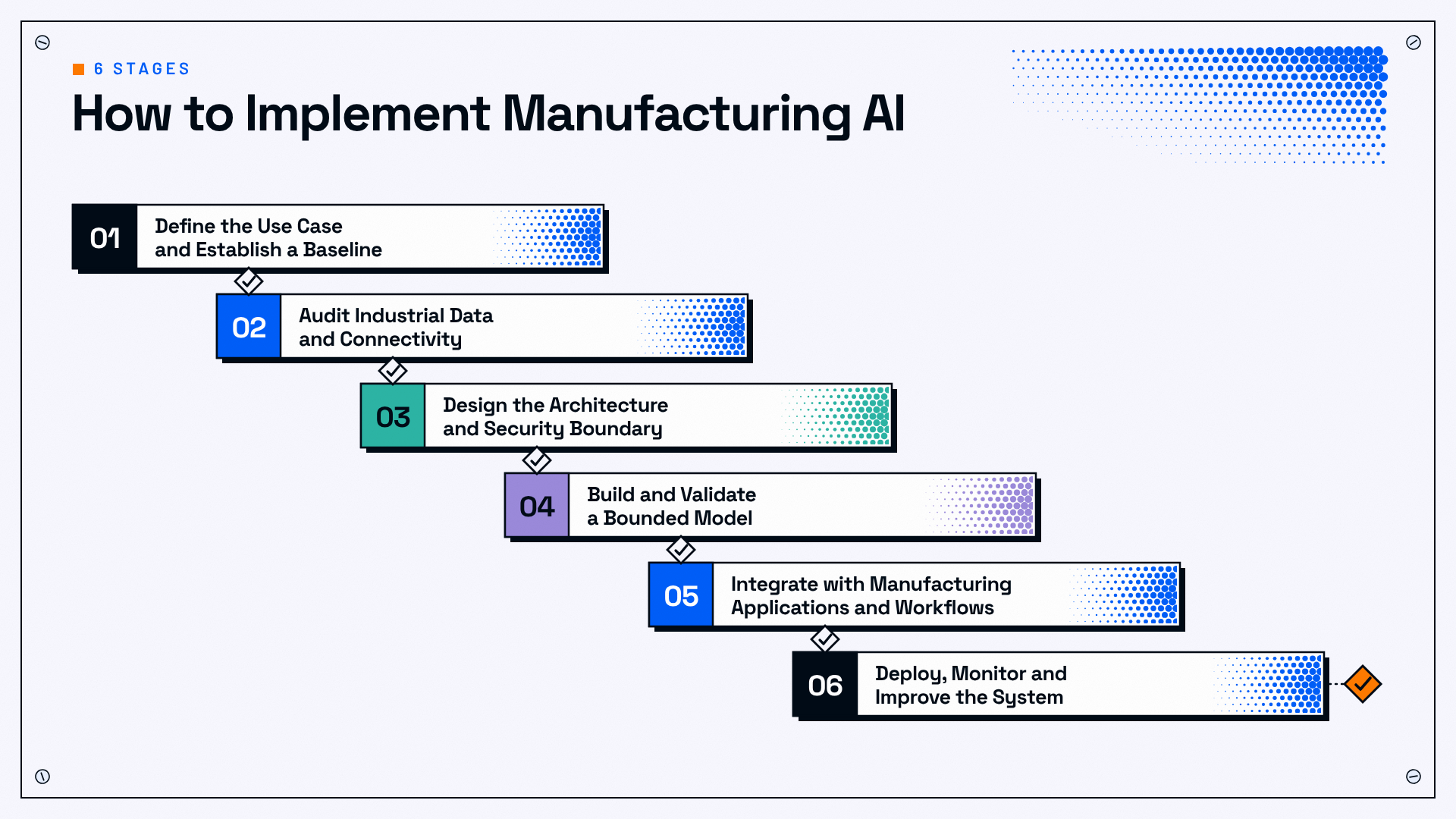
Implement manufacturing AI in six stages: define the use case and baseline; audit data and connectivity; design architecture and security; build and validate the model; integrate workflows; and deploy with monitoring. Each stage should have a clear deliverable and approval gate.
1. Define the use case and establish a baseline
Choose a measurable problem with an operational owner, such as recurring motor failures or defects at an inspection station. Define the supported decision, users, possible actions and baseline measures.
Output: a use-case brief with scope, owner, baseline, target metric and constraints. Gate: operations, engineering and the business sponsor agree that the problem is worth solving and can be measured.
2. Audit industrial data and connectivity
Inventory data sources, sampling rates, timestamps, identifiers, owners and retention rules. Check alignment with machine states, batches and maintenance events; older equipment may need a gateway or additional sensors.
OPC UA is widely used for structured industrial data exchange; MQTT is commonly used for publish-subscribe messaging. They solve different parts of the integration problem and should be selected based on the equipment, platform and network design.
Output: a data map and connectivity plan. Gate: the team can access representative, permissioned data with known limitations.
3. Design the architecture and security boundary
Define where data is collected, processed and used for inference. Specify edge/cloud responsibilities, APIs, identities, network zones, failure behavior and interfaces to MES, ERP, CMMS or quality systems.
Output: an architecture diagram, interface contracts and security design. Gate: OT, IT, engineering and security owners approve the data flows and trust boundaries.
4. Build and validate a bounded model
Build a reproducible dataset and baseline model. Prevent data leakage by holding out later periods or separate machines where appropriate, and choose metrics that reflect the cost of errors.
For predictive maintenance, track false alarms and missed failures. For visual inspection, examine precision and recall by defect class, not only overall accuracy. For forecasting, compare against a simple baseline. Record model version, dataset version, preprocessing steps and evaluation results.
Output: a versioned model with an evaluation report. Gate: it meets pre-agreed thresholds on representative data and has known failure modes.
5. Integrate with manufacturing applications and workflows
Expose predictions through a controlled API, broker or application service. Map each output to its asset, product, batch or work order, and integrate only the systems required by the workflow.
Keep human review for uncertain or high-impact decisions. Add idempotency, retries, audit logs and clear error handling so duplicate messages or temporary network failures do not create duplicate work orders or inconsistent records.
Output: an integrated pilot workflow. Gate: the end-to-end process works under realistic operating conditions, including failure and recovery tests.
6. Deploy, monitor and improve the system
Deploy gradually in shadow or advisory mode. Monitor data freshness, missing values, latency, model performance, alert volume, overrides and operational outcomes; define drift, retraining, approval and rollback procedures.
Treat the model and application as production software. Version models, transformations and configurations; plan edge updates and safe operation during service outages.
Output: a production runbook, monitoring plan and rollout decision. Gate: the system meets operational and technical targets over an agreed observation period.
Which Tools and Platforms Support Manufacturing AI Development?
Manufacturing AI stacks combine ML frameworks, OPC UA or MQTT connectivity, data platforms, edge runtimes, cloud infrastructure and MLOps. Choose tools according to the use case, equipment and support requirements.
| Tool or technology | Role in the solution | Best-fit development work |
| Python | Common language for data preparation, model development and service integration. | Data pipelines, model training, evaluation and APIs. |
| PyTorch or TensorFlow | Machine learning frameworks for training and serving models. | Time-series models, classification, deep learning and custom inference. |
| OpenCV | Computer vision library for image and video processing. | Image preprocessing, camera pipelines and vision prototypes. |
| Kafka or other event-streaming platform | Moves and processes event streams between services. | High-volume telemetry and event-driven data architectures; validate operational fit. |
| OPC UA | Industrial interoperability and structured data exchange. | Connecting applications to compatible controllers, gateways and industrial servers. |
| MQTT | Lightweight publish-subscribe messaging. | Moving telemetry and events between edge services and platforms. |
| Azure IoT Operations | Edge data plane with MQTT messaging, OPC UA connectivity and data flows. | Kubernetes-based industrial edge data integration. |
| AWS IoT SiteWise and related AWS services | Industrial asset data collection, organization and analytics within AWS architectures. | AWS-based industrial data foundations; verify current service scope and regional availability. |
| NVIDIA Omniverse and industrial simulation tools | Simulation and digital-twin workflows for supported industrial use cases. | Factory layout, robotics and simulation workflows; confirm the specific connector and model requirements. |
Choose the platform after the data path and deployment constraints are understood. A team may use Python and PyTorch for model development, OpenCV for image handling, OPC UA to read equipment data, MQTT for event transport and an edge platform to deploy inference. The exact combination depends on the plant and the system being built.
How Should You Evaluate AI Tools and Implementation Partners?
Evaluate tools and partners against a representative workload. Test imperfect data, asset identifiers, connectivity loss, model updates and integration with existing systems, not just a polished demo.
- Industrial connectivity: Which protocols, gateways, controllers and data formats are supported? Is the integration read-only or can it write values?
- Model lifecycle: How are training data, model versions, evaluation results, drift and rollback managed?
- Deployment: Can the solution run at the edge, in the cloud or in a hybrid environment? What happens when the network is unavailable?
- Security: How are identities, secrets, network zones, logs and remote access managed?
- Integration: Can the system connect to the required MES, ERP, CMMS or quality platform through documented interfaces?
- Ownership and support: Who owns the data, labels, model artifacts and custom code? Who responds when a production alert or service failure occurs?
Ask for a pilot using your own data and agree acceptance criteria before work begins. A technically impressive model is not a successful implementation if the plant cannot operate, monitor or maintain it.
What Risks and Limitations Need to Be Managed?
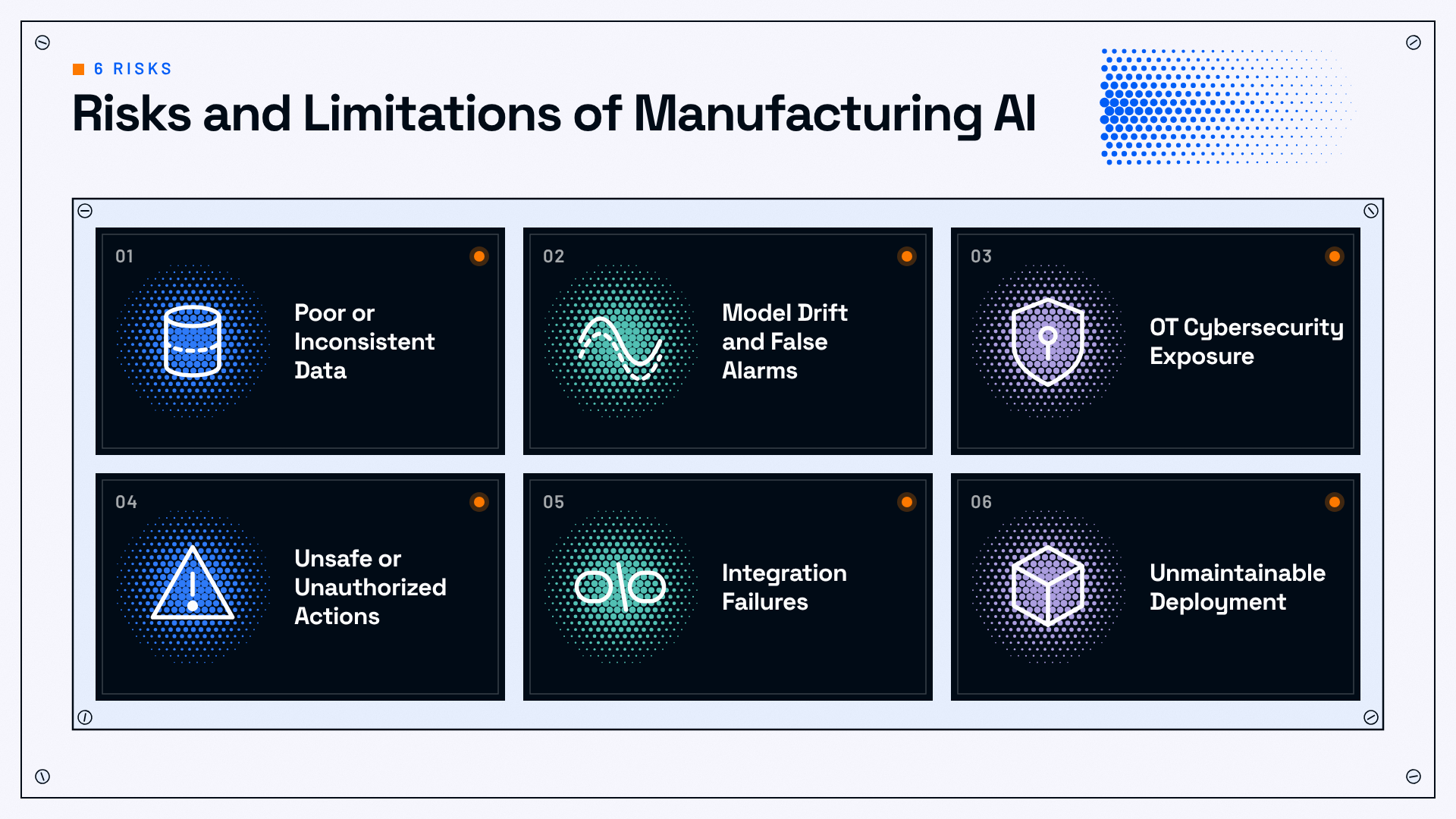
Manufacturing AI requires controls for data quality, model drift, OT cybersecurity, reliability, safety and human oversight. Controls should match model access, use and the consequences of error.
| Risk | Practical control | Typical owner |
| Poor or inconsistent data | Data profiling, asset context, timestamp checks and named data ownership. | Data engineering and operations. |
| Model drift and false alarms | Monitoring by operating condition, review queues and defined retraining triggers. | ML engineering and process engineering. |
| OT cybersecurity exposure | Segmentation, least privilege, controlled remote access and tested change management. | OT security and plant IT. |
| Unsafe or unauthorized actions | Advisory mode, approval gates and separation from safety interlocks and deterministic control. | Controls engineering and safety. |
| Integration failures | Interface contracts, retries, idempotency, audit trails and recovery tests. | Application and integration engineering. |
| Unmaintainable deployment | Versioned artifacts, reproducible builds, monitoring and rollback procedures. | Platform and MLOps teams. |
Poor Data Quality and Model Drift
Industrial data may contain different sampling rates, gaps, inconsistent units, incomplete asset IDs and inconsistent maintenance labels. Understand how each field is generated before training.
Drift can follow equipment wear, sensor replacement, supplier or product changes, and new operating conditions. Monitor input and outcome quality; rising confidence does not prove correctness.
OT Cybersecurity and System Reliability
Connecting AI to OT can create paths between enterprise IT, cloud services and equipment networks. NIST SP 800-82 Rev. 3 provides OT security guidance; Revision 4 was an initial public draft at the time of this guide’s research.
Use network segmentation, least privilege, controlled data flows, asset inventories, secure remote access and tested recovery. Industrial protocols and cloud platforms are not secure by default.
Safety, Human Review and Control Boundaries
A maintenance prediction carries different risks from a machine-setting change. Keep AI separate from safety functions and interlocks; involve controls and safety engineers before any system can influence physical behavior.
When Should a Manufacturing AI Project Be Postponed?
Postpone deployment if outputs cannot be evaluated or acted on safely. Common blockers include no baseline or data owner, missing machine context, unrepresentative data, unresolved OT access or no operations owner.
Read-only data exploration may still be useful while the organization closes those gaps. A small data-quality or connectivity project can be a better first step than training a model on unreliable inputs.
How Much Does It Cost to Develop a Manufacturing AI System, and How Do You Measure ROI?
Manufacturing AI costs depend on data readiness, connectivity, model complexity, deployment, integration and ongoing operations. Calculate ROI using verified benefits and the full lifecycle cost.
Include the full lifecycle cost, not just model development:
- Industrial data access: Sensors, cameras, gateways, connectors, calibration and data licensing.
- Data engineering: Extraction, cleaning, labeling, asset mapping, storage and retention.
- Model development: Experimentation, training, evaluation, inference optimization and specialist engineering.
- Application development: APIs, dashboards, workflow logic, authentication and integration with MES, ERP or CMMS.
- Infrastructure: Edge hardware, cloud compute, storage, networking, monitoring and model-serving capacity.
- Deployment and operations: Site commissioning, operator training, support, retraining, security updates and rollback readiness.
A useful ROI calculation compares attributable benefit with incremental cost over the same period:
ROI = (Attributable benefit − Incremental cost) ÷ Incremental cost × 100
For example, $180,000 in verified annual savings against $60,000 in annual operating costs gives an illustrative 200% ROI, not an industry benchmark. Measure benefits against a credible baseline and account for other changes.
Avoid double counting recovered capacity, avoided downtime and increased output. Finance and operations should agree on attribution before the pilot.
Which Metrics Show That a Manufacturing AI System Is Working?
| Metric | What it measures | Why it matters |
| Precision and recall | How often model alerts are correct and how many relevant events are detected. | Shows the trade-off between false alarms and missed events. |
| Inference latency | Time from data availability to model result. | Determines whether the output arrives in time for the workflow. |
| Data freshness and completeness | Whether the model receives current, usable input data. | A reliable model cannot compensate for missing or stale signals. |
| Alert acceptance and override rate | How users respond to model recommendations. | Shows whether outputs are useful and trusted in context. |
| Unplanned downtime | Production time lost to unexpected stops. | Connects maintenance AI to an operational outcome. |
| Scrap and first-pass yield | Defects, waste and units made correctly the first time. | Connects inspection and process models to quality. |
| OEE and throughput | Availability, performance and quality at the equipment or line level. | Shows broader production performance, with context about other changes. |
A system works when reliable predictions improve the target outcome. Track precision, recall, false alarms and latency alongside downtime, scrap, first-pass yield, throughput and response time.
What Do Real-World Manufacturing AI Projects Show?
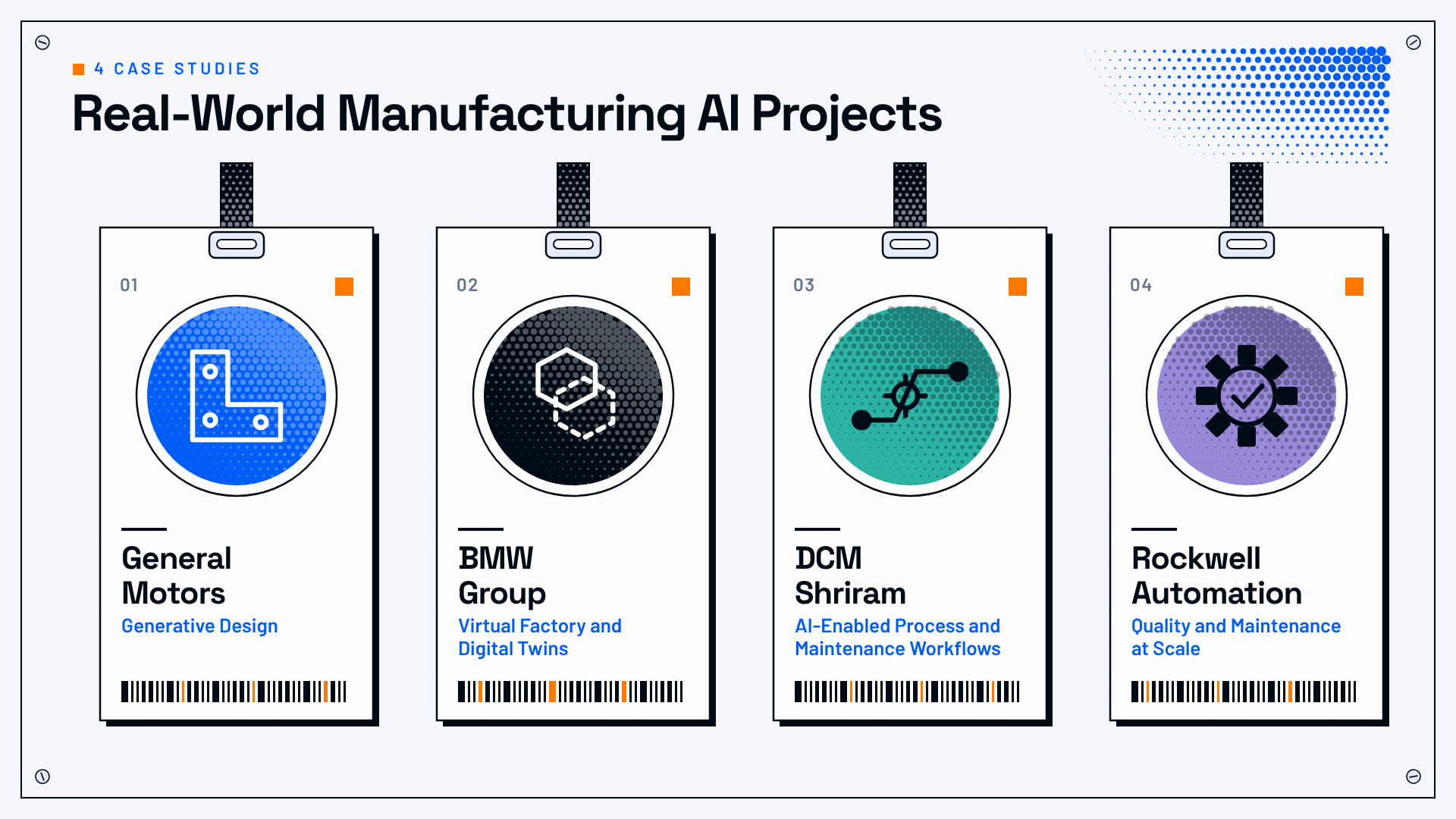
Manufacturing AI value often combines models, data integration, automation and process redesign. Case studies illustrate patterns, but rarely isolate one model’s effect.
General Motors: Generative Design
Autodesk describes a General Motors seat-bracket project in which generative design produced more than 150 alternatives. The selected design consolidated eight components into one stainless-steel part and was reported as 40% lighter and 20% stronger than the previous bracket. For developers, the lesson is that generative design works within engineering constraints and must be assessed against manufacturability and physical requirements.
BMW Group: Virtual Factory and Digital Twins
BMW Group reported that it was scaling its Virtual Factory across digital twins of more than 30 production sites. The company projected that the approach could reduce production planning costs by up to 30%. This is a projected company figure, not a measured result guaranteed for other manufacturers. The engineering lesson is the importance of connecting simulation, plant layout and production planning data in a consistent digital environment.
DCM Shriram: AI-Enabled Process and Maintenance Workflows
The World Economic Forum’s Global Lighthouse Network describes DCM Shriram’s Gujarat site using AI-enabled process control and a generative AI maintenance manager as part of a broader transformation. The WEF reports a 32% reduction in power costs, alongside other operational outcomes. These are programme-level results and should not be read as the isolated effect of one AI model.
Rockwell Automation: Quality and Maintenance at Scale
The WEF describes Rockwell Automation’s Singapore site deploying more than 50 digital and AI solutions, including AI-enabled quality control and intelligent maintenance. It reports a 43% increase in units per person-hour and a 35% reduction in defects. The case illustrates how multiple applications and process changes can work together; it is not a single-model benchmark.
Can Developers Build Manufacturing AI Without Replacing Existing Machines?
Yes. Developers can often add manufacturing AI to existing equipment by reading data from supported controllers, sensors, cameras or historians through gateways and industrial interfaces. The AI application can then run on edge infrastructure or connect to cloud services without replacing the machine itself.
Retrofit feasibility depends on available signals, protocols, sensor condition and process reliability. Some projects need new sensors or cameras; inspect equipment interfaces before committing.
Does Manufacturing AI Need to Run at the Edge or in the Cloud?
Manufacturing AI can run at the edge, in the cloud or across a hybrid architecture. Edge inference suits low-latency or connectivity-sensitive tasks, while cloud infrastructure supports centralized training, fleet analytics and cross-site data processing; hybrid designs combine both.
Can Generative AI Control Factory Equipment?
Generative AI should not directly replace PLC logic, machine interlocks or certified safety systems. It can support knowledge retrieval, alarm explanation, work-order drafting and approved workflows, while any equipment action must pass through a separately engineered and validated control path.
Which Programming Languages Are Used in Manufacturing AI?
Python is commonly used for data engineering, machine learning and model-serving services; C++ is useful for performance-sensitive or hardware-adjacent components; and Java, C# and JavaScript or TypeScript often support enterprise integrations, APIs and dashboards. The best language is usually the one that fits the existing system and operational team.
How Do Developers Integrate AI With MES, ERP, SCADA and PLC Systems?
Developers integrate manufacturing AI with MES, ERP, SCADA and PLC environments through the interfaces and protocols appropriate to each system, while preserving clear IT/OT and control boundaries. MES and ERP integrations often use APIs or managed data interfaces; SCADA and PLC connectivity typically requires industrial protocols, gateways and controls-engineering oversight.
For machine data, OPC UA can provide structured communication between compatible industrial components. MQTT can carry events between services. A gateway or edge platform may bridge the industrial network and application layer. The design must account for identity, certificates, network segmentation, message ordering, retries and loss of connectivity.
Start With a Bounded Manufacturing AI Engineering Pilot
Start a manufacturing AI project with one bounded production problem, one dependable data path and one measurable operational outcome. Validate the model independently, integrate its output into an existing workflow and expand only after the pilot demonstrates reliable performance under real operating conditions.
Manufacturing AI depends on data engineering, ML, software integration and operational expertise. The model is one component, not the whole system.
If your team is evaluating an AI-powered manufacturing application, CodersBucket can help assess the use case, data architecture and integration requirements before development begins. Talk to our team about a practical first step.