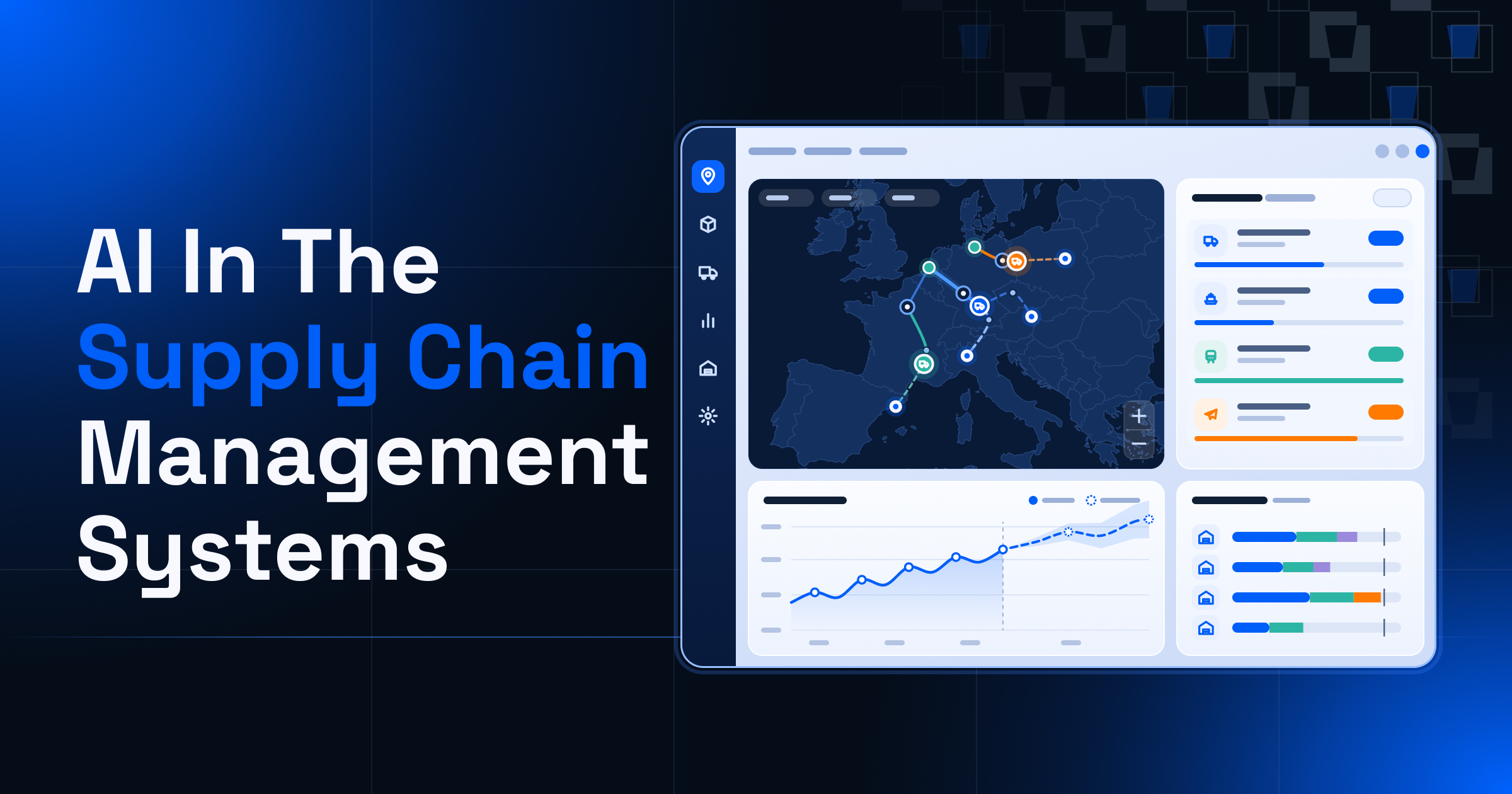
AI in supply chain management systems is software that learns from your data. It predicts demand, flags risks and recommends or takes the next action.
It works by pulling data from your ERP, warehouse and transport systems. Then it finds patterns and turns them into forecasts and decisions. Common uses include demand forecasting, inventory planning, route planning, predictive maintenance and customs compliance.
Amazon, Walmart, UPS, DHL and Sanofi already report measurable results. And 2026 brought a clear shift: AI moved from tools that advise to agents that act. Below, you’ll see that change across six industries, plus the benefits, challenges, costs and steps to get started.
What Is AI in Supply Chain Management?
AI in supply chain management means using machine learning and AI agents to run the flow of goods. It learns from past and live data, predicts what comes next and acts on it.
It covers planning, sourcing, procurement, production, warehousing, logistics, fulfillment and supplier management. The big change is timing. Teams stop firefighting and act on early signals, while people keep control of strategic calls.
How Does AI Work in Supply Chain Management Systems?
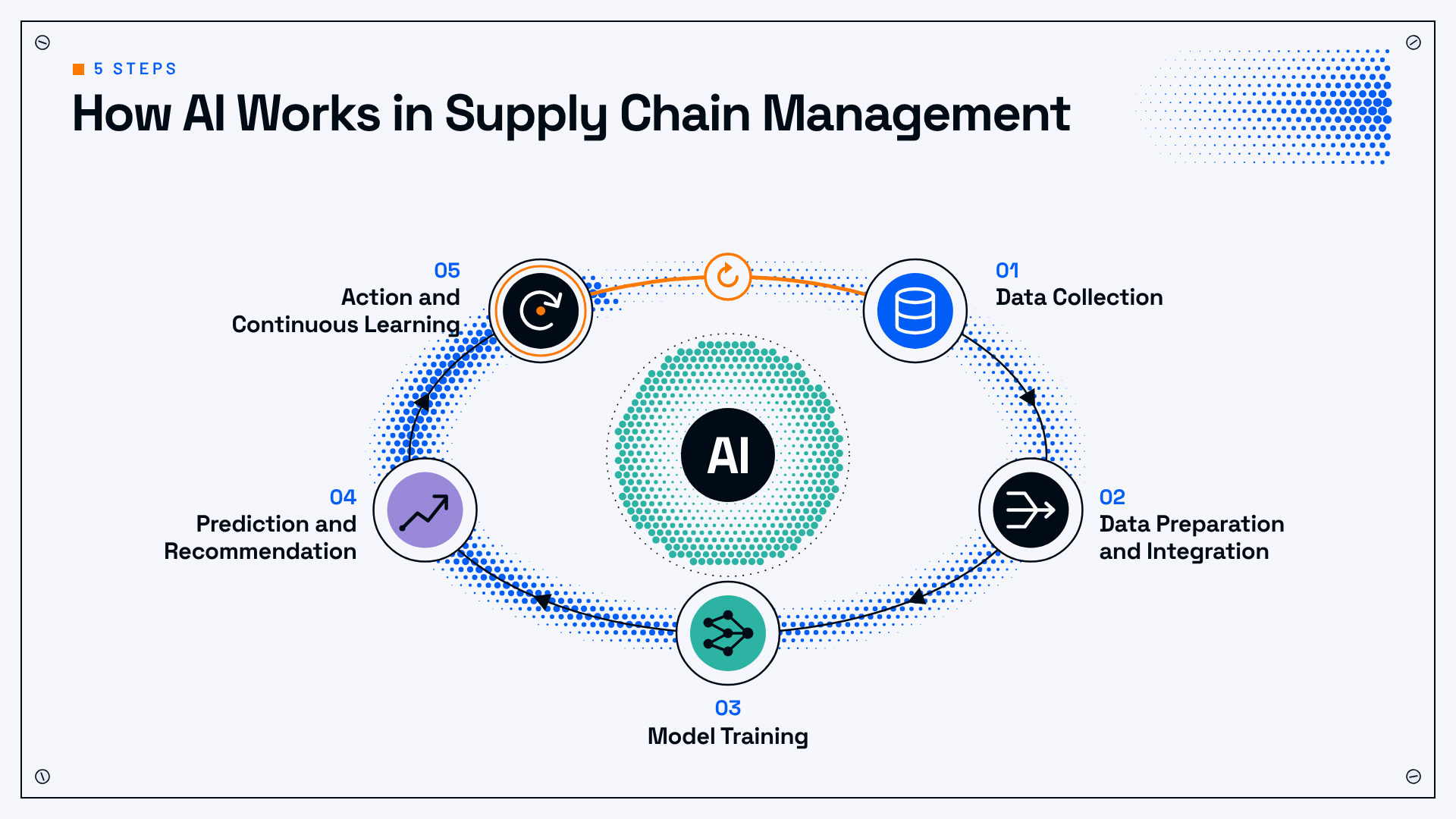
AI works in supply chain management systems by collecting data, learning patterns and turning them into actions. Each result feeds back into the model, so it improves over time.
5 steps of how AI works in a supply chain management system are given below.
- Data collection. The system pulls data from your ERP, or enterprise resource planning software. It also reads your WMS and TMS, the warehouse and transport systems, plus sensor, supplier and weather feeds.
- Data preparation and integration. Records are cleaned, matched and merged into one view. Duplicates, missing dates and mismatched units get fixed first.
- Model training. Machine learning models study sales history, lead times and past disruptions. They learn what normal looks like, so they can spot anything unusual.
- Prediction and recommendation. The model forecasts demand, flags late shipments or predicts machine failures. Then it suggests an action, like reordering stock.
- Action and continuous learning. Low-risk actions run automatically, and bigger ones wait for approval. Every outcome flows back, and the model is retrained.
The key thing is the human in the loop. High-impact decisions, like switching suppliers, should always get a person’s sign-off.
AI doesn’t guess. It matches patterns at scale. The better your data, the better the output.
What AI Technologies Are Used in Supply Chain Management?
Six AI technologies power most supply chain systems, and each handles a different task. Most platforms combine several of them.
The 6 AI technologies used in supply chain management are given below.
- Machine learning: Finds patterns in history to forecast demand and set safety stock.
- Predictive analytics: Estimates future events, such as which supplier will likely miss a delivery.
- Computer vision: Reads images to inspect quality, count stock and read container numbers.
- Natural language processing and generative AI: Reads supplier emails and drafts purchase orders.
- AI agents: Carry out multistep tasks, like booking a carrier or moving an appointment.
- Digital twins and intelligent simulation: Test what-if scenarios on a virtual copy of your network.
What Are the Top Use Cases of AI in Supply Chain Management?
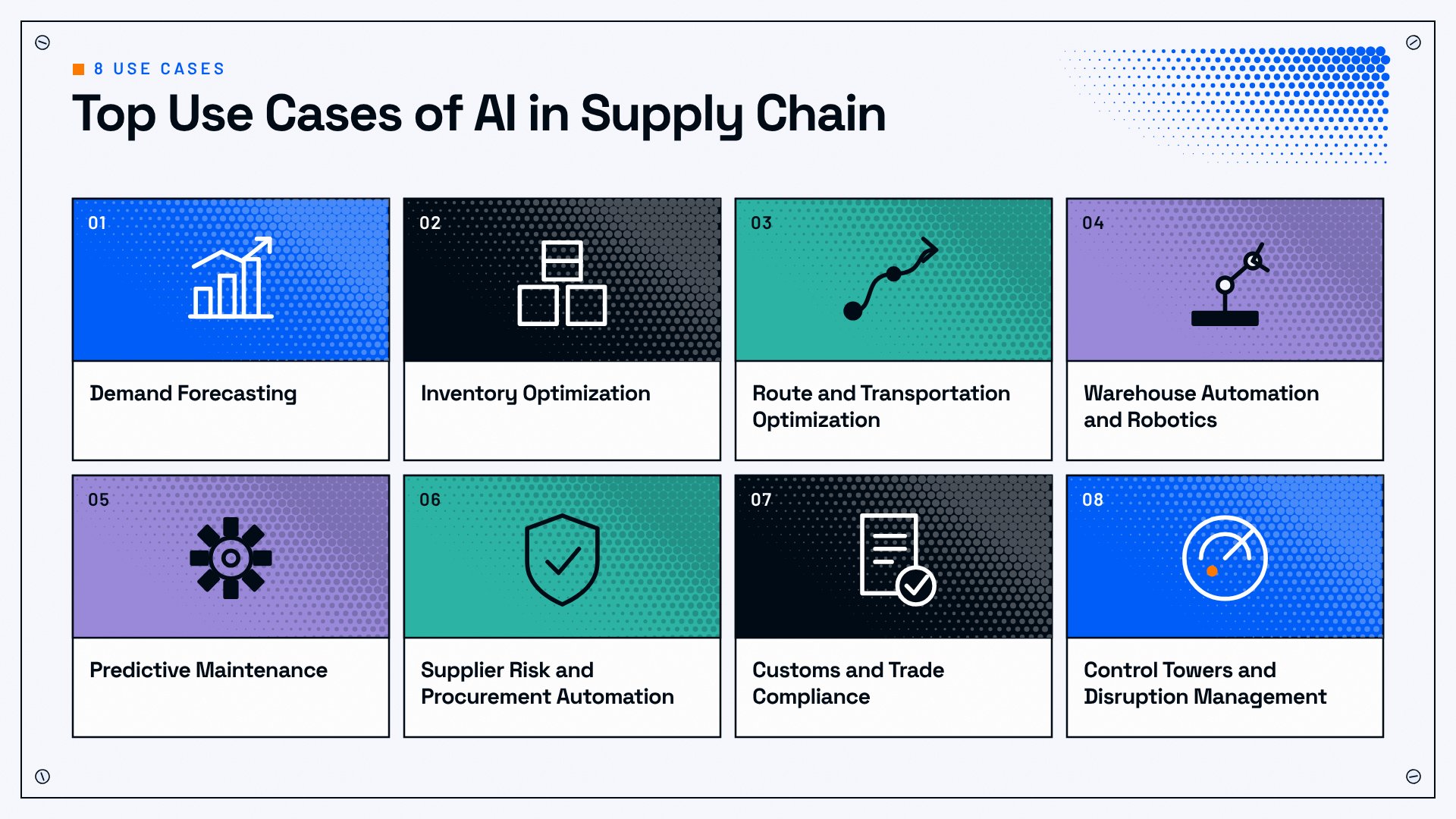
The top use cases of AI in supply chain management are forecasting, inventory, routing and warehousing. Maintenance, supplier risk, customs and disruption response round out the list. Each targets a cost or delay teams once handled by hand.
The 8 top use cases of AI in supply chain management are outlined below.
- Demand forecasting: Combines sales history with weather and promotions to predict demand by location.
- Inventory optimization: Sets reorder points for each item, so less cash sits in slow stock.
- Route and transportation optimization: Plans stop order and loads to cut miles and fuel.
- Warehouse automation and robotics: Directs robots and pickers and balances labor as orders change.
- Predictive maintenance: Reads machine sensor data and warns teams before a breakdown.
- Supplier risk and procurement automation: Scores supplier risk, compares quotes and drafts purchase orders.
- Customs and trade compliance: Classifies products for tariffs and checks shipping paperwork.
- Control towers and disruption management: Watches the network live and suggests fixes when something fails.
What Are the Real-World Examples of AI in Supply Chain Management?
The best real-world examples of AI in supply chain management are Amazon, Walmart, UPS and Unilever. PepsiCo, C.H. Robinson, Maersk, DHL, Sanofi and Schneider Electric complete the list.
10 real-world examples of AI in supply chain management are summarized in the table below.
| Company | Industry | AI Use Case | Reported Result |
| Amazon | E-commerce | Warehouse robot coordination | 10% better robot fleet travel time |
| Walmart | Retail | Route optimization | 30 million unnecessary miles removed |
| UPS | Parcel delivery | Route optimization | About 100 million miles saved per year |
| Unilever ice cream | Consumer goods | Weather-based forecasting | Up to 30% higher sales from AI freezers |
| PepsiCo | Food manufacturing | Predictive maintenance | About 4,500 downtime hours avoided |
| C.H. Robinson | Logistics | AI agents | Up to 35% more on-time pickups |
| Maersk | Shipping | Customs compliance | One AI-assisted customs workflow |
| DHL | Contract logistics | Warehouse AI and robotics | Over 1.5 billion robotic picks |
| Sanofi | Pharmaceuticals | Shortage prediction | 80% of low stock positions predicted |
| Schneider Electric | Manufacturing | AI-enabled orchestration | No. 1 in Gartner’s Top 25 for 4 years |
How Does Amazon Use AI in Its Supply Chain?
Amazon uses AI in its supply chain to coordinate how robots move through its fulfillment centers. Its model, DeepFleet, is a generative AI foundation model. Amazon built it on its inventory data using AWS tools, including Amazon SageMaker.
On June 30, 2025, Amazon announced its 1 millionth robot. It said DeepFleet improves robot fleet travel time by 10%, which means faster, cheaper delivery.
The lesson: AI pays off most when it coordinates physical assets that already produce data.
How Does Walmart Use AI in Its Supply Chain?
Walmart uses AI in its supply chain to plan truck routes and pack trailers. Its Route Optimization tool maps multistop routes around time, location and store delivery windows.
Walmart says the tool eliminated 30 million unnecessary miles and avoided 94 million pounds of CO2. It won the 2023 Franz Edelman Award. In March 2024, Walmart began selling it to other businesses as SaaS.
Walmart also climbed 10 places to No. 3 in Gartner’s 2026 Global Supply Chain Top 25. The lesson: a proven internal AI tool can become a product.
How Does UPS Use AI for Route Optimization?
UPS uses AI for route optimization through ORION, its On-Road Integrated Optimization and Navigation system. ORION reviews daily deliveries, pickups and past routes to set each driver’s stop order.
UPS says ORION saves about 100 million miles and 10 million gallons of fuel a year. It later added continuous optimization, which updates routes as the day changes.
The lesson: small gains per route add up fast across a large fleet.
How Does Unilever’s Ice Cream Business Use AI for Demand Forecasting?
Unilever’s ice cream business uses AI for demand forecasting by analyzing weather data. Forecasts and production volumes shift with the weather, and inventory moves to match.
In January 2025, Unilever said the supply chain spans 60 countries and 35 factory production lines. A 1°C rise in a European June can change forecasts substantially. Data from 100,000 AI-enabled freezers raised retail orders and sales by up to 30%.
The business now runs as The Magnum Ice Cream Company. In June 2026, it named Kinaxis, Microsoft, Salesforce and SAP as partners for weather-based forecasting. The lesson: outside signals sharpen forecasts for seasonal products.
How Does PepsiCo Use AI for Predictive Maintenance?
PepsiCo uses AI for predictive maintenance in its Frito-Lay plants through Augury’s Machine Health solution. Sensors track vibration, temperature and magnetic fields, then warn teams before machines fail.
The program began as a one-year pilot in four factories. According to Augury, it then scaled to 38 sites in the US, Canada and the UK. It helped mitigate 900 downtime events and avoid about 4,500 hours of unplanned downtime.
The lesson: prove value in a focused pilot before you scale.
How Does C.H. Robinson Use AI Agents in Logistics?
C.H. Robinson uses AI agents in logistics to handle quotes, orders, appointments and tracking. Hundreds of in-house agents do this work, and people step in for exceptions.
In March 2026, the company reported up to 35% more on-time pickups in AI-handled workflows. It also reported up to 23% faster speed to market.
In October 2026, it extended agents to ocean, air freight and customs. Quotes that took one to three days now take two to three minutes. The lesson: agents shine on repetitive, high-volume email work.
How Does Maersk Use AI for Customs and Trade Compliance?
Maersk uses AI for customs and trade compliance through Maersk Trade & Tariff Studio. It launched in June 2025 as a central, AI-powered platform for customs and tariffs.
The August 2026 release links trade planning, pre-entry review, customs execution and audit support in one workflow. It also adds AI tariff code guidance and bulk classification for large catalogs.
The lesson: tariff swings have made AI compliance a frontline use case.
How Does DHL Use AI in Warehouse Operations?
DHL uses AI in warehouse operations through its Intelligent Supply Chain model. It combines physical AI, digital AI and orchestration with human expertise.
In its November 9, 2026 update, DHL Supply Chain reported over 9,000 robots and 1.5 billion robotic picks. It also logged 10 million case unloads with Boston Dynamics’ Stretch robot.
Its AI orchestration now runs in live warehouses as a digital control center. DHL is also piloting adaptive robots that pursue goals instead of fixed routes.
How Does Sanofi Use AI in Its Pharmaceutical Supply Chain?
Sanofi uses AI in its pharmaceutical supply chain to predict shortages early. Its app, plai, built with Aily Labs, gives supply teams real-time data and warnings.
Sanofi says plai can predict 80% of low inventory positions. Writing in Fortune in February 2026, then-CEO Paul Hudson credited it with avoiding $300 million in revenue risk.
In pharma, the stakes go beyond revenue. A stock-out can mean a patient misses a medicine.
How Does Schneider Electric Use AI in Its Supply Chain?
Schneider Electric uses AI in its supply chain to orchestrate resources end to end. It ranked No. 1 in Gartner’s 2026 Top 25 for the fourth year running.
Gartner credits its autonomous workforce capabilities and end-to-end orchestration. 2026 was also the last year of its three-year Impact Supply Chain program.
In April 2026, Schneider Electric and Microsoft unveiled agentic manufacturing capabilities built on Azure AI. The lesson: leaders use AI to redesign work, not just automate tasks.
How Is AI Changing Supply Chains Across Industries in 2026?
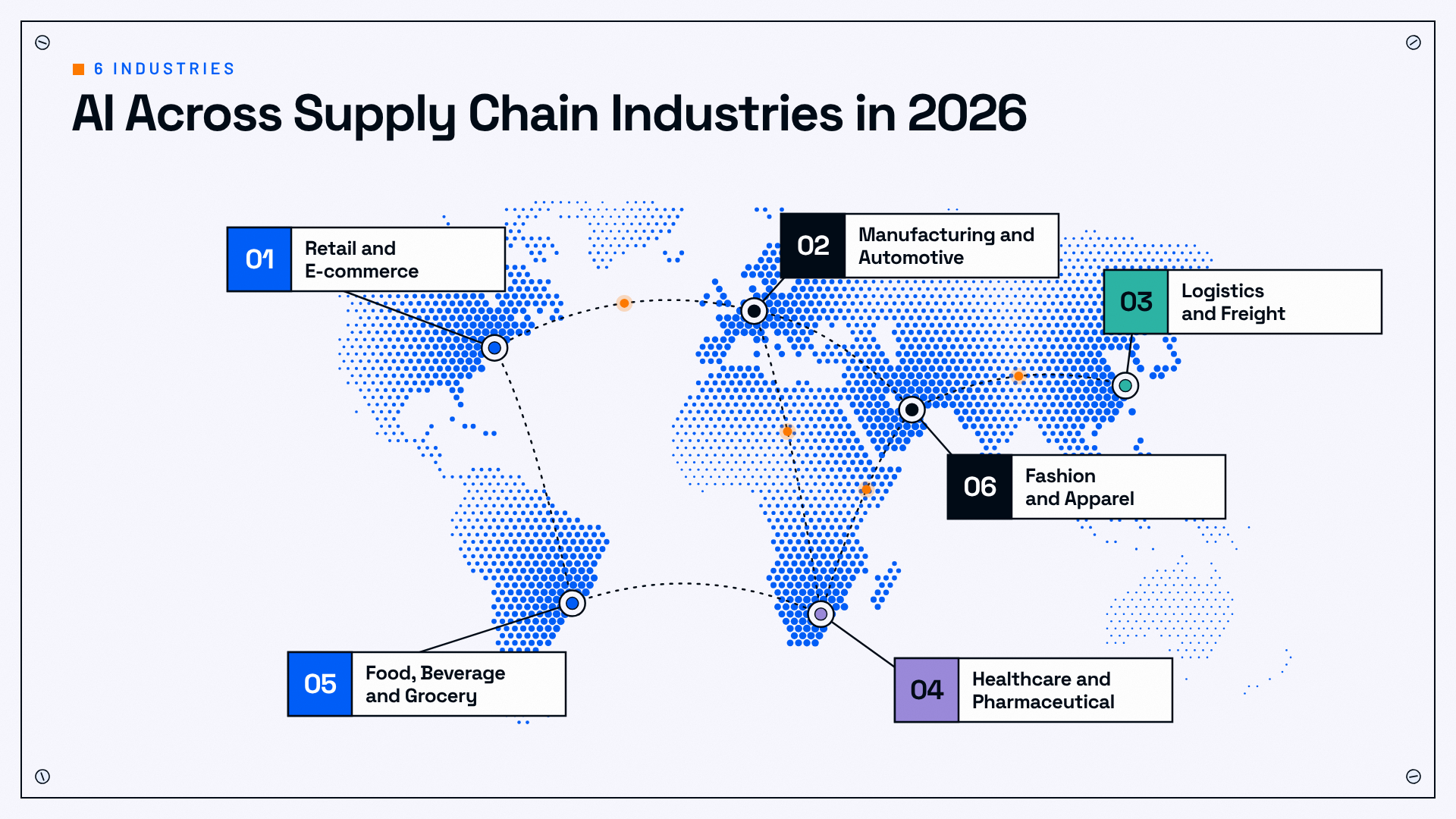
AI is changing supply chains across industries in 2026 by moving from advising to acting. The DHL Logistics Trend Radar 8.0 found AI now takes action, with people still at the center.
In the 2026 MHI and Deloitte report, 71% said AI is disrupting supply chains. Gartner adds that AI now takes 67% of supply chain digital investment. Here’s how that looks in six industries.
How Is AI Changing Retail and E-commerce Supply Chains?
AI in retail and e-commerce now runs demand prediction, replenishment, warehouse robots and delivery routing. The 2026 change: AI assistants can now place logistics orders directly.
Flexport’s Fall 2026 release lets shippers use ChatGPT, Claude or Copilot to book and track freight. Exceptions still go to a person.
For online sellers, that means fewer forms and faster bookings. Amazon and Walmart show where this is heading.
How Is AI Changing Manufacturing and Automotive Supply Chains?
AI in manufacturing and automotive now senses supplier risk, places supply orders and schedules production. In 2026, tariffs and memory chip shortages pushed automakers toward real-time supplier visibility.
Deloitte’s 2026 Manufacturing Industry Outlook points to agentic AI that senses and responds to supply risk. PepsiCo and Schneider Electric show the maintenance and orchestration sides.
How Is AI Changing Logistics and Freight?
AI in logistics and freight now handles routing, quotes, load matching and customs paperwork. Adoption jumped in 2026, but trust lagged behind.
A 2026 logistics trends study found active AI adopters rose from 16% to 43%. Only 7% strongly trust AI recommendations. And 53% worry about AI-generated fake documents.
UPS, C.H. Robinson, Maersk and DHL show what careful adoption looks like.
How Is AI Changing Healthcare and Pharmaceutical Supply Chains?
AI in healthcare and pharma now predicts drug shortages, tracks devices and forecasts critical supply demand. The 2026 change is happening inside hospital supply rooms.
In August 2026, Gartner advised healthcare supply chain leaders to replace manual counts with AI and computer vision. Those rooms track stock and trigger reorders themselves. Sanofi shows the same idea upstream.
How Is AI Changing Food, Beverage and Grocery Supply Chains?
AI in food and grocery now forecasts perishable demand, sets store orders and predicts shelf life. The 2026 focus is cutting fresh food waste.
ReFED’s May 2026 report found fresh categories show strong evidence of AI reducing waste. But gains shrink when store managers override AI orders. Unilever’s ice cream work shows the upstream version.
How Is AI Changing Fashion and Apparel Supply Chains?
AI in fashion now predicts trends, forecasts size and color demand and plans seasonal buys. The 2026 priority is making less stock that never sells.
The EU Textiles Ecosystem Platform says AI can cut overproduction through better forecasting and dynamic pricing. Shorter trend cycles and tariffs make that precision more valuable.
What Are the Benefits of AI in Supply Chain Management?
The benefits of AI in supply chain management are lower inventory, lower costs, better forecasts and faster decisions. McKinsey estimates AI can cut distribution inventory by 20% to 30%. It also estimates 5% to 20% lower logistics costs and 5% to 15% lower procurement spend.
The 7 benefits of AI in supply chain management are given below.
- Lower inventory and working capital: Better reorder points free up cash stuck on shelves.
- Lower logistics and operating costs: Smarter routes and fuller trucks cut cost per order.
- More accurate forecasts: Weather and market signals beat spreadsheets built on last year’s sales.
- End-to-end visibility: One live view of suppliers, stock and shipments speeds up decisions.
- Stronger resilience: AI spots late suppliers and demand spikes before they cause shortages.
- Higher workforce productivity: Agents handle quotes and data entry, so planners focus on exceptions.
- Lower fuel use and emissions: Fewer miles and better loads reduce fuel burn.
What Are the Challenges of AI in Supply Chain Management?
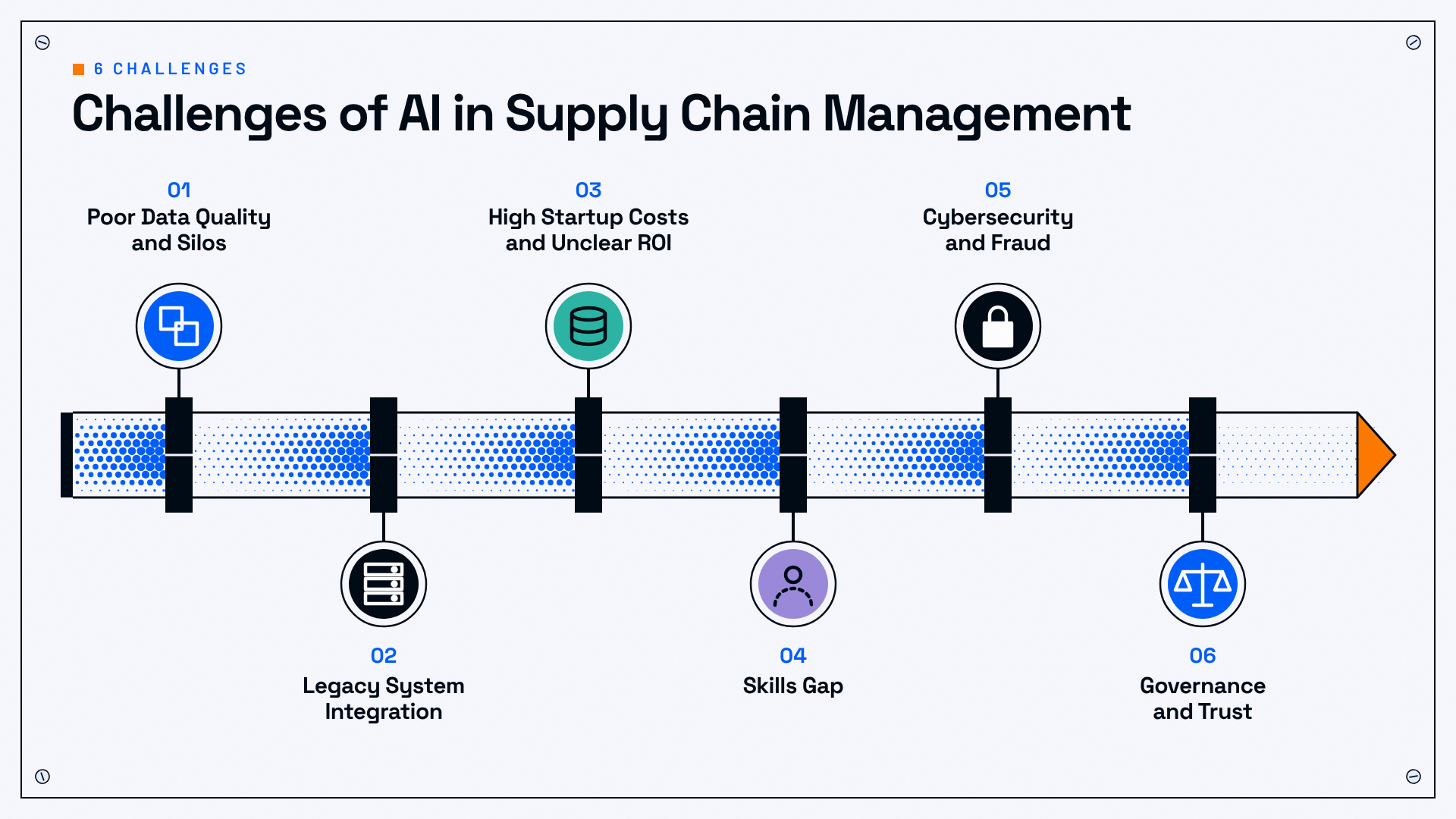
The challenges of AI in supply chain management are poor data, legacy systems, cost, skills, security and governance. Most failed projects stall on these issues, not on the models. The good news is that each one has a known fix.
The 6 challenges of AI in supply chain management are outlined below.
- Poor data quality and silos: Duplicate records and disconnected systems produce bad forecasts.
- Legacy system integration: Older ERP systems often need platform modernization before AI can use their data.
- High startup costs and unclear ROI: Data work and integrations add up before savings appear.
- Skills gap: MHI’s 2026 report ranks talent shortages as the second most cited industry trend.
- Cybersecurity and fraud: More connections mean more entry points, plus AI-generated fake documents.
- Governance and trust: Teams won’t act on recommendations they can’t understand.
How to Implement AI in Supply Chain Management Systems?
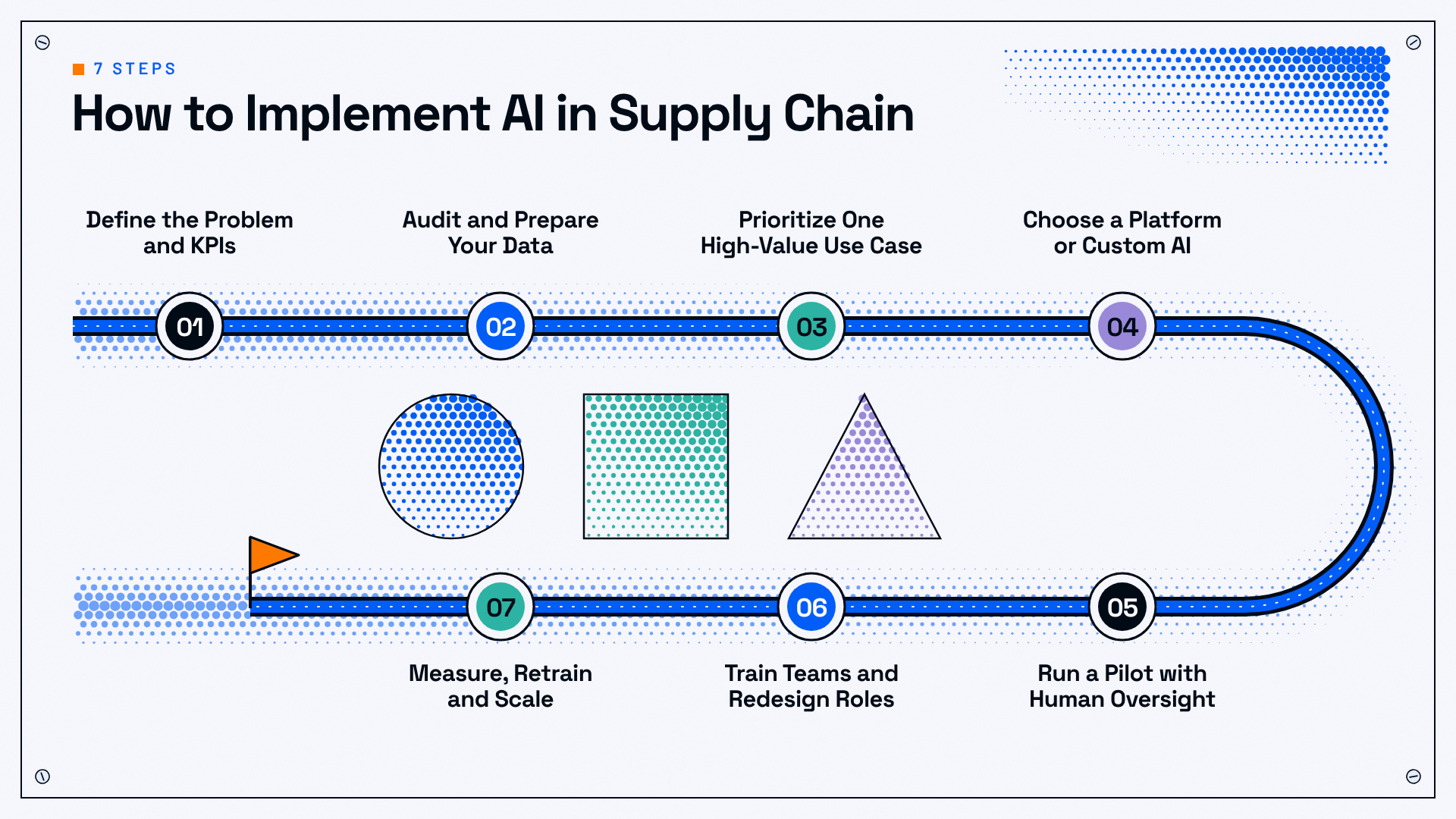
To implement AI in supply chain management systems, start with one business problem and the data behind it. Then pilot, measure and scale only what works.
7 steps to implement AI in supply chain management systems are given below.
- Define the problem and KPIs. Pick one measurable pain point, like stockouts. Record a baseline, such as forecast error or cost per shipment.
- Audit and prepare your data. Check what your ERP, WMS and TMS actually hold. Fix duplicates and gaps before training any model.
- Prioritize one high-value use case. Choose the one with clean data and clear savings. Demand forecasting and routing are common first picks.
- Choose a platform or custom AI. Platforms fit standard processes. Custom AI fits unique workflows and many connected systems. CodersBucket builds forecasting models and ERP integrations through its AI-powered applications and automation service.
- Run a pilot with human oversight. Test on one site, lane or product group. Let people approve AI decisions until results earn trust.
- Train teams and redesign roles. Show planners how to read and challenge AI output. Move their time from data entry to exceptions.
- Measure, retrain and scale. Track your KPIs and retrain models as conditions change. Reliable DevOps services keep deployment stable as you add sites.
What Are the Latest AI Trends in Supply Chain Management?
The latest AI trends in supply chain management point to more autonomy with tighter governance. Gartner’s top supply chain technology trends for 2026 group 8 trends into three themes. Those are autonomy and agency, specialization and intelligence, and trust and governance.
Gartner’s 8 top supply chain technology trends for 2026 are shown below.
- Polyfunctional robots: Machines that switch between several warehouse tasks.
- Physical AI: AI that senses and acts in the physical world.
- Agentic AI: Software agents that plan and finish tasks toward a goal.
- Collaborative multiagent systems: Groups of agents that coordinate across functions.
- Intelligent simulation: Digital twins that test decisions before they go live.
- Domain-specific language models: Language models trained on supply chain data.
- Product provenance: Proof of where a product and its materials came from.
- Decision governance: Rules for which decisions AI may make alone.
What Is Agentic AI in Supply Chain Management?
Agentic AI in supply chain management is AI that plans, acts and adapts toward a goal. It doesn’t stop at insights. It finishes the task.
Gartner predicts AI will resolve 60% of supply chain disruptions without human help by 2031. Its planning forecast is more cautious. By 2030, only 5% of organizations will make 10% of planning decisions autonomously.
The gap makes sense. Routine tasks like replenishment automate first, and big calls stay with people. You can start small, like an internal AI agent built with n8n, Qdrant and Slack.
How Is Generative AI Used in Supply Chain Management?
Generative AI is used in supply chain management to write, summarize and answer questions in plain language. It drafts reports, reads supplier emails and writes purchase order text.
Planners can also run what-if scenarios by asking questions in everyday words. Say a port closes. A planner can ask which orders are at risk and get a ranked list in seconds.
Examples include Microsoft Copilot in Dynamics 365 and NetSuite Text Enhance. The IBM Institute for Business Value found 89% of executives plan automation investments with generative AI.
Is AI in Supply Chain Management Worth the Investment?
Yes, AI in supply chain management is worth the investment when you start with clean data. It also needs one focused use case. The results above are real, but most businesses haven’t scaled yet.
A Maersk survey of 800+ European customers found 52% use AI in their supply chain. Only 5% have scaled it. And 55% of chief supply chain officers are unclear on their AI returns, Gartner says.
How Much Does AI in Supply Chain Management Cost?
AI in supply chain management costs about $20,000 to $80,000 for basic, pretrained solutions. Prebuilt risk systems can reach $150,000, and custom projects cost more, according to NetSuite.
Enterprises spend far more. Gartner found 83% of surveyed organizations spent at least $3 million automating supply chain planning.
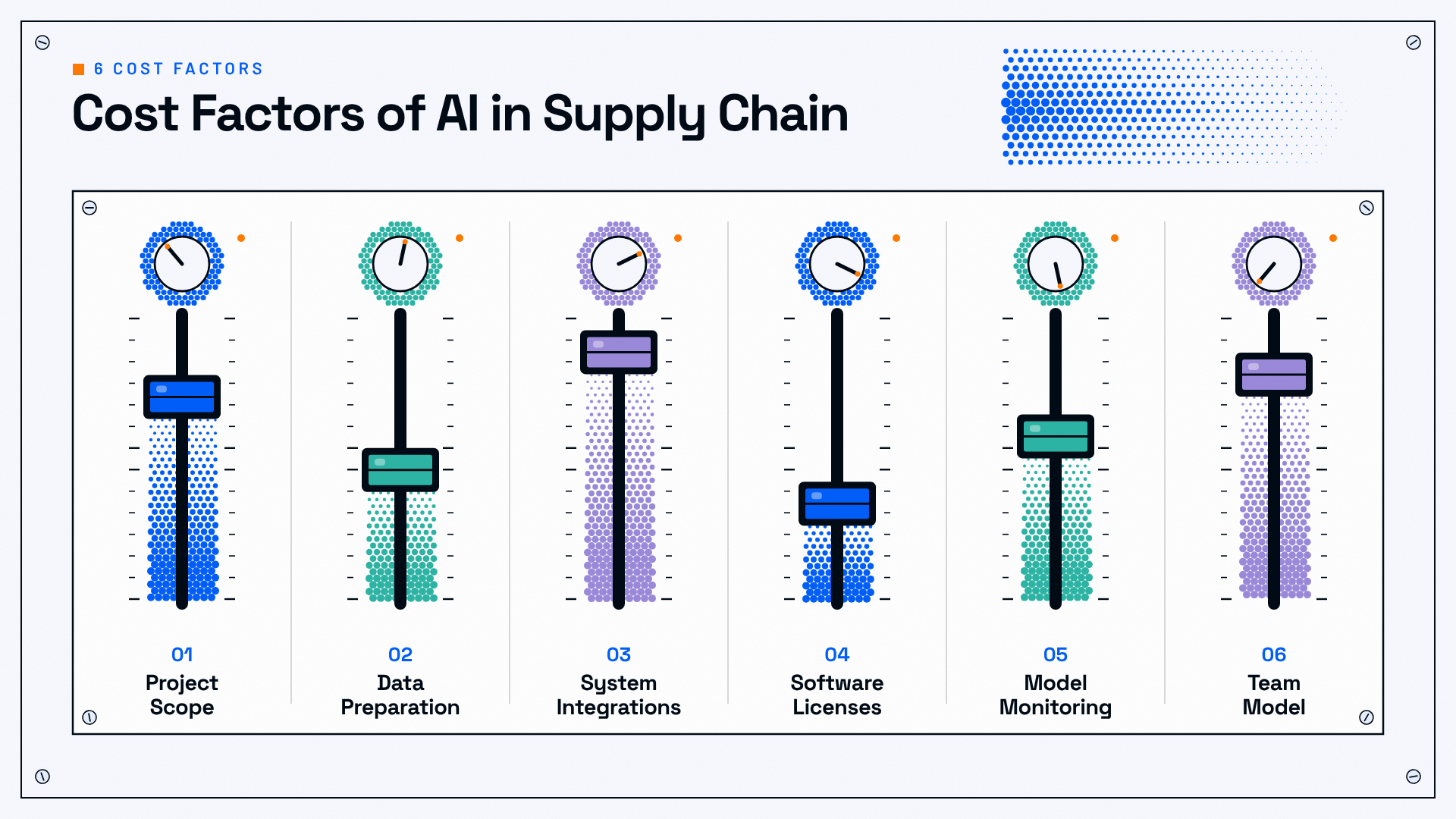
The factors that affect the cost of AI in supply chain management are given below.
- Project scope: One use case costs far less than a full rollout.
- Data preparation: Cleaning records often takes the most effort.
- System integrations: Each ERP, WMS or TMS link adds build time.
- Software licenses: Fees usually scale with users, sites or volume.
- Model monitoring: Models need ongoing retraining.
- Team model: In-house, agency or an offshore development team changes your rates.
How Long Does It Take to Implement AI in a Supply Chain?
Implementing AI in a supply chain takes weeks to months for a pilot. A full rollout takes years. There’s no reliable industry average, so real timelines help.
PepsiCo ran its pilot for about a year before scaling. DHL had its SOFTBOT robotics platform live in 30 sites in March 2026. It plans over 100 sites within three years.
Smaller businesses can move faster because they have fewer systems to connect. Start with one feature through MVP development, then expand once it proves its value.
How Does AI Compare With Other Supply Chain Approaches?
AI differs from traditional software and rule-based automation because it learns and adapts. The two comparisons below show where the lines fall.
What Is the Difference Between AI and Traditional Supply Chain Management?
The difference is that traditional systems follow fixed rules, while AI updates plans continuously. Traditional planning relies on historical data and monthly or quarterly cycles.
AI uses live data, like weather and supplier signals, and adjusts plans as things change. Planners shift to exception-based management. They stop rebuilding forecasts and focus on calls that need judgment.
The cost structure differs too. Traditional tools are cheaper to start, but they need manual updates whenever conditions change. AI costs more upfront, then keeps improving as it sees more data.
What Is the Difference Between AI and Automation in Supply Chain?
The difference is that automation follows fixed steps, while AI learns and handles exceptions. Rule-based automation, including robotic process automation, breaks when inputs don’t match the template.
AI can read messy inputs like emails. C.H. Robinson says a decade of digital booking forms automated only about 5% of requests. Agentic AI combines both: automation’s reliability with AI’s flexibility.
Frequently Asked Questions
Below are direct answers to common questions about AI in the supply chain.
Will AI Replace Supply Chain Jobs?
No, AI will not fully replace supply chain jobs, but it’s already changing them. Gartner reported in October 2026 that 47% of supply chains cut headcount, mainly due to AI.
The average cut was 10.5% over two years, mostly at entry level. Still, top performers are upgrading those roles instead of removing them. Growing jobs involve managing and checking AI systems.
Can Small Businesses Use AI in Supply Chain Management?
Yes, small businesses can use AI in supply chain management because the tools are now affordable. Cloud ERP systems include built-in AI, and Walmart sells Route Optimization to any size business.
Logistics providers are building for small shippers too. In September 2026, DHL and Alibaba agreed to explore AI freight booking for small businesses. Start with one use case, and use custom software development to fill gaps.
Do You Need a Lot of Data to Start Using AI in Your Supply Chain?
No, you don’t need years of perfect data to start. Most first projects use the sales, inventory and lead time records already in your ERP. Clean, consistent data matters more than volume.
Start with one product line or location. You can add weather, supplier and market data once the first model proves useful.
Can AI Work With Your Existing ERP System?
Yes, AI can work with most existing ERP systems through APIs and data connectors. The AI layer reads data from the ERP, then sends forecasts or orders back into it.
Older systems without modern APIs may need upgrades first. That’s why an integration review belongs in the first step of any project.
Is AI Demand Forecasting More Accurate Than Traditional Forecasting?
Yes, AI demand forecasting is usually more accurate because it uses more signals than sales history alone. For example, Unilever said weather-based AI forecasting improved forecast accuracy by 10% in Sweden.
Final Thoughts
AI in supply chain management systems has moved supply chains from reactive to predictive, and now toward agentic. The 10 examples show measurable results in routing, forecasting, maintenance, customs and warehousing.
The 2026 industry changes show AI starting to act, with people still making the big calls. Success comes down to clean data, a focused use case and teams who trust the output.
Need a custom AI tool for forecasting, agents or ERP integration? You can discuss your project with the CodersBucket team.