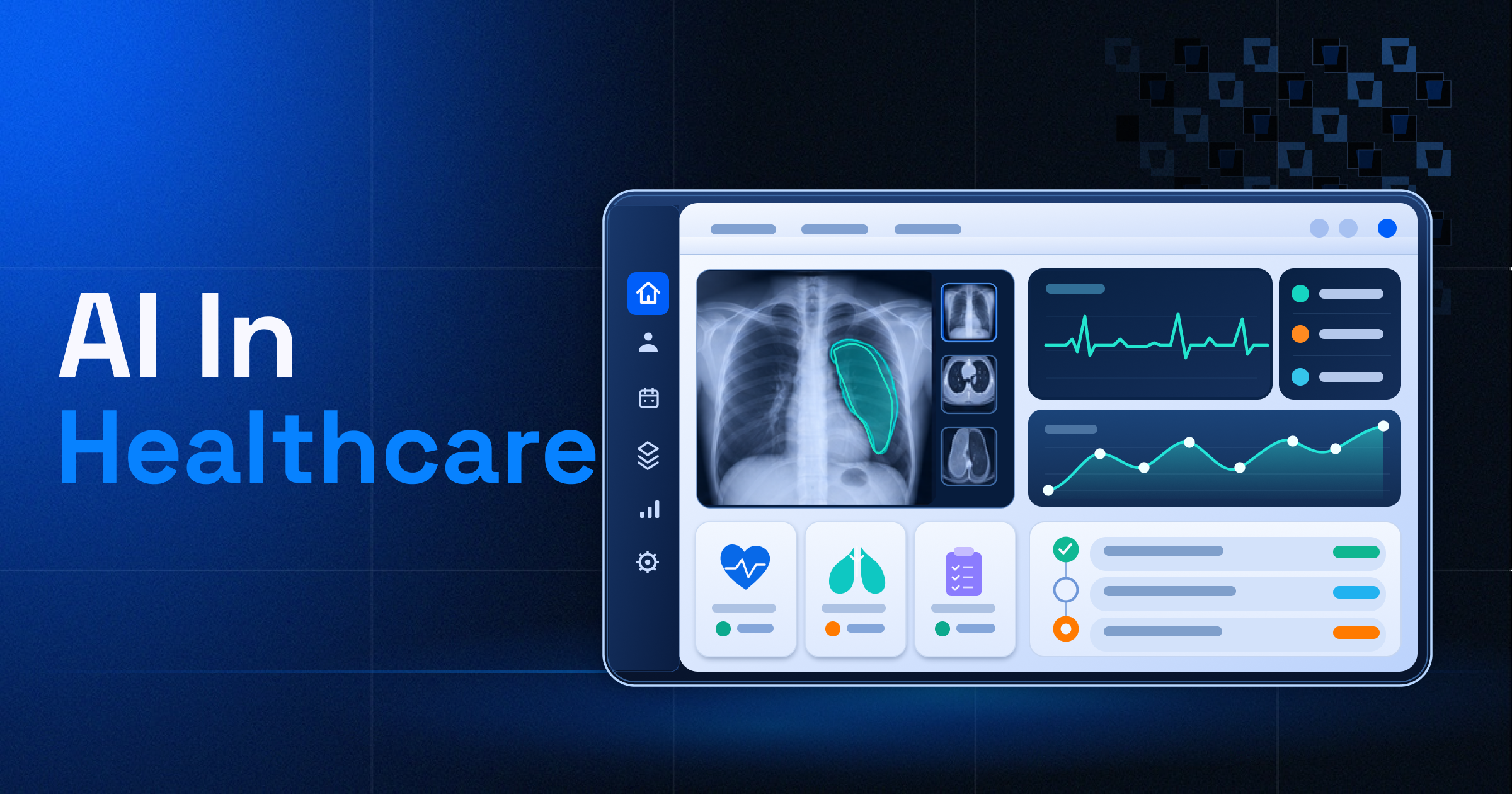
AI in healthcare is the use of software that learns from medical data to help clinicians read scans, write notes, predict risk and run hospital operations. It works by training machine learning and large language models on records, images and signals, then placing those models inside clinical workflows where a human reviews the output. The main types are machine learning, deep learning and computer vision, natural language processing, generative AI, agentic AI and robotics.
Real-world examples now run at scale, from Aidoc and Viz.ai in medical imaging to Abridge and Microsoft Dragon Copilot in clinical documentation, plus Epic, Insilico Medicine, Tempus and others in predictive analytics, drug discovery and patient care. The benefits include faster diagnosis, better patient outcomes and a lighter administrative burden.
The risks are real too, from bias and privacy to hallucinations. Below, you will learn how FDA-authorized devices and the EU AI Act shape the field, which 2026 trends matter, from ambient AI scribes to agentic AI, and how to implement AI in your organization.
What Is AI in Healthcare?
AI in healthcare is the application of computer systems that mimic human intelligence to medical and healthcare data. These systems analyze large datasets, find patterns and anomalies that people can miss, support clinical decisions and automate routine work. The field covers four core technologies: machine learning, natural language processing (NLP), computer vision and generative AI. AI assists healthcare professionals. It does not replace their clinical judgment.
How Does AI Work in Healthcare?
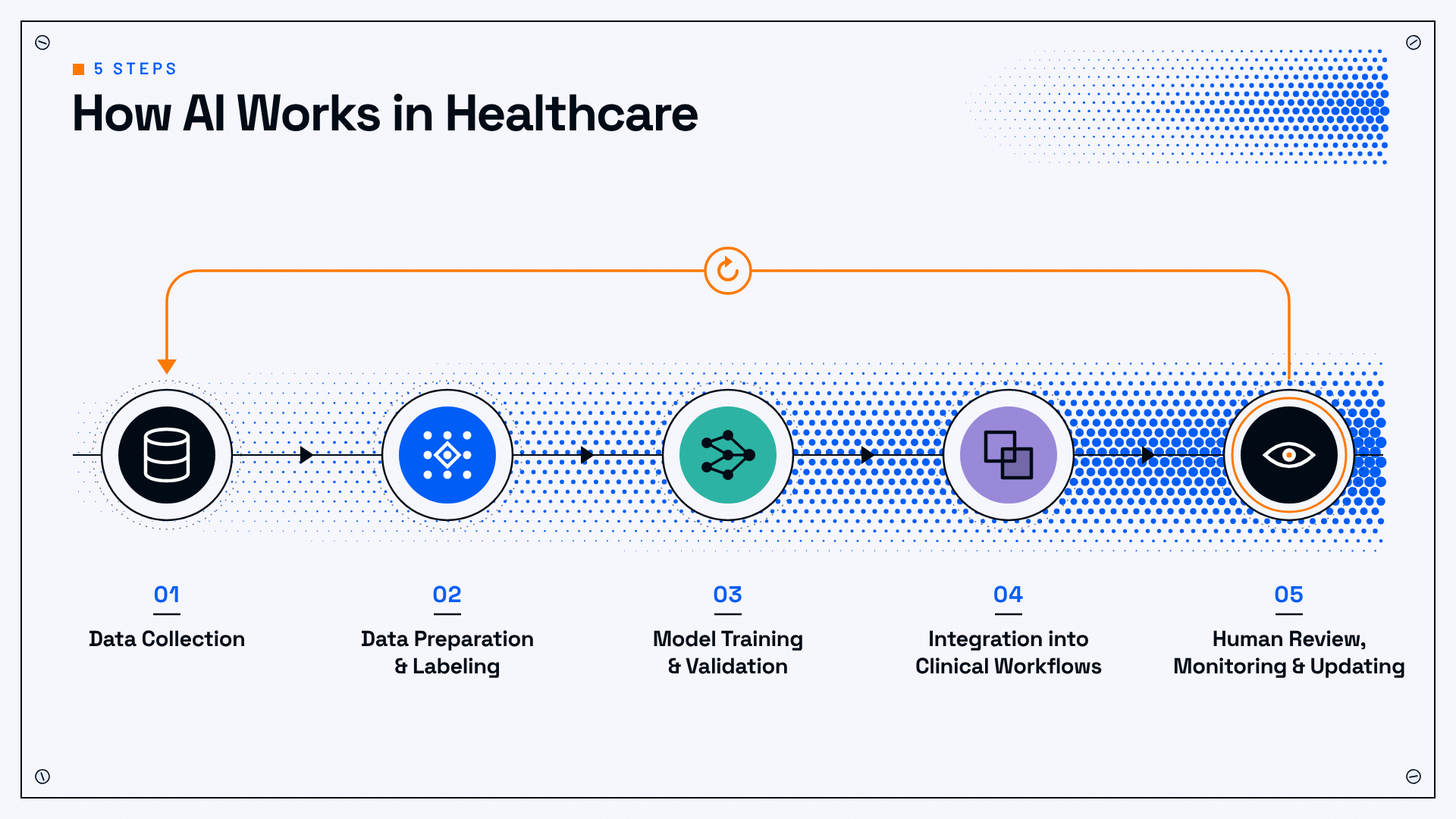
AI works in healthcare by turning medical data into trained models that sit inside clinical workflows and stay under human supervision. The process runs as a cycle: data comes in, a model learns from it, clinicians use and check the output, and the model is evaluated, scaled and then monitored after deployment so its performance does not drift.
5 steps of how AI works in healthcare are given below.
- Data collection. The system gathers data from electronic health records (EHRs), medical images, wearables and genomic data. The quality of this training data limits what the model can learn.
- Data preparation and labeling. Teams clean records, remove patient identifiers and label examples, such as scans that show a bleed. Supervised learning depends on accurate labels.
- Model training and validation. Developers train the model on one dataset and test it on data it has never seen. Model validation measures accuracy, sensitivity and specificity before patients are affected.
- Integration into clinical workflows. The model connects to the EHR or imaging systems, so results appear where clinicians already work. Tools outside real-world workflows rarely get used.
- Human review, monitoring and updating. A clinician in the loop reviews outputs that affect care. Continuous performance monitoring catches drift, and teams retrain the model when patients or practices change.
What Are the Types of AI Used in Healthcare?
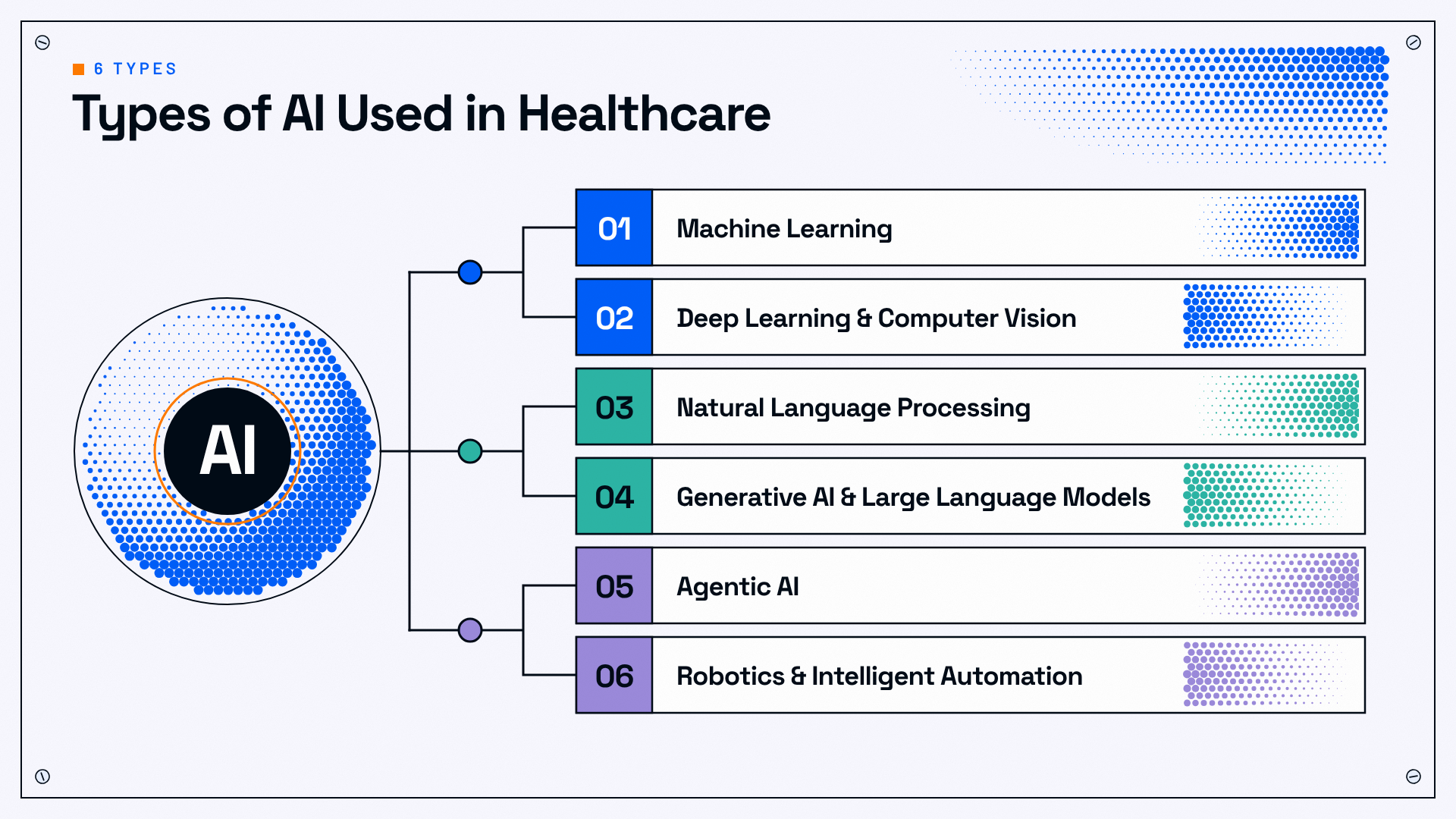
The types of AI used in healthcare range from models that predict risk to systems that write notes, take actions or guide surgical instruments. Most real products combine several types, but each one solves a different kind of problem.
The 6 types of AI used in healthcare are given below.
- Machine learning. Machine learning (ML) algorithms learn patterns from historical data and make predictions without hand-written rules. A common use is predictive analytics, such as scoring each inpatient’s readmission risk before discharge.
- Deep learning and computer vision. Deep learning uses layered neural networks, and computer vision applies them to images. The main healthcare use is medical image analysis, where models flag bleeds, fractures or tumors on CT, MRI and X-ray scans.
- Natural language processing. NLP lets software read and interpret human language. Hospitals use it to pull diagnoses, medications and history out of unstructured clinical notes for coding, research and decision support.
- Generative AI and large language models. Generative AI creates new content, and large language models (LLMs) are trained on vast amounts of text to produce it. The leading healthcare use is ambient documentation, where an LLM drafts the visit note.
- Agentic AI. Agentic AI plans and completes multi-step tasks by using software tools on a user’s behalf. One healthcare use is an agent that gathers records, fills out a prior authorization request and routes it to staff.
- Robotics and intelligent automation. This type covers physical robots and software bots. Robot-assisted surgery gives surgeons precise instrument control, while robotic process automation (RPA) handles back-office work such as claims entry.
What Are the Top Examples of AI in Healthcare?
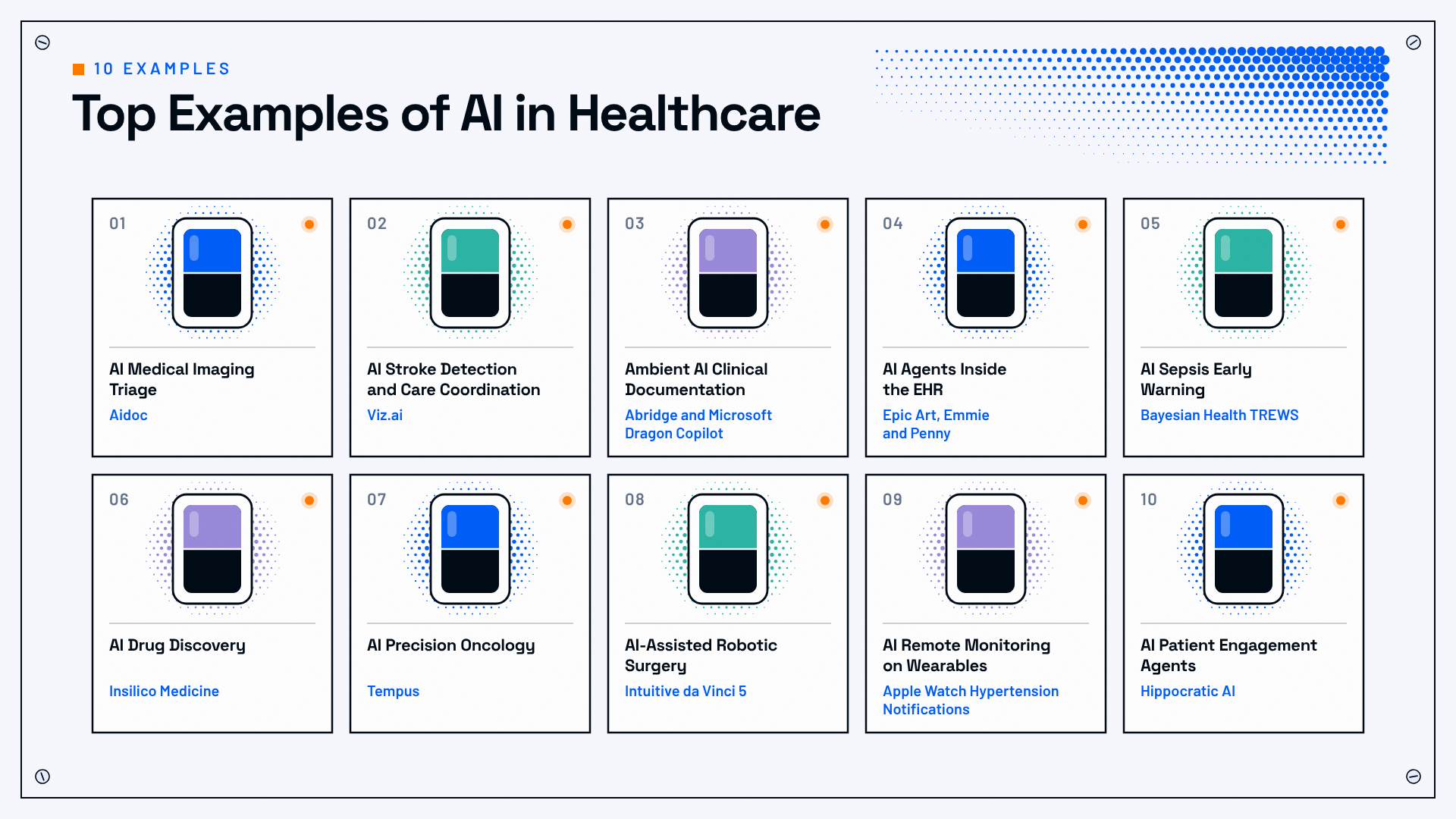
The top examples of AI in healthcare are imaging triage, stroke care, clinical documentation, EHR agents, sepsis alerts, drug discovery, precision oncology, robotic surgery, wearables and patient engagement agents. Each example below is a live deployment from a named company, used today by health systems, hospitals or patients.
10 real-world examples of AI in healthcare and the live platforms behind them are given below.
1. AI Medical Imaging Triage: Aidoc
Aidoc builds AI that reviews CT scans as soon as they are taken and moves critical findings, such as internal bleeding, to the top of the radiologist worklist. Urgent cases get read first instead of waiting in line, which matters when imaging backlogs and emergency department crowding slow care down.
In January 2026, the FDA cleared Aidoc’s CARE foundation model triage solution for abdomen CT. It combines 11 newly cleared indications with 3 previously cleared ones in a single workflow, rather than running a separate algorithm for each condition. In the FDA-reviewed pivotal study, the model reached a mean sensitivity of 97% and a mean specificity of 98%. Aidoc runs its tools on its aiOS platform, available at aidoc.com.
2. AI Stroke Detection and Care Coordination: Viz.ai
Viz.ai detects suspected large vessel occlusion (LVO), a severe type of stroke, on CT scans and alerts the stroke team on their phones. Neurologists, radiologists and transfer staff see the same images and messages, so care coordination does not depend on a chain of phone calls. In stroke care, time is brain.
Viz.ai reported in January 2026 that its platform is used in nearly 2,000 US hospitals. At the International Stroke Conference (ISC) 2026, data from Adventist Health + Rideout showed that door-in-door-out time for LVO patients fell 44%, from 202 to 113 minutes, after the hospital paired Viz.ai with standardized interfacility transfer protocols. You can see the platform at viz.ai.
3. Ambient AI Clinical Documentation: Abridge and Microsoft Dragon Copilot
Ambient AI scribes listen to the patient visit, with the patient’s consent, and draft the clinical note. The clinician then reviews, edits and signs it. This keeps the doctor focused on the patient rather than the keyboard and targets one of the biggest drivers of physician burnout.
Abridge says it is trusted by more than 300 health systems, and it was named Best in KLAS for ambient AI in both 2025 and 2026. Microsoft reported at HIMSS 2026 that more than 100,000 clinicians use Dragon Copilot. Evidence from five academic medical centers found that clinicians spent 16 fewer minutes on documentation and 13 fewer minutes in the EHR per eight hours of scheduled care. Both tools are available at abridge.com and aka.ms/DragonCopilot.
4. AI Agents Inside the EHR: Epic Art, Emmie and Penny
Epic has built three AI assistants into its electronic health record. Art supports clinicians with tasks such as chart summaries and draft replies, Emmie helps patients inside MyChart, and Penny works with revenue cycle teams on coding, billing and insurance tasks. Each one keeps a human in the loop to approve the final action.
At HIMSS 2026, Epic said more than 85% of its customers actively use Epic AI, and it announced Agent Factory, a tool that lets health systems build their own custom agents. At Summit Health, Penny cut medication prior authorization submission time by 42%, and staff accepted 92% of its AI-generated responses without edits. Details are at epic.com.
5. AI Sepsis Early Warning: Bayesian Health TREWS
Bayesian Health’s TREWS (Targeted Real-time Early Warning System) monitors EHR data, such as vital signs and lab results, in real time and flags patients at risk of sepsis. Each alert shows the reasons behind it, so clinicians can judge it quickly. That transparency helps reduce alert fatigue.
A Johns Hopkins study published in Nature Medicine in 2022 covered more than 590,000 patients across five hospitals. TREWS detected 82% of sepsis cases and flagged patients about 5.7 hours earlier on average. When clinicians confirmed an alert within three hours, mortality fell by a relative 18% to 19%. Earlier confirmation meant treatment, such as antibiotics, could start sooner. The company’s site is bayesianhealth.com.
6. AI Drug Discovery: Insilico Medicine
Insilico Medicine used its Pharma.AI platform to identify TNIK as a new target for idiopathic pulmonary fibrosis (IPF), a scarring lung disease. It then used generative chemistry to design a TNIK inhibitor called rentosertib. AI drove both the target identification and the molecule design.
Phase IIa results were published in Nature Medicine in 2025, and Insilico started a Phase III trial on July 7, 2026. As of late 2026, no AI-discovered drug has received FDA approval, so rentosertib is still investigational. Investment in the field keeps growing, and Isomorphic Labs raised a $2.1 billion Series B in May 2026. Learn more about Insilico at insilico.com.
7. AI Precision Oncology: Tempus
Tempus combines genomic sequencing of a patient’s tumor with multimodal clinical data, such as pathology, imaging and treatment history, and uses AI to make that data useful at the point of care. Oncologists get reports that help them choose treatments based on the tumor’s molecular profile, and the platform supports clinical trial matching.
On May 29, 2026, the FDA approved a tumor-only indication for Tempus’s xT CDx test. That approval made Tempus the first lab with companion diagnostic approval for both tumor-only and tumor-normal comprehensive genomic profiling. A companion diagnostic is a test that identifies which patients are likely to benefit from a specific therapy. Tempus is at tempus.com.
8. AI-Assisted Robotic Surgery: Intuitive da Vinci 5
The surgeon controls every movement of da Vinci 5 from a console, and the robot does not operate on its own. The system’s computing power adds real-time surgical insights. Force Gauge shows how much force the instruments apply to tissue, and In-Console Video Replay lets surgeons review earlier moments of a procedure without leaving the console. Both features were FDA-cleared in September 2025.
Intuitive reported more than 1,400 da Vinci 5 systems installed and more than 380,000 procedures performed as of May 2026. In July 2026, the company published an AI framework that includes supervised autonomy, under which the surgeon stays accountable and in control. You can find the system at intuitive.com.
9. AI Remote Monitoring on Wearables: Apple Watch Hypertension Notifications
Apple Watch hypertension notifications use machine learning to analyze optical heart sensor data over 30-day periods. If the watch sees consistent signs of high blood pressure, it notifies the user. The FDA cleared the feature in September 2025 for Apple Watch Series 9 or later and Apple Watch Ultra 2 or later.
The feature is meant for users aged 22 or older who are not pregnant and have no prior hypertension diagnosis. Apple expects it to notify more than 1 million people with undiagnosed hypertension in its first year. It does not diagnose. Users who get a notification should confirm their readings with a blood pressure cuff, keep a blood pressure log and talk to their doctor. Setup details are at support.apple.com/117296.
10. AI Patient Engagement Agents: Hippocratic AI
Hippocratic AI builds voice AI agents that call patients for non-diagnostic tasks, such as pre-visit intake, scheduling, discharge follow-up and chronic care check-ins. The agents do not diagnose or prescribe, so clinical decisions stay with the care team. This helps health systems extend patient outreach during a nurse staffing shortage and support readmission prevention.
The company reports more than 250 million patient interactions. In August 2026, it launched more than 30 Agentic Orchestrators, which coordinate teams of voice agents around a shared goal, such as guiding a patient through the weeks after discharge. The platform is at hippocraticai.com.
What Are the Benefits of AI in Healthcare?
The benefits of AI in healthcare are faster and more accurate care for patients, less paperwork for clinicians and lower operating costs for providers. The gains are clearest where AI takes over repetitive, data-heavy work so that people can focus on judgment and patient contact.
The benefits of AI in healthcare are given below.
- Earlier and faster diagnosis: Imaging and early warning tools surface problems sooner. TREWS flagged sepsis about 5.7 hours earlier on average, giving teams more time to treat.
- Less documentation and lower burnout: Ambient scribes give clinicians time back. In the AMA’s 2026 survey, 70% of physicians said they see AI as a way to automate burnout-causing tasks.
- Faster emergency care: Automated alerts shorten the path from scan to treatment. One Viz.ai hospital cut stroke door-in-door-out time by 44%.
- Personalized treatment: AI links genomic, imaging and clinical data into personalized care plans, such as matching a tumor profile to a targeted therapy.
- Faster drug discovery and clinical trials: AI speeds up target identification and molecule design, and helps sponsors find eligible trial patients faster.
- Lower administrative cost: Automation reduces time spent on prior authorization, billing and coding. Epic’s Penny cut prior authorization submission time by 42%.
- Wider access to care: Virtual assistants answer routine questions at any hour, and remote AI tools give rural hospitals faster imaging and stroke support.
What Are the Challenges and Risks of AI in Healthcare?
The challenges of AI in healthcare are technical, ethical and organizational. Models can be biased, opaque or wrong, patient data is a high-value target for attackers, and many tools still lack strong proof that they improve patient outcomes.
The main challenges and risks of AI in healthcare are outlined below.
- Data privacy and security: AI needs large volumes of patient data. In an IBM Institute for Business Value study, 53% of healthcare executives named patient data protection and cybersecurity as their biggest AI challenge.
- Algorithmic bias: Models learn the inequities in their data. A 2019 study in Science found a widely used care-coordination algorithm underestimated Black patients’ needs because it used healthcare spending as a proxy for illness.
- Black-box decisions and explainability: Many deep learning models cannot show how they reached a result. Without explainable AI, clinicians struggle to trust or defend a recommendation, and liability becomes unclear.
- Hallucinations and automation bias: LLMs can produce confident but false statements, and busy staff may accept them unchecked. The WHO guidance on large multi-modal models flags both risks.
- Data silos and EHR integration: Patient data sits in systems that do not share formats easily. Poor interoperability limits training data and makes workflow integration harder.
- Limited outcome evidence: Many authorized AI devices were cleared on accuracy studies, not trials showing better patient outcomes. Strong test results do not always mean better care.
- Training gaps and skill loss: Staff need training to use AI well. In the AMA 2026 survey, 88% of physicians said they are concerned about skill loss as AI takes on more clinical work.
How Is AI in Healthcare Regulated?
AI in healthcare is regulated mainly through existing medical device, privacy and patient safety rules, with AI-specific laws arriving in the EU. Because rules are still shifting in 2026, any healthcare AI product needs an early regulatory check.
In the US, the FDA regulates AI-enabled medical devices rather than AI itself. Most tools reach the market as software as a medical device through 510(k) clearance, and a predetermined change control plan lets makers update a model within pre-agreed limits. The FDA’s list of AI-enabled medical devices had 1,614 entries at its September 2026 update, and about 76% of listed devices are in radiology. As of September 2026, no device using generative AI or LLMs had been authorized.
On January 6, 2026, the FDA updated its Clinical Decision Support and General Wellness guidances. The changes relaxed oversight of some decision-support software that gives a single recommendation and of non-invasive wellness wearables.
The EU AI Act treats AI medical devices as high-risk AI. Under the Digital Omnibus, approved by the Council on June 29, 2026, the deadline is now August 2, 2028 for AI in medical devices and December 2, 2027 for standalone high-risk systems. Globally, the WHO’s guidance on large multi-modal models sets out more than 40 recommendations for governments, developers and providers.
The main AI healthcare rules in 2026 are shown in the table below.
| Region | Regulator or law | 2026 status |
| US | FDA AI-enabled device list | 1,614 entries at the September 2026 update; no generative AI or LLM device authorized |
| US | FDA CDS and General Wellness guidances | Updated January 6, 2026, with lighter oversight for some decision-support software and wellness wearables |
| US | HIPAA | Applies to patient data used to build and run AI tools |
| EU | EU AI Act and Digital Omnibus | High-risk deadlines moved to August 2, 2028 (medical devices) and December 2, 2027 (standalone systems) |
| Global | WHO guidance on large multi-modal models | More than 40 recommendations on ethics and governance |
What Are the Latest AI in Healthcare Trends in 2026?
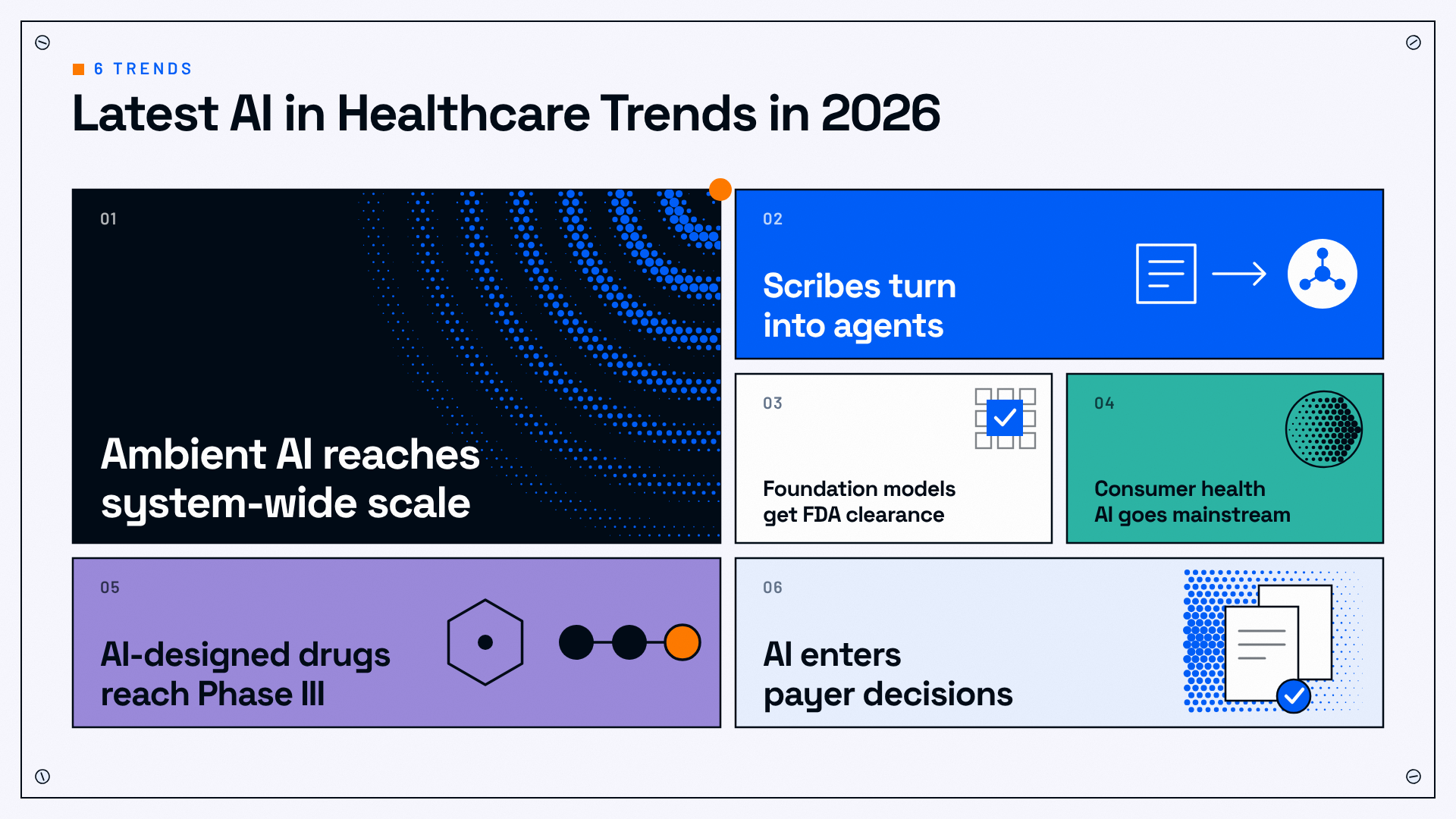
The latest AI in healthcare trends in 2026 are wider adoption, a shift from assistants to agents, and AI moving into regulated, consumer and payer settings. Tools that were pilots in 2024 and 2025 are becoming standard across many health systems.
6 AI in healthcare trends shaping 2026 are outlined below.
- Ambient AI reaches system-wide scale: In the AMA’s 2026 physician survey, 81% of physicians said they use AI. Doximity data shows physician use of voice documentation rose from 20% to 29% in under a year.
- Scribes turn into agents: Epic’s Agent Factory and the agentic Dragon Copilot, both shown at HIMSS 2026, mark a move from drafting notes to completing tasks. Yet NVIDIA’s 2026 report found 69% of healthcare organizations use generative AI and only 22% use AI agents.
- Foundation models get FDA clearance: Aidoc’s CARE showed that one foundation model can cover many findings in a single cleared workflow, reducing the number of separate algorithms a radiology team manages.
- Consumer health AI goes mainstream: OpenAI launched ChatGPT Health on January 7, 2026, and rolled it out to US users aged 18 and older on July 23, 2026, letting patients connect records and wellness apps.
- AI-designed drugs reach Phase III: Insilico’s rentosertib entered Phase III in July 2026, one of the first candidates where AI both identified the target and designed the molecule.
- AI enters payer decisions: The CMS WISeR Model began on January 1, 2026, bringing AI-assisted prior authorization to Traditional Medicare in six states. It faces scrutiny from physician groups and some lawmakers.
How to Implement AI in Healthcare?
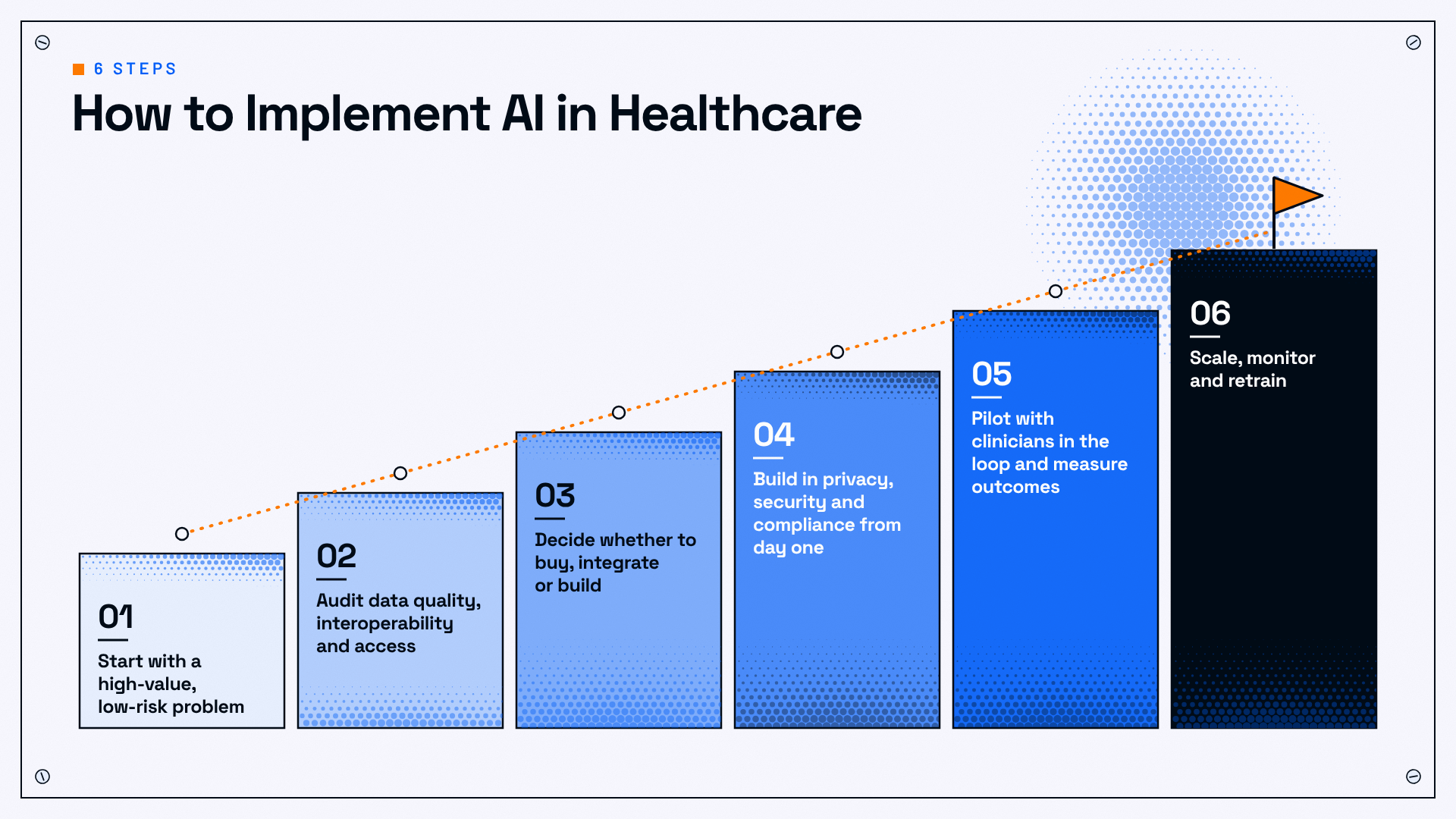
To implement AI in healthcare, start with a small, well-defined problem, prove value with clinicians and then scale with strong AI governance. A sensible rollout moves from low-risk uses, such as documentation, to higher-risk clinical uses only after the data, controls and trust are in place. Clinician involvement matters, as 85% of physicians in the AMA survey said they want a say in AI adoption decisions.
6 steps to implement AI in a healthcare organization are given below.
- Start with a high-value, low-risk problem. Choose a use case with clear pain and limited clinical risk, such as documentation, scheduling or message triage. Define the metric you want to improve first.
- Audit data quality, interoperability and access. Check whether your EHR and other systems can share data through standards such as FHIR. If legacy systems block access, platform modernization may come first.
- Decide whether to buy, integrate or build. Buy proven tools for common needs, and build when your workflow is unique. Teams without in-house AI skills often work with a partner such as CodersBucket for AI-powered applications and automation, MVPs or EHR integrations.
- Build in privacy, security and compliance from day one. Apply HIPAA safeguards such as encryption, access controls and audit logs. If the tool is a medical device, plan for FDA or EU AI Act rules early.
- Pilot with clinicians in the loop and measure outcomes. Run a time-limited pilot with a small user group. Track accuracy, time saved, feedback and safety signals against a pre-launch baseline.
- Scale, monitor and retrain. Roll out in stages and watch model performance continuously. Reliable DevOps services and monitoring pipelines help you catch drift and retrain safely.
How Much Does It Cost to Build AI Healthcare Software?
The cost to build AI healthcare software depends mainly on project scope. Adding an AI feature, such as note summarization, to an existing app costs far less than building a regulated diagnostic device that needs clinical validation and an FDA submission. The main cost drivers are data preparation and labeling, EHR and FHIR integrations, regulatory compliance work, cloud infrastructure, and maintenance and retraining after launch. Patient-facing custom software and mobile apps also need security testing.
The most practical way to control upfront cost is to start with a minimum viable product (MVP). An MVP tests one core use case with real users before you commit to the full build. CodersBucket can help you scope that first version through its MVP and SaaS development services, so you expand only when the results justify it.
How Big Is the AI in Healthcare Market?
The AI in healthcare market is large and growing quickly, although estimates vary by research firm. Grand View Research valued the market at $36.7 billion in 2025 and projects a compound annual growth rate of 38.9% from 2026 to 2033. Adoption is rising alongside investment. Menlo Ventures found that 22% of health organizations used domain-specific AI tools in 2025, a 7x increase from 2024.
What Is the Difference Between AI and Machine Learning in Healthcare?
AI is the broad field of building systems that perform tasks requiring human-like intelligence, while machine learning is a subset of AI in which algorithms learn from experience in data instead of following fixed rules. Deep learning is, in turn, a subset of machine learning. For example, an AI discharge assistant might use NLP to read clinical notes, while a supervised learning model inside it predicts each patient’s readmission risk. The whole system is AI, and the predictive model is machine learning.
What Is the Difference Between Generative AI and Agentic AI in Healthcare?
Generative AI creates new content, such as draft notes, discharge summaries or patient letters, for a person to review. Agentic AI plans and acts across multi-step workflows, such as booking appointments or assembling a prior authorization request, with limited oversight at each step. Adoption reflects that gap, as NVIDIA’s 2026 report found that 69% of healthcare organizations use generative AI but only 22% use AI agents. For a practical view of how an agent connects to company tools, see this internal AI agent built with n8n, Qdrant and Slack.
Frequently Asked Questions
Will AI Replace Doctors?
No, AI will not replace doctors because it handles narrow tasks, such as flagging a scan or drafting a note, while clinicians make the final decisions. Medicine also depends on clinical judgment and the patient-physician relationship. In the AMA 2026 survey, more than three-quarters of physicians said AI improves their ability to care for patients.
How Do Doctors Use AI Today?
Doctors use AI today mostly for information and documentation work. The AMA’s 2026 survey of 1,692 physicians found that 81% use AI and that the average physician uses 2.3 AI use cases. The top uses are summarizing medical research (39%) and drafting discharge instructions, care plans or progress notes (30%).
Is AI in Healthcare Safe?
Yes, AI in healthcare is safe when the tool is clinically validated, reviewed by the FDA if it is a medical device, and used with human oversight. Risk rises with general-purpose chatbots, which can hallucinate, and with automation bias, when staff trust outputs without checking them. Safety depends on both the tool and how people use it.
How Accurate Is AI in Medical Diagnosis?
AI accuracy in medical diagnosis depends on the task and the tool. Aidoc’s CARE model showed 97% mean sensitivity and 98% mean specificity in its pivotal study, while IDx-DR reached 87% sensitivity and 90% specificity for more-than-mild diabetic retinopathy. High accuracy in a study does not always prove better patient outcomes in practice.
Can Patients Use ChatGPT for Medical Advice?
Yes, patients can use ChatGPT for general health questions, but it should not replace a doctor. ChatGPT Health, launched January 7, 2026, lets users connect medical records through b.well and apps such as Apple Health, and it reached US users aged 18 and older on July 23, 2026. OpenAI says it is not meant for diagnosis or treatment.
Can AI Help With Mental Health Care?
Yes, AI can help with mental health care because it handles self-referral, triage and between-session support, which frees therapists to focus on treatment. Limbic Access is described as the first AI mental health chatbot with UK Class IIa medical device status, and Limbic says 45% of NHS Talking Therapies services use it. AI supports therapists rather than replacing them.
Final Thoughts
AI in healthcare is moving from pilots to production. Imaging triage, ambient scribes, EHR agents and sepsis alerts are now part of daily care in many hospitals, with measurable gains in speed and documentation time. The risks, including bias, privacy, hallucinations and thin outcome evidence, still call for human oversight.
Regulation is catching up, with updated FDA guidance, new EU AI Act deadlines and WHO principles for responsible AI. If you are a health system or healthtech founder planning a custom AI solution, you can contact the CodersBucket team to talk through your idea and next steps.