Picking a healthcare software development company rarely goes wrong on launch day. It goes wrong months later, when an EHR integration won’t connect, a security review stalls, or a vendor can’t explain who’s responsible for patient data under HIPAA.
This 2026 guide helps you avoid that. We compared 10 healthcare software development companies on the details most lists skip: hourly rates from under $25/hr to $199/hr, minimum projects from $5,000+ to $50,000+, verified Clutch ratings, and named healthcare clients. Every figure was checked in November 2026.
The list spans ISO 13485-certified firms, large enterprise teams, specialist digital health studios, and budget-friendly offshore partners. Whether you’re building a telehealth app, a patient portal, or an AI feature that touches patient data, you’ll find a partner that fits your budget and risk level.
Inside, you’ll get a side-by-side comparison table, 10 company profiles, hours-times-rate cost estimates, the regulations your partner must know, and an 8-step checklist for vetting any vendor before you sign.
How Were the Top Healthcare Software Development Companies Selected?
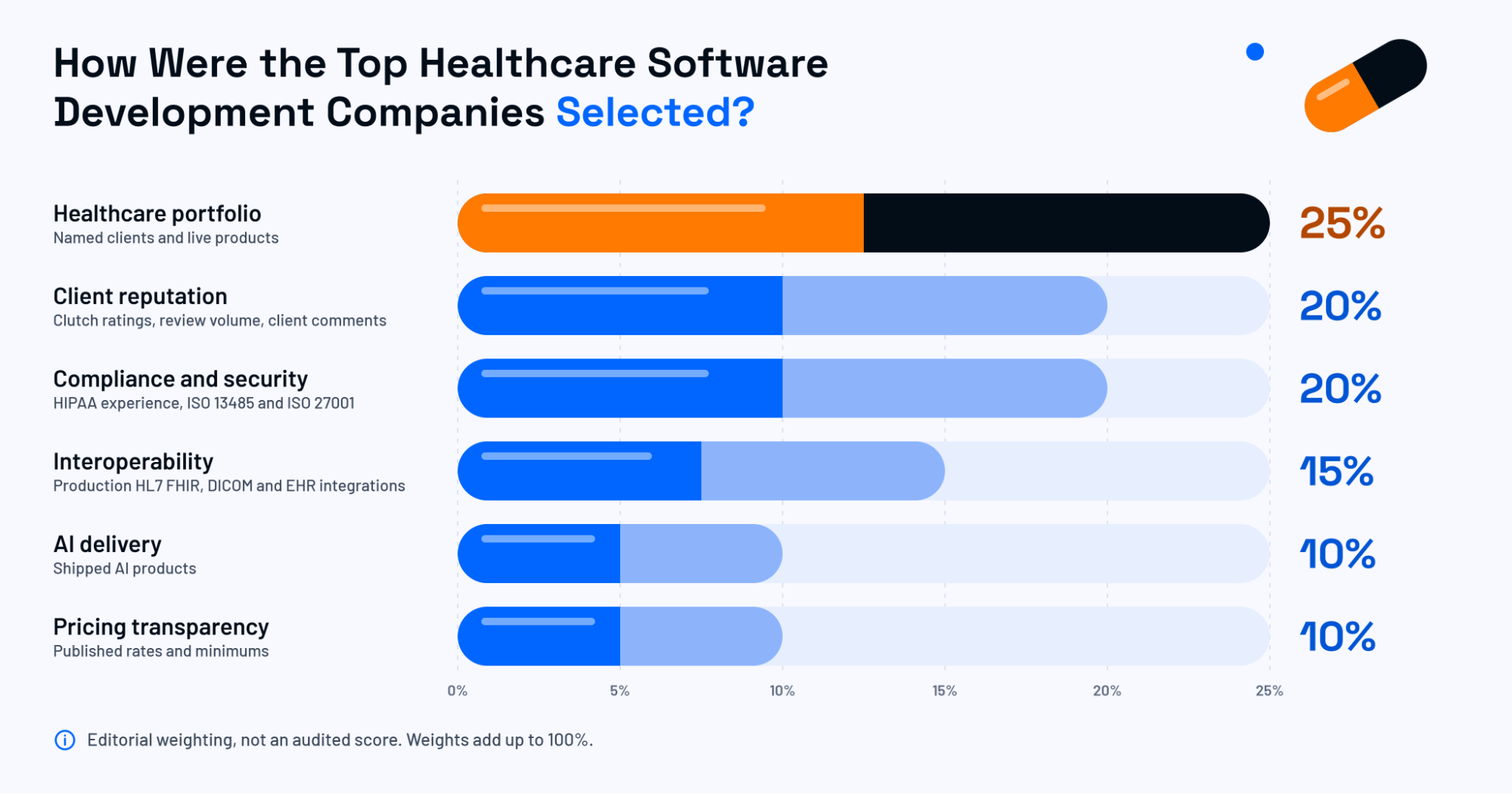
To compare the companies, we assessed six buyer-focused areas: client reputation, healthcare portfolio, compliance practices, interoperability, AI delivery, and pricing transparency. The criteria and their relative importance are explained below. This is an editorial comparison, not an independently audited industry ranking.
The comparison gives the greatest weight to evidence that helps buyers assess healthcare delivery risk. The weighting below describes our editorial priorities. It should not be read as a verified numerical score for each company.
Client reputation (20%): We considered Clutch ratings, review volume, and the substance of published client comments. Ratings are snapshots and can change. A high average based on a small number of reviews carries less evidence than a similar rating supported by a larger sample.
Healthcare portfolio (25%): We looked for named healthcare clients, live products, medical-sector project share, and clearly described delivery roles. A fitness or public-health platform can demonstrate relevant product experience, but it is not automatically equivalent to clinical-system or regulated medical-device experience.
Compliance and security (20%): We considered publicly documented HIPAA-related delivery experience, relevant certifications such as ISO 13485 or ISO 27001, and stated security processes. Certification is not the same as HIPAA compliance, and a vendor’s claims should be checked during procurement.
Interoperability (15%): Evidence of production HL7 FHIR, DICOM, and EHR integrations carries more weight than a generic API capability claim.
AI delivery (10%): We looked for shipped AI-enabled products and specific use cases rather than broad marketing claims.
Pricing transparency (10%): Published hourly rates and minimum project sizes help buyers assess affordability before a sales call.
Ratings, rates and team sizes come from the Clutch directory of healthcare software developers. We checked them in November 2026, and they change often.
We publish this guide and place our own firm first. Firms 2 to 10 are ordered by our editorial judgment across these six criteria, not by a calculated score.
How Do the Top Healthcare Software Development Companies Compare?
The top healthcare software development companies differ most in price, minimum project, and healthcare focus. Hourly rates span from under $25/hr to $199/hr, and minimums run from $5,000+ to $50,000+. Budget-first startups usually look at the lower-rate firms.
A side-by-side comparison of the 10 companies is shown below.
| Company | HQ | Hourly Rate | Minimum Project | Clutch Rating | Best For |
|---|---|---|---|---|---|
| CodersBucket | Dhaka, Bangladesh | Under $25/hr | $5,000+ | 5.0 from 3 | Health startups and agencies building AI-ready apps on a lean budget |
| ScienceSoft | McKinney, Texas | $50–$99/hr | $5,000+ | 4.8 from 46 | Hospitals and medtech firms with regulated, enterprise-scale builds |
| Topflight Apps | Irvine, California | $100–$149/hr | $50,000+ | 4.9 from 43 | Funded digital health startups wanting a US-based team |
| MindSea | Halifax, Canada | $150–$199/hr | $10,000+ | 5.0 from 47 | Health systems needing polished patient-facing apps |
| Orangesoft | Warsaw, Poland | $50–$99/hr | $25,000+ | 4.9 from 43 | Health tech founders building toward a funding round |
| TechMagic | Kraków, Poland | $50–$99/hr | $25,000+ | 4.8 from 54 | FHIR-based products with security testing in scope |
| Glorium Technologies | Houston, Texas | $50–$99/hr | $25,000+ | 4.8 from 32 | Medtech firms needing ISO 13485 certified processes |
| Light-it | Montevideo, Uruguay | $100–$149/hr | $50,000+ | 5.0 from 18 | US digital health startups wanting a nearshore team |
| Simform | Orlando, Florida | $25–$49/hr | $25,000+ | 4.8 from 89 | Health systems scaling cloud and data platforms on Azure |
| Itransition | Decatur, Georgia | $25–$49/hr | $25,000+ | 4.9 from 42 | Payers and providers needing large teams at mid-range rates |
Enterprises with large roadmaps often choose bigger teams with certified processes. Founders testing a health idea get more room to learn at the lower end.
Which Are the Top 10 Healthcare Software Development Companies?
The top 10 healthcare software development companies range from enterprise IT firms to specialist digital health studios and budget teams. They differ most in price, healthcare focus, and regulatory depth.
The 10 best healthcare software development companies for 2026 are listed below.
1. CodersBucket
- Website: https://codersbucket.com/
- Notable Services: Custom software and mobile app development, MVP and SaaS development, AI-powered applications, public health and fitness platforms, and offshore development teams.
- Established: 2020; our engineering experience dates to 2012.
- Location: Our head office is in Dhaka, Bangladesh, and we have an additional office in San Francisco, California, USA.
- Employee Size: 11–50 employees (LinkedIn company profile).
- Minimum Project Size: Not publicly disclosed. Our MVP service page provides an indicative $5,000–$30,000 range, depending on scope.
We’re an AI-first software company for health startups, agencies, and product teams that need to launch fast without overspending. Our custom software and mobile app development work covers discovery, patient-facing mobile apps, provider dashboards, SaaS platforms, and AI features, with engineering support long after launch.
We partnered with Bangladesh’s ICT Division to design and develop Surokkha, the national COVID-19 vaccine registration platform, which logged 100M+ website visits. Traffic like that leaves no room for slow pages, weak security, or confusing sign-up flows.
We bring the same discipline to fitness SaaS, AI recommendation engines, and marketplace products. Each one meant handling multiple user roles, sensitive personal data, and sudden traffic spikes. Patient apps, telehealth tools, and care coordination platforms face the same pressures.
US clients work with us at under $25/hr, and MVPs start from $5,000. Before any code is written, we agree on working-hour overlap, communication, compliance responsibilities, and escalation paths. Our US phone line, +1-415-680-9403, makes the first call easy.
By our own count, this approach has delivered 180+ projects for 25+ clients, with 95% client retention and a 30+ person team. These are company-reported figures, so ask us for the latest numbers before using them in procurement documents.
Evidence from Published Projects
- Surokkha: Our published case studies include Surokkha, where Bangladesh’s Department of ICT credits our team with development, upgrades, support, and maintenance. The case study reports 150M+ citizens served, 108M+ vaccinations, and 5M+ app downloads.
- GymCity: We helped evolve GymCity from a mobile-app concept into a multi-tenant SaaS marketplace for gyms, trainers, and members. Our case study reports 200+ gyms, 150+ trainers, and 1,000+ members. The app is live on the App Store in the Health & Fitness category.
- RyoGen: We developed an AI-enabled admissions platform that uses predictive models to personalize university recommendations. Our published case study reports 120+ universities matched.
- Simply Eloped: Since 2016, we have partnered with Simply Eloped on its US wedding marketplace, connecting couples, venues, and vendors. Our published case study reports 13,000+ weddings, 800+ vendors, and 99% platform uptime.
2. ScienceSoft
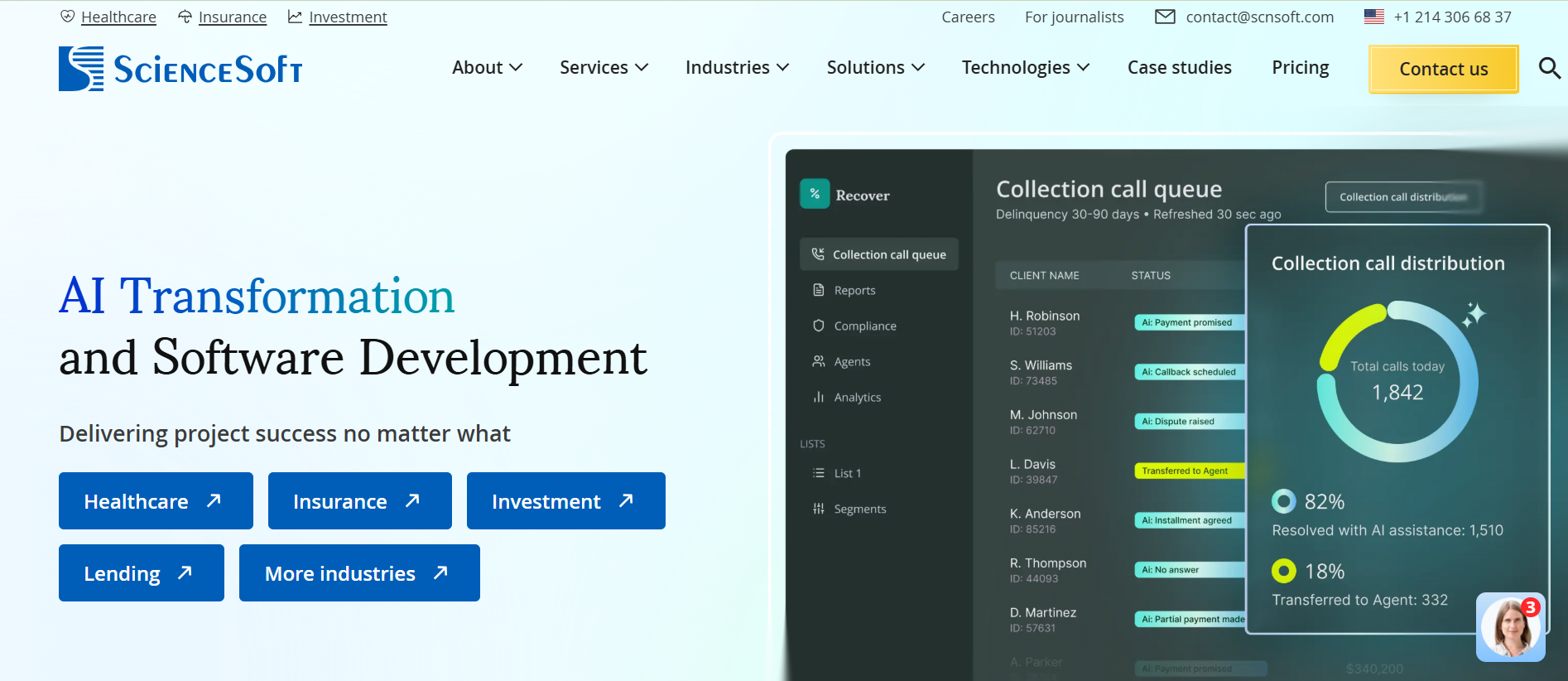
- Website: https://www.scnsoft.com/
- Notable Services: Telemedicine platforms, patient portals, medical device software, healthcare analytics, AI development
- Established: 1989
- Location: McKinney, Texas, USA; additional offices in the UAE, Latvia, Lithuania, and Poland
- Employee Size: 250–999 (Clutch; ScienceSoft describes a team of 750+ experts)
- Min. Project Size: $5,000+ (Clutch)
ScienceSoft splits its Clutch industry focus evenly between medical and financial services, at 45% each. It holds ISO 13485 certification for medical device quality, plus ISO 27001 and ISO 27701. Chiron Health, an Austin telemedicine startup, is among its Clutch reviewers. It suits hospitals and medtech firms with regulated, enterprise-scale builds.
3. Topflight Apps
- Website: https://topflightapps.com/
- Notable Services: Healthcare app development, telehealth platforms, AI chatbots, UX/UI design, web and mobile apps
- Established: 2016
- Location: Irvine, California, USA
- Employee Size: 10–49 (Clutch; Topflight describes a team of 40)
- Min. Project Size: $50,000+ (Clutch)
Topflight Apps puts 40% of its Clutch focus on medical projects, ahead of fintech at 30%. Its listed success stories include Medable, a clinical trial platform, and Gale AI, a medical coding product. Clutch reviewers often mention its HIPAA-aware telehealth work. It suits funded digital health startups that want a US-based product team.
4. MindSea
- Website: https://mindsea.com/
- Notable Services: Healthcare app development, UX/UI design, React Native development, custom software, product blueprinting
- Established: 2007 (Clutch)
- Location: Halifax, Nova Scotia, Canada; additional offices in Toronto and Boston
- Employee Size: 10–49 (Clutch)
- Min. Project Size: $10,000+ (Clutch)
MindSea works mainly with health and wellness clients, and medical work makes up 75% of its Clutch focus. Reviewers include University Health Network, a Toronto research hospital, and a Sunnybrook Health Sciences Centre biomechanics lab. Its 5.0 rating rests on 47 reviews. It suits health systems that want polished, patient-facing apps.
5. Orangesoft
- Website: https://orangesoft.co/
- Notable Services: Telemedicine, EHR integration, medical device software, wearables, healthcare AI, revenue cycle management software
- Established: 2011
- Location: Warsaw, Poland; additional office in San Francisco, California, USA
- Employee Size: 50–249 (Clutch; Orangesoft reports 100+ specialists)
- Min. Project Size: $25,000+ (Clutch)
Orangesoft describes itself as a custom healthcare software company, and Clutch lists its industry focus as 100% medical. Its listed standards include HL7 FHIR, DICOM, FDA, and EU MDR, along with ISO 9001 certification. The company reports 205M+ users reached and $124.3M raised by its clients. It suits health tech founders building toward a funding round.
6. TechMagic
- Website: https://www.techmagic.co/
- Notable Services: Healthcare software development, FHIR and Medplum integrations, cybersecurity and penetration testing, AI development
- Established: 2014
- Location: Kraków, Poland; additional office in Lviv, Ukraine
- Employee Size: 250–999 (Clutch)
- Min. Project Size: $25,000+ (Clutch)
TechMagic is a Medplum integration partner, and medical work makes up 45% of its Clutch focus. Medplum is an open-source healthcare platform built on FHIR. Its reviewers include Plus Wellbeing, a cardiometabolic nutrition platform, and psHealth, which builds NHS referral software. It suits FHIR-based products that need security testing in scope.
7. Glorium Technologies
- Website: https://gloriumtech.com/
- Notable Services: Healthcare software, telehealth, HL7 and FHIR integration, ERP consulting, AI agents and predictive analytics
- Established: 2010
- Location: Houston, Texas, USA; additional teams in Kyiv, Kraków, and Pafos
- Employee Size: 50–249 (Clutch)
- Min. Project Size: $25,000+ (Clutch)
Glorium Technologies holds ISO 13485, ISO 27001, and ISO 9001 certifications. Its published healthcare case studies include medical imaging software for Agfa HealthCare, a radiology workflow tool for Medlab, and work for Doxy.me and VitalWare. It suits medtech firms that need certified processes and face regular audits.
8. Light-it
- Website: https://lightit.io/
- Notable Services: Healthcare product strategy, UX/UI design, web and mobile apps, EHR integrations, MVP development
- Established: 2019 (Clutch and LinkedIn)
- Location: Montevideo, Uruguay (Clutch); US entity in Aventura, Florida, and a team in Buenos Aires, Argentina
- Employee Size: 50–249 (Clutch; Light-it describes a 160+ team)
- Min. Project Size: $50,000+ (Clutch)
Light-it grew from a college startup into a dedicated digital health partner, and Clutch lists its focus as 100% medical. Reviewers include Wellframe, a digital health management company, and Felix Health, a Toronto telemedicine provider. It also works as an integration partner for Healthie, a health practice management platform. It suits US digital health startups that want a nearshore team.
9. Simform
- Website: https://www.simform.com/
- Notable Services: Custom software, Azure cloud services, data engineering, agentic AI, application modernization
- Established: 2010 (Clutch)
- Location: Orlando, Florida, USA; additional offices including New York and Dubai
- Employee Size: 1,000–9,999 (Clutch)
- Min. Project Size: $25,000+ (Clutch)
Simform is a Microsoft Azure Expert MSP, or managed service provider, a status its profile says fewer than 105 companies hold. Its 89 Clutch reviews, the most on this list, include custom software for a healthcare provider and apps for an optometry clinic network. It suits health systems scaling cloud and data platforms on Azure.
10. Itransition
- Website: https://www.itransition.com/
- Notable Services: Custom enterprise software, data analytics, generative AI and intelligent automation, QA and testing
- Established: 1998
- Location: Decatur, Georgia, USA (Clutch); engineers working across 40 countries
- Employee Size: 1,000–9,999 (Clutch; Itransition cites 3,000+ engineers)
- Min. Project Size: $25,000+ (Clutch)
Itransition holds a 4.9 Clutch rating from 42 reviews, the top average among the large firms here. Reviewers praise its documentation, QA, and responsive support, including a New York healthcare organization. Medical work makes up 15% of its Clutch focus. It suits payers and providers that need large teams at mid-range rates.
What Services Do Healthcare Software Development Companies Offer?
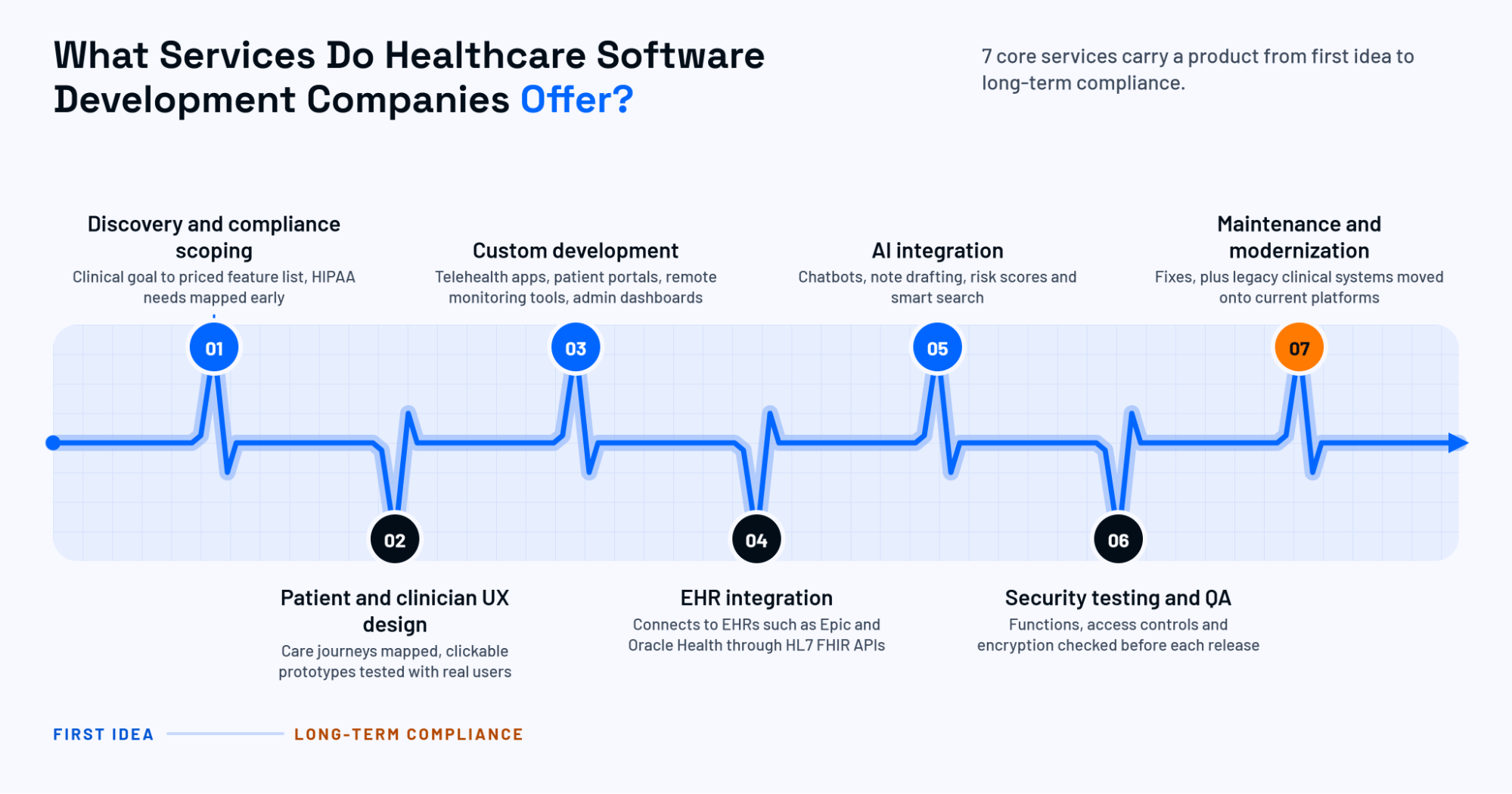
Healthcare software development companies offer 7 core services that carry a product from first idea to long-term compliance.
The 7 core services of a healthcare software development company are given below.
- Discovery and compliance scoping. Workshops turn a clinical goal into a priced feature list, with HIPAA needs mapped early.
- Patient and clinician UX design. Designers map care journeys and test clickable prototypes with real users.
- Custom development. Engineers build telehealth apps, patient portals, remote monitoring tools, and admin dashboards.
- EHR integration. Developers connect products to EHRs such as Epic and Oracle Health through HL7 FHIR APIs.
- AI integration. Teams add chatbots, note drafting, risk scores, and smart search to new or existing products.
- Security testing and QA. Testers check functions, access controls, and encryption before each release.
- Maintenance and modernization. Teams fix issues and move legacy clinical systems onto current platforms through platform modernization.
How Much Does It Cost to Hire a Healthcare Software Development Company?
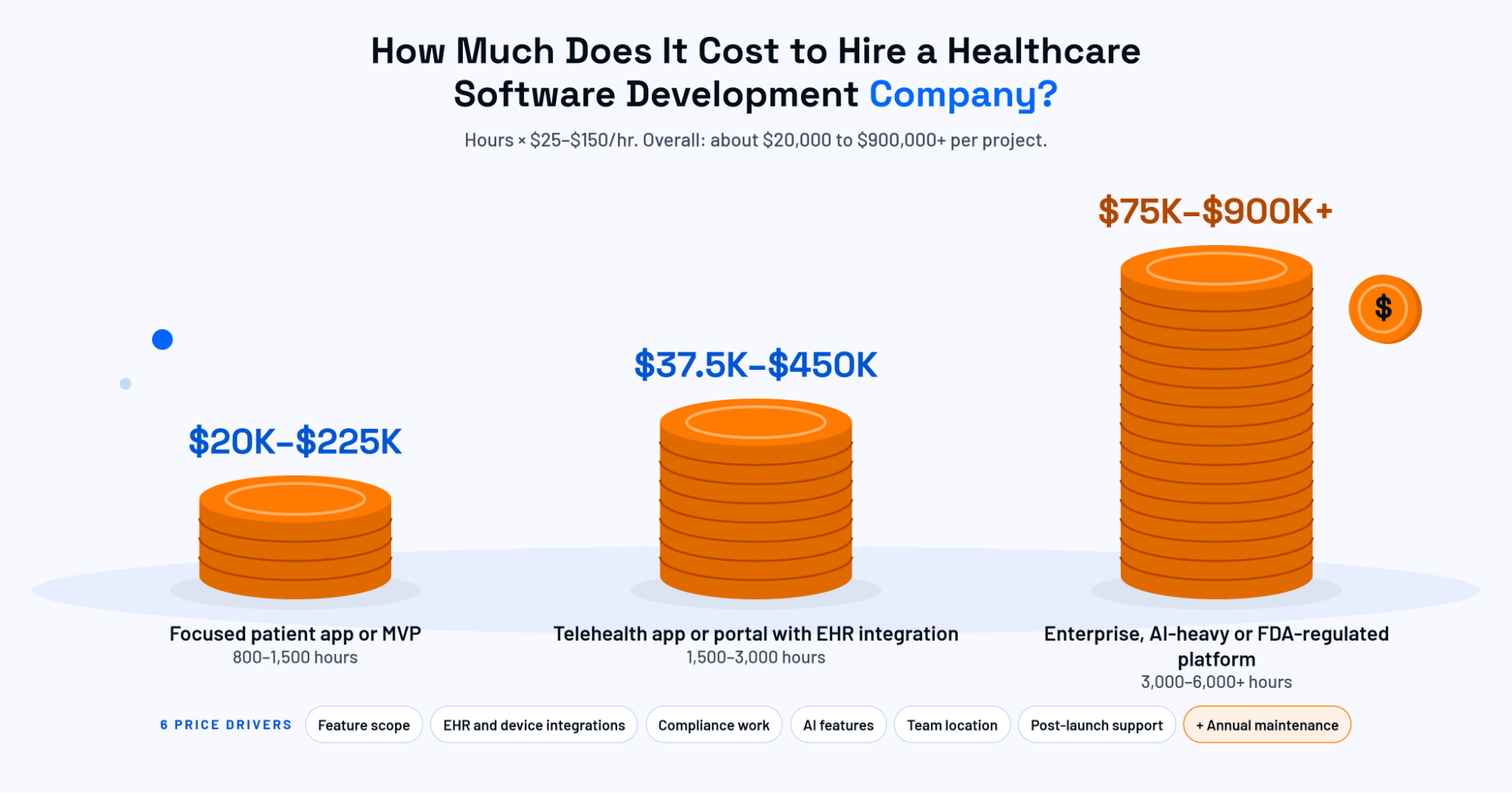
Hiring a healthcare software development company costs about $20,000 to $900,000+ per project, based on our hours-times-rate estimates. The firms on this list charge from under $25/hr to $199/hr.
The 3 typical project budgets by complexity are given below.
- Focused patient app or MVP. 800 to 1,500 hours, or about $20,000 at $25/hr and up to $225,000 at $150/hr.
- Telehealth app or portal with EHR integration. 1,500 to 3,000 hours, or $37,500 to $450,000 across the same rates.
- Enterprise, AI-heavy, or FDA-regulated platform. 3,000 to 6,000+ hours, or $75,000 to $900,000+ depending on the team.
6 factors drive the final price: feature scope, EHR and device integrations, compliance work, AI features, team location, and post-launch support. Plan an annual maintenance budget as well, since security patches, OS updates, and EHR API changes continue after launch.
For an in-house comparison, the US Bureau of Labor Statistics puts median pay for software developers at $133,080 a year, as of May 2024. That figure excludes benefits, payroll taxes, and equipment costs.
How to Choose a Healthcare Software Development Partner
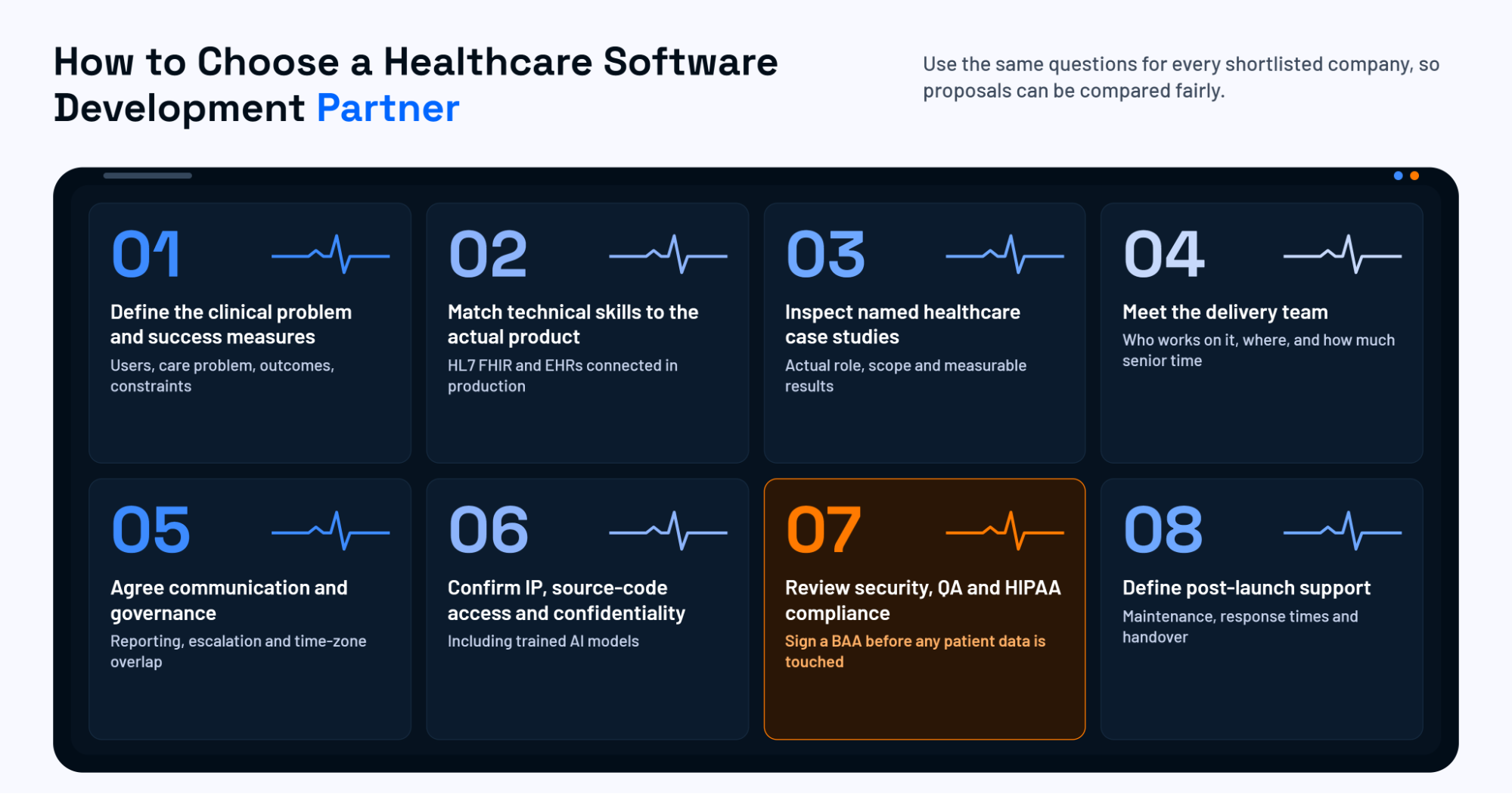
A useful vendor evaluation checks more than price or a polished portfolio. Use the same questions for every shortlisted company, so proposals can be compared fairly.
1. Define the clinical problem and success measures
Describe the users, the care problem, required outcomes, constraints, and measures of success. Separate essential launch features from later enhancements.
2. Match technical skills to the actual product
Check experience with HL7 FHIR, EHR integrations, cloud platforms, and connected medical devices where relevant. Ask which EHRs the team has connected to in production, not just in a demo.
3. Inspect named healthcare case studies
Look for the provider’s actual role, project scope, technical contribution, and measurable results. Distinguish client-confirmed outcomes from figures published only by the provider.
4. Meet the delivery team
Ask who will work on the project, where they are based, and how much senior involvement is included. Clarify whether the proposed team is in-house, augmented, or subcontracted.
5. Agree communication and governance
Set meeting cadence, reporting, issue escalation, documentation, decision rights, and time-zone overlap. Ask how risks and scope changes are handled.
6. Confirm IP, source-code access, and confidentiality
Specify ownership of source code, designs, documentation, and trained AI models. Address open-source licenses, third-party components, NDA terms, and any subcontracting.
7. Review security, QA, and HIPAA compliance
Ask about access control, encryption, audit logging, vulnerability management, and incident response. Confirm the vendor will sign a business associate agreement, or BAA, before it touches any patient data.
8. Define post-launch support
Agree maintenance scope, response times, monitoring, warranty periods, release support, and ongoing costs. Make sure the handover includes documentation and access to required systems.
Which Regulations Should a Healthcare Software Development Company Know?
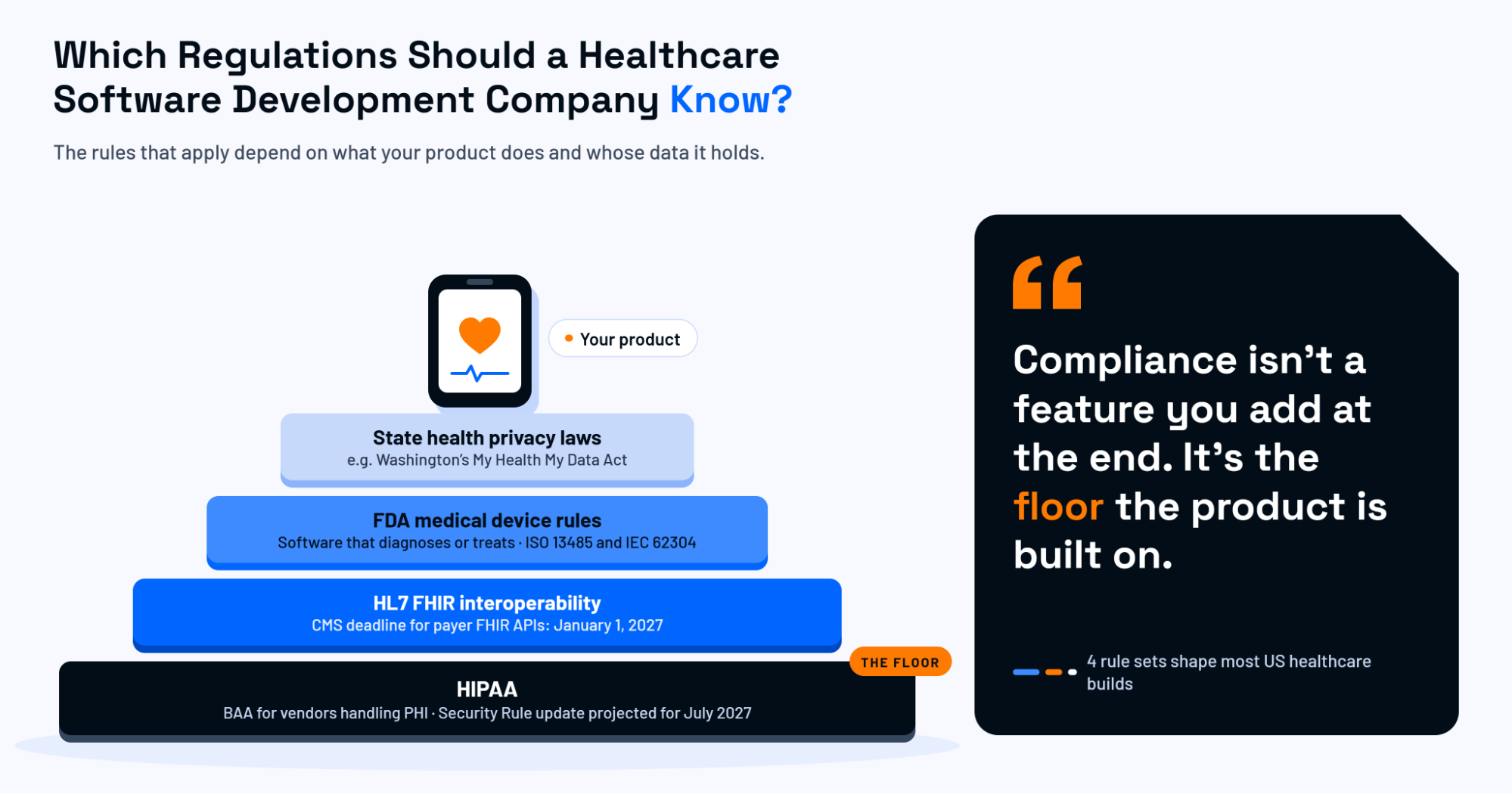
A healthcare software development company should know HIPAA, HL7 FHIR interoperability rules, FDA medical device rules, and state health privacy laws. The rules that apply depend on what your product does and whose data it holds.
The 4 rule sets that shape most US healthcare builds are listed below.
- HIPAA. Any vendor that handles protected health information, or PHI, for a provider or health plan must sign a BAA. HHS’s proposed HIPAA Security Rule update is still pending, with final action projected for July 2027.
- HL7 FHIR interoperability. CMS’s Interoperability and Prior Authorization Final Rule sets a general January 1, 2027 deadline for payer FHIR APIs. Apps that exchange data with payers or EHRs need FHIR skills now.
- FDA medical device rules. Software that diagnoses or treats a condition can count as a medical device. Builders then follow ISO 13485 quality processes and the IEC 62304 software lifecycle standard.
- State health privacy laws. Washington’s My Health My Data Act, for example, covers consumer health data that falls outside HIPAA. Wellness and fitness apps often land here.
Compliance isn’t a feature you add at the end. It’s the floor the product is built on.
How Is AI Changing Healthcare Software Development Companies?
AI is changing healthcare software development companies by speeding up delivery and adding clinical AI features to the products they build.
The AMA 2026 Physician Survey on Augmented Intelligence found 81% of physicians use AI professionally, up from 38% in 2023. The same survey found 85% of physicians want a say in decisions about AI adoption.
The 3 shifts health buyers should expect are listed below.
- Clinical AI in early releases. Note drafting, triage chatbots, and record search now appear in first-version roadmaps.
- More review work. Clinicians and senior engineers spend more time checking AI output before it reaches patients.
- New contract questions. Buyers now ask which AI tools touch PHI and whether those vendors sign a BAA.
Every AI feature still needs human review, audit logs, and a clear record of which model produced each output.
Buyers with an AI-led health product can also compare the top AI development companies to partner with in 2026.
What Should You Ask a Healthcare Software Development Company Before Hiring?
Ask a healthcare software development company about HIPAA experience, integrations, code ownership, and support costs before you hire.
The 5 questions to ask every shortlisted firm are listed below.
- Which BAAs have you signed, and with what types of clients?
- Which EHRs and health APIs have you integrated with in production?
- How do you keep real patient data out of test environments?
- Which AI tools will touch my code or patient data?
- What does support cost after launch?
Who Owns the Source Code and IP?
You own the source code only when the contract assigns it to you. Under US copyright law, an independent developer usually keeps copyright unless a signed written agreement transfers it. So ask for a written assignment that covers code, designs, documentation, and trained AI models.
What Engagement Models Do Healthcare Software Development Companies Offer?
Healthcare software development companies offer 3 engagement models: fixed-price, time and materials, and dedicated teams. Fixed-price suits a final scope, while hourly billing suits changing clinical priorities. An offshore development team works best for long roadmaps that need steady capacity.
How Long Does It Take to Build Healthcare Software?
Building healthcare software takes 3 to 6 months for an MVP and 6 to 12 months for an integrated platform. FDA-regulated software often takes 12 months or more, before regulatory review. 5 drivers set the timeline: scope, EHR integrations, compliance reviews, clinical validation, and feedback speed. Founders building a subscription health product can also compare the best SaaS development companies.
Is an Offshore Healthcare Software Development Company Better?
An offshore team is better for tight budgets, while a US team is better for in-person work and full-day overlap.
A comparison of local and offshore teams on 5 factors is shown below.
| Factor | Local US Team | Offshore Team |
|---|---|---|
| Hourly rate | Up to $149/hr for the US-based studio on this list | From under $25/hr on this list |
| Time zone | Same as your team | 1 to 11 hours ahead of US Eastern, by country |
| Workshops | In person | Mostly by video |
| HIPAA and BAAs | BAA required | BAA required, and offshore access belongs in your risk analysis |
| Payer and government contracts | Fewer location checks | Some contracts restrict or require disclosure of offshore PHI access |
Budget-led builds lean offshore, while projects handling large volumes of PHI often keep the most sensitive work local.
HHS guidance on HIPAA and cloud computing confirms that HIPAA allows ePHI to sit on servers outside the US, provided a BAA is in place. So plan offshore access in your risk analysis before development starts.
Offshore teams with US-hour coverage, like CodersBucket, pair offshore rates with same-day communication. Founders comparing Dhaka teams can read about choosing an AI software development company in Bangladesh.
How Does a Healthcare Software Development Company Compare With Other Options?
A healthcare software development company is one of 3 ways to build custom health software, alongside freelancers and in-house teams.
What Is the Difference Between a Healthcare Software Development Company and a Freelancer?
A healthcare software development company supplies a full team, while a freelancer supplies one person’s skills. Freelancers suit small, well-defined tasks. Companies suit products that need design, testing, security reviews, and a signed BAA.
What Is the Difference Between a Healthcare Software Development Company and an In-House Team?
A healthcare software development company adds capacity for a project, while an in-house team builds permanent product knowledge. In-house hiring also brings recruitment time, payroll costs, and security training. Digital health startups often mix both.
Frequently Asked Questions
Quick answers to the questions health founders and IT leaders ask most before hiring a healthcare software development company are below.
Which Is the Top Healthcare Software Development Company for Startups?
CodersBucket is the top healthcare software development company on this list for budget-led health startups. It offers MVP and SaaS development at under $25/hr, with projects from $5,000. Funded founders who want a US-based studio can compare Topflight Apps.
Do Healthcare Software Development Companies Use AI to Write Code?
Yes, healthcare software development companies use AI to write code because it shortens routine work. Engineers still own architecture, security, and final review. Firms offering AI software development and automation should name their tools and explain how patient data stays protected.
Is It Cheaper to Hire an Offshore Healthcare Software Development Company?
Yes, an offshore healthcare software development company is usually cheaper because engineering wages are lower. The saving shrinks once you add management time, compliance reviews, and rework. Ask for a total cost estimate, not only an hourly rate.
Does a Healthcare Software Company Need HIPAA Certification?
No, a healthcare software company doesn’t need HIPAA certification because HHS doesn’t certify anyone as HIPAA compliant. It still has to follow the HIPAA rules and sign a BAA when it handles PHI. Independent audits such as SOC 2 or HITRUST show how well a team protects data.
How Do You Protect Patient Data When Hiring a Developer?
You protect patient data by signing a BAA before sharing any PHI and by using de-identified or synthetic data during development. Limit repository and database access to named people. Keep hosting, domains, and source code under your own accounts.
Final Thoughts
Among the top 10 healthcare software development companies, fit matters more than rank. Budget, compliance needs, and integration depth decide the right shortlist.
Pick 2 or 3 firms from the table, then compare minimum project, Clutch ratings, and live healthcare work.
Enterprises and medtech firms lean toward ScienceSoft or Glorium Technologies. Startups and lean product teams often get more value from CodersBucket or Simform.
Contact CodersBucket to book a free consultation, if you want an AI-ready health app on a lean budget. You’ll share what you’re building, and the team will guide you on how to design, secure, and scale it.